search-icon
Coral Recruitment in the Garden of Good and Evil: How baby corals get started on coral reefs

Corals in tropical reefs are like trees in a forest. We all know from the tiny acorn, the mighty oak tree grows but where do the mighty corals come from?   You’d think we know all there is to know about where baby corals come from and how they get started on coral reefs but we don’t.  When I started graduate school no one knew how or when coral reproduction occurred.

Dr. Bob Steneck from the University of Maine


Then coral spawning was observed – it is linked to the full moon in late summer and when it happens it is like a snow storm in reverse.  Tiny white bundles of coral eggs release all at once and float to the surface. They get fertilized and a small oblong larva covered in tiny hairs (cilia) floats until it develops into a baby coral.  The trick for this tiny larva (which is about the size of a pencil dot on a piece of paper) is how does it find a good place to live in a coral reef.  Coral larvae are blind and they cannot swim, but they can adjust their buoyancy.  My research considers the environment baby corals encounter that affect their choice of where they will glue themselves to the reef and begin their long life.  Most coral reefs are comprised of coral (logically), but corals are terrible places for larvae to settle since they’d get eaten.  So the rest of the coral reef that is mostly covered in different types of seaweeds can be tasted and evaluated by the tiny coral larvae.  The bigger seaweeds are bad places for baby corals – the seaweed can beat them up and some seaweeds can poison the newly settled corals.  However, limestone producing coralline algae is a different story.
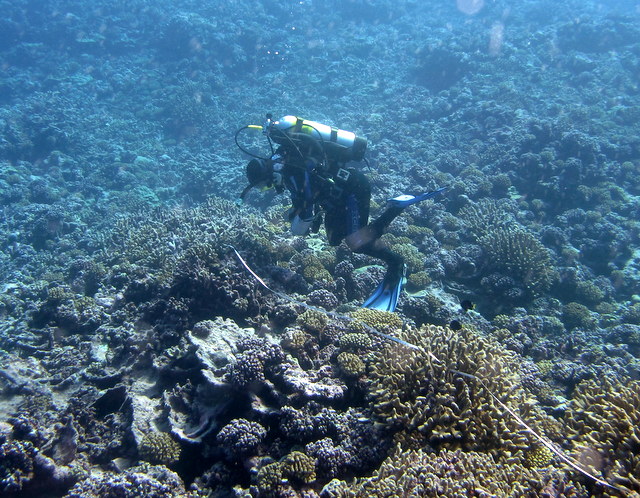
Bob takes notes along his transect in Rangiroa


Some of the coralline species actually attract baby corals, allowing them to settle where they grow best and fewer of them die.  My research examines that association.  I consider how receptive different coral reefs are to settling coral larvae.  Reefs that have more “recruitment” of baby corals, will recover quicker from a hurricane, crown-of-thorns starfish outbreak or a coral bleaching event.  Figuring out how baby corals get started on reefs may help managers and policy makers improve the fate of these stressed ecosystems.
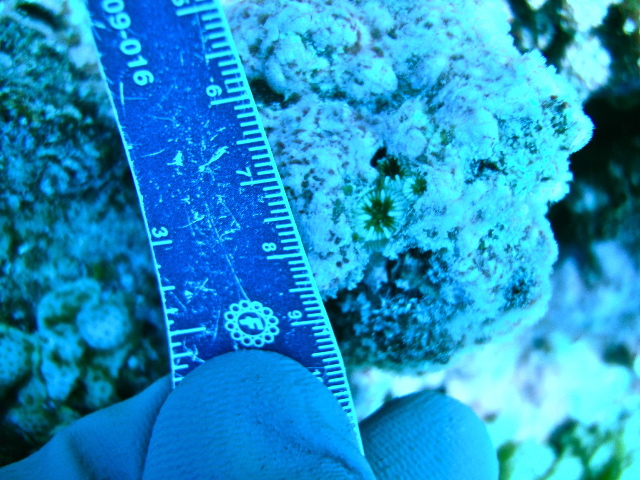
Some new baby corals nestled in crustose coralline algae (CCA)

(Photos by 1 & 2 – Brian Beck; 3-Bob Steneck)

To follow along and see more photos, please visit us on Facebook!
 

Related Posts

2025-2026 B.A.M. Student Voices

Throughout the Bahamas Awareness of Mangroves (B.A.M.) and Jamaica Awareness of Mangroves in Nature (J.A.M.I.N.) programs, we evaluate each phase of the mangrove education and restoration process to better understand how students are learning, growing, and connecting with their coastal environments.

Before the programs begin, students share what they already know about mangroves and how they feel about them. As the program progresses, we continue to gather feedback to see how their knowledge evolves from identifying mangrove species and understanding food webs to recognizing the role mangroves play in coastal protection and climate change mitigation.

But the surveys go beyond science content.

We also ask students…

Read More

Ten Years of B.A.M.: Rooted in Partnership, Growing in Purpose

Ten years ago, the Bahamas Awareness of Mangroves (B.A.M.) program began with a simple but meaningful commitment: to connect Bahamian students with the mangrove ecosystems that shape and protect their island home.

Since 2015, B.A.M. has been implemented in partnership with Friends of the Environment, whose dedication to environmental stewardship in Abaco has made this program possible year after year. Together, we have worked alongside Patrick J. Bethel High School and Forest Heights Academy to bring hands-on mangrove science into classrooms and out into the field.

What makes ten years remarkable is not just longevity — it is consistency…

Read More
Privacy Overview

This website uses cookies so that we can provide you with the best user experience possible. Cookie information is stored in your browser and performs functions such as recognising you when you return to our website and helping our team to understand which sections of the website you find most interesting and useful.  You can view our complete Privacy Policy here.

Strictly Necessary Cookies

Most of our cookies are used to improve website security and reduce spam. These cookies should be enabled at all times. They also enable us to save your preferences for cookie settings.

3rd Party Cookies

This website uses Google Analytics to collect anonymous information such as the number of visitors to the site, and the most popular pages. Keeping this cookie enabled helps us to improve our website.