After arriving at our new anchorage point around noon, the expedition team was quickly underway again on the M/Y Golden Osprey for more research dives on Cay Sal Bank. During the transit, I caught up with coral reef scientist Dr. Judy Lang to find out more about her work and the AGRRA surveys that the expedition team is conducting here in Cay Sal.
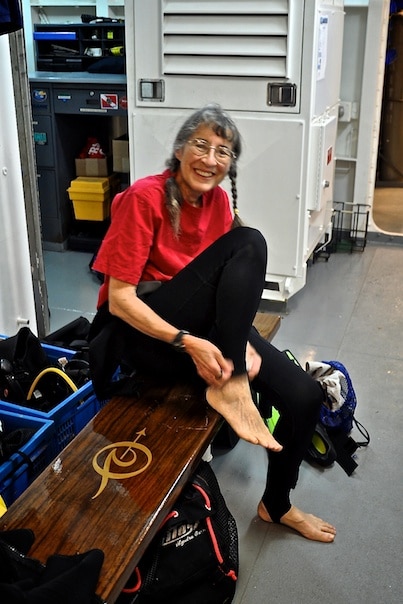
Hi Judy… Can you tell me a little bit about your background and what your role is on this mission of the Global Reef Expedition?
I’m a coral reef biologist and for the last 12 years I’ve been involved with the AGRRA project. AGRRA is the Atlantic and Gulf Reef Rapid Assessment program. It was started by Robert Ginsberg in the mid-1990s following a large gathering of coral reef scientists from all around the world. Ginsberg wanted to know what was the status of reefs across the tropical Western Atlantic, so the program was designed to try and answer that question. We assess some important structural and functional attributes of reefs using a standardized protocol so the data can be broadly comparable. That means we’re mainly focused on the stony corals that are the primary constructors of the reef habitat, the herbivores that help to control the growth of the algae there, and the predators of both. And we’re trying to rapidly acquire information that’s representative not just of a few reefs, but the region as a whole and that means we have to get a little bit of information from a large number of sites throughout any given area of interest, such as Cay Sal.
How does a team actually go about doing an AGRRA survey?
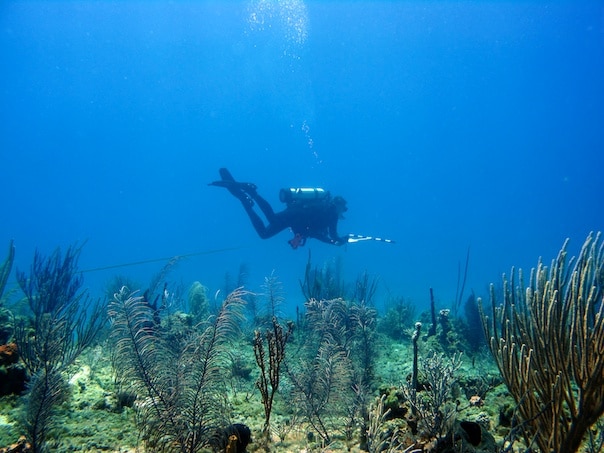
Ideally, we have at least 6 divers in the water at one time, two of whom are doing transects that are each 10-meters long, recording the dominant benthic cover. They’re also assessing the density of “recruits” – tiny corals that are up to 2cm in diameter and up to several years in age.
The second team is running belt transects that are 10 m long by 1 m wide, examining every coral that’s more than 4cm in diameter and measuring its size, its maximum length, width and height and the percent of the surface area that’s been killed. Corals being colonial animals, they can lose some polyps and if some of the others survive, then the colony itself is still alive. Measuring this percent of mortality gives us an idea of the health of the reef.
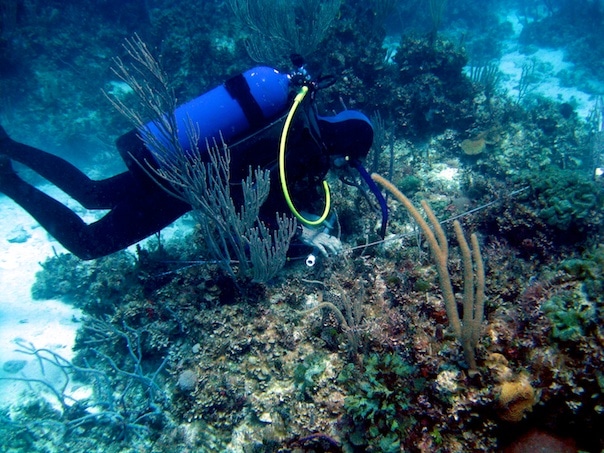
The third team is doing fish surveys swimming longer transects and they are focusing on counting, within a belt that’s 2 meters wide and 30 meters long, what we call the AGRRA fishes – these are ones that are either important herbivores, predators of the herbivores, and coral predators. The fish team is also assessing the vertical relief of the habitat – it’s well known that the fish populations vary with the three-dimensional structure, or rugosity, of the reef, so we want to get that information as well.
How do these results contribute overall?
We have about 1400 standardized surveys in the AGRRA database and they come from all over the Caribbean. It’s not complete in the sense that we don’t have surveys from every nation or even all parts of the Bahamas-like Cay Sal. For a long time we’ve known there was the possibility of the Golden Shadow spending some time in the Caribbean this year, and we were excited to be asked to be a part of this expedition because it allows us to reach places that are remote and hard to get to, so the data we’re collecting is really contributing to our efforts to add to the geographic spread of the AGRRA database.
For you personally, why is this work important?
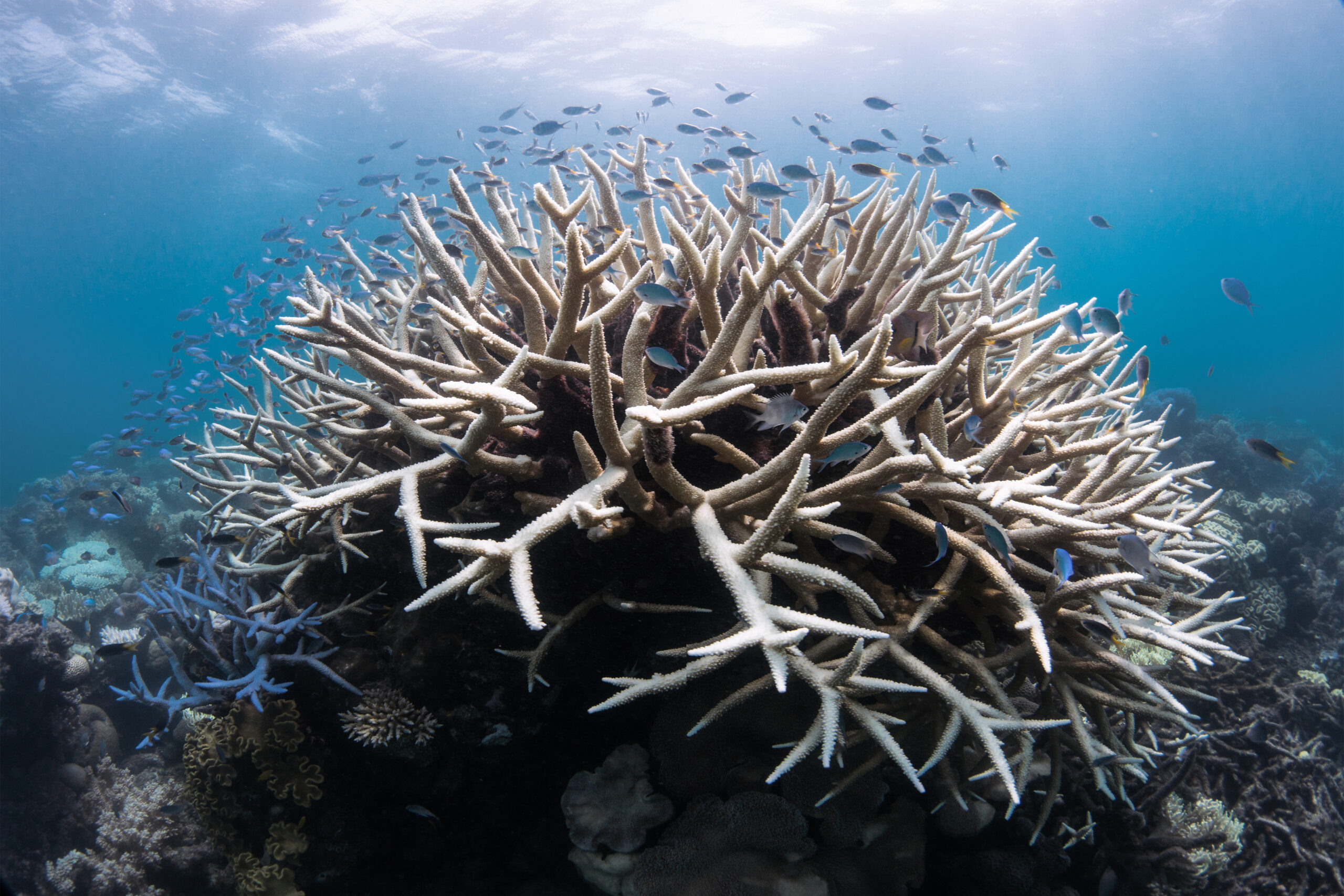
Well, my mother says that I just fell in love with the sea, with the reefs really. I was fortunate enough to grow up in Jamaica as a teenager and have somebody one day hand me a face mask and say ‘hey, put this on and see what it looks like underwater’ because we went to the beach every weekend. And the first time I did that, I just thought: ‘Oh my gosh. This is fantastic. How can I continue looking at this?’ It was just love at first sight. At the time, the reefs in the Caribbean, and especially in Jamaica, were just fabulously beautiful and very productive… and then things fell apart over the last several decades due to the accumulated stressors of overfishing, various kinds of pollution, global warming effects and disease. Now I continue to work, as much as anything else, to bear witness because I think it’s important for future generations to know what humans can do. We bear a major responsibility in how we take care of the sea and I’m a glass half-fuller. I think we can learn. I think we are capable of changing course rapidly when we really understand what we’re looking at and I think we have a chance to change for the better.
Don’t forget to follow along on Facebook to get blog updates and see more photos! You can also follow the expedition on our Global Reef Expedition main page, where there is more information about our research and our team members.
Post by Liz Smith
(Image credit: 1. Liz Smith; 2. Amanda Williams; 3. Lindy Knowles)