Focus for today:
‘Cleaning stations’ on the reef.
Target key stage: Key Stage 4, National Science Curriculum, Dual Award, Sc2, 5a: the distribution and relative abundance of organisms in habitats can be explained using ideas of interdependence, adaptation, competition and predation.
Key information:
It may not be something you have ever thought about, but how do fish stay clean and healthy? The answer is – there are ‘cleaning stations’ on the reef where fish go to be groomed. Fish have tiny parasites living on their bodies and if these parasites are not removed, they will multiply in number and the fish may develop an infection.
Cleaning stations are places on the reef where special cleaning fish or shrimp live. These small fish and shrimp pick off bacteria, parasites and dead skin from the skin, scales, gills and even the mouths of fish. Cleaner fish are small (approximately 5 cm in length), striped, colourful fish of the Wrasse family. The cleaning activity is mutually beneficial – the fish gets cleaned and in return, the cleaner fish or shrimp gets a meal!
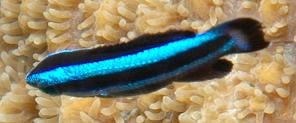
Cleaner Wrasse
Cleaner shrimp advertise their services by waving their antennae at passing fish and cleaner fish perform a short dance to indicate that they are available for cleaning services. The visitors to cleaning stations hang motionless in the water as the shrimp or cleaner fish works its way over its body, nibbling off the parasites. The fish even get their teeth cleaned. Several fish may line up at a time, waiting for their turn… just like at a car wash!

Cleaner Shrimp
The grouper, a large predatory fish could easily swallow a small cleaner fish in one gulp, but during cleaning, all predatory activity stops and the cleaner wrasse can enter a grouper’s mouth and come out unharmed.
However, fish must beware of false cleaner blennies, which are small fish that are cleverly patterned and coloured to look like cleaner wrasse. The visitor to the cleaning station allows the blenny to approach (thinking it is a cleaner wrasse), but instead of conducting any cleaning duties, the blenny will take a chunk out of the fish’s flesh.
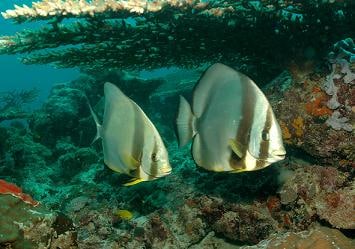
Bat fish queing at the station…!
Cleaner fish and shrimp are an incredibly important component of a healthy reef ecosystem. It has been shown experimentally that if cleaners are removed, either the customers move away from the area, or the fish suffer from ulcers, frayed fins or fungal diseases.
Question for students/food for thought:
This is an example of cleaning services in the marine environment – can you think of any cleaning associations between animals in the terrestrial environment? In the terrestrial example you come up with – how do the cleaners in the relationship indicate that they are available to start grooming?