search-icon
J.A.M.I.N. Students Pioneer New Mangrove Disease Research

Sometimes no matter how much we try to schedule activities during our Mangrove Education and Restoration Programs, there are unforeseen events that arise at the schools. That is exactly what occurred during phase 2 of the J.A.M.I.N. program. Due to scheduling conflicts, we had to postpone our mangrove disease activities in Jamaica until this third phase.

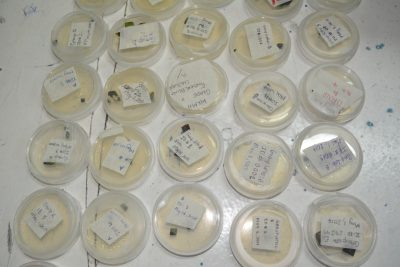
During phase 2, through a new partnership with North Carolina State University, we provided students in our year 2 B.A.M. program with an opportunity to be at the forefront of current mangrove research. Our students worked alongside Ryann Rossi, a PhD Candidate from North Carolina State University, who is studying mangrove disease in the Bahamas. The students learned how to identify and collect potentially diseased mangrove leaves and then placed them on an agar plate to grow. After waiting for about 2-3 weeks, students learned how to identify the fungus. They found similar results to what Ryann has been finding in Abaco, the Bahamas.
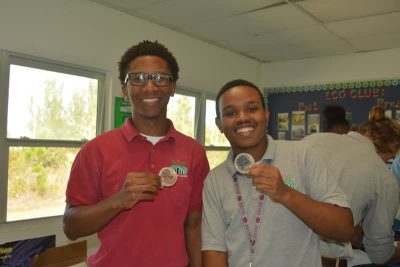
Students at Forest Heights Academy smile proudly displaying their plated mangrove leaves.
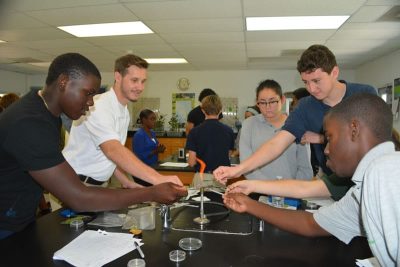

Before plating their disease leaves, students at Forest Heights Academy sterilize their lab equipment to avoid contamination.
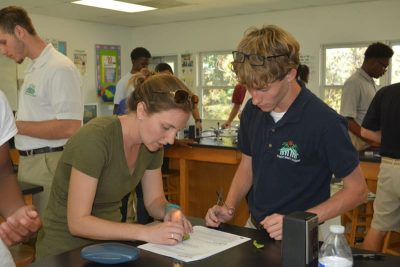
 

B.A.M. participant works with North Carolina University PhD Candidate, Ryann Rossi, to plate their diseased mangroves leaves.


Now it’s time for the J.A.M.I.N. students to figure out whether or not they would find the same fungus that is suspect of causing mangrove disease in the Bahamas. Never before have scientists looked for fungal disease on mangrove leaves in Jamaica. Students in the year 2 J.A.M.I.N. program will be the first to pioneer this important scientific work.
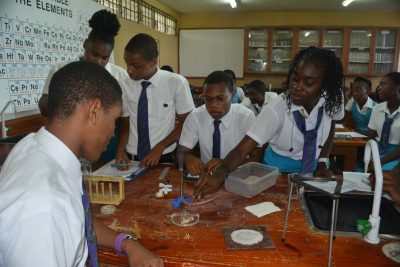
JAMIN disease 2017

Students at William Knibb High School plate their mangrove leaves in agar to find out which fungus might be present in the mangroves in Jamaica. 
JAMIN Disease 2017

The agar plates sent to Ryann Rossi at North Carolina University.


Stay tuned to find out the students’ results!

Related Posts

Global Reef Expedition Data Contributes to Landmark Report on the World’s Coral Reefs

More than a decade after scientists aboard the Global Reef Expedition surveyed coral reefs across the Pacific, the data they collected continues to contribute to our understanding of the world’s coral reefs.

Today, the Global Coral Reef Monitoring Network (GCRMN) released Status of Coral Reefs of the World: 2025, the most comprehensive assessment to date of the status and trends of coral reefs worldwide. The report brings together an extraordinary amount of information collected over more than four decades—and the Khaled bin Sultan Living Oceans Foundation is proud to have contributed data from the Global Reef Expedition to this global effort. 

Read More

Announcing the 15th Annual Science Without Borders® Challenge: Navigate with Care

Every day, fishing boats, ferries, sailboats, kayaks, research vessels, cargo ships, whales, sea turtles, dolphins, seabirds, and countless other marine animals share the same waters. While people rely on the ocean for transportation, recreation, research, fishing, and exploration, it is also home to some of the most diverse and important ecosystems on Earth.

That simple but powerful idea is the inspiration behind the 15th Annual Science Without Borders® Challenge.

Read More
Privacy Overview

This website uses cookies so that we can provide you with the best user experience possible. Cookie information is stored in your browser and performs functions such as recognising you when you return to our website and helping our team to understand which sections of the website you find most interesting and useful.  You can view our complete Privacy Policy here.

Strictly Necessary Cookies

Most of our cookies are used to improve website security and reduce spam. These cookies should be enabled at all times. They also enable us to save your preferences for cookie settings.

3rd Party Cookies

This website uses Google Analytics to collect anonymous information such as the number of visitors to the site, and the most popular pages. Keeping this cookie enabled helps us to improve our website.