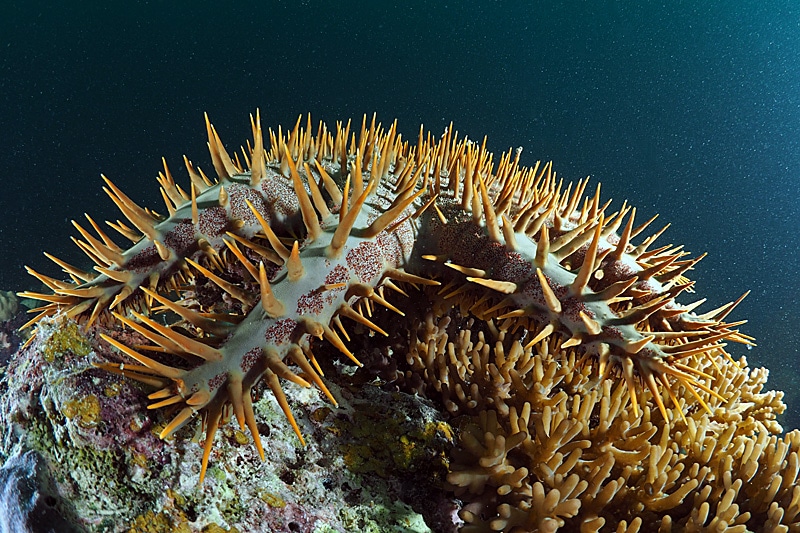
Recently, I participated in the Saudi National Center for Wildlife (NCW), workshop on managing outbreaks of crown-of-thorns starfish (COTS) in the Kingdom of Saudi Arabia. The event took place in Riyadh, where experts from around the world were invited to share their research and knowledge about the devastating impacts of crown-of-thorns outbreaks and the best management strategies for combatting them. The workshop included an in-depth description of the Kingdom’s early warning system for COTS outbreaks, standard operating procedures for response implementation (including detailed assessment and mitigation protocols), and recommendations for post-outbreak management, reef recovery, and restoration approaches. My presentation, “Mitigating the impacts of Acanthaster planci outbreaks on coral reefs in the Indo-Pacific region,” focused on the research and data we collected on COTS that we encountered on the Global Reef Expedition and other fieldwork projects.
During a COTS outbreak, these corallivores can become very dense. On some reefs, we found thousands of COTS, often at densities of 4-6 animals per square meter. They can consume all the corals in an area, leaving behind a graveyard of skeletons that are quickly removed by bioerosion and storms. COTS have the highest rates of fertilization of any invertebrate, which is achieved due to their aggregating behavior and synchronized spawning. There are several reasons why COTS outbreaks can be so detrimental to a reef system, which is why there is a need for coordinated efforts to manage eruptions in their populations.
I gave two real-life examples of the effects of COTS outbreaks in the Indo-Pacific. The first was Aitutaki, located in the Cook Islands. In 2013, outer reef communities surrounding Aitutaki were impacted by a severe outbreak of COTS. When KSLOF returned to the island in 2016, coral cover had further declined, with limited coral recruitment or signs of recovery. Later in 2016, KSLOF was brought in to assess the COTS outbreak damage in the Maldives. There, the team collected over 7,000 COTS in a span of 10 days. Based on our experience combatting these two outbreaks, we learned a great deal in the process about what worked, which allowed me to contribute meaningfully to the COTS monitoring and reporting protocols in the Red Sea. The NCW Crown-of-Thorns Response Plan exists to maximize the effectiveness of activities conducted by the National Center for Wildlife and all other stakeholders in the Kingdom, and ensure efficient use of resources and personnel by providing a standardized framework for responding to COTS outbreaks.
Given the enormous loss of corals worldwide, there is considerable interest in identifying options to minimize impacts from coral diseases, bleaching, and predator outbreaks. It’s important to remember that these are natural stressors, and they are a normal component of a healthy reef system. However, they become problematic under certain conditions, most often associated with human impacts such as pollution. To avoid this, we need to ensure that the ecosystem is intact – there are adequate-sized populations of all major functional groups of fish and invertebrates. We need to eliminate sources of sedimentation and pollution, as this will reduce the likelihood of a transmission of a pathogen, ensure that the coral’s resistance to disease is maximized, and reduce the potential for plankton blooms. We need to reduce fishing pressure on keystone fish species and invertebrates that are known to feed on corallivores. There is also a need to establish protected areas in locations where environmental conditions are likely to be optimal, emphasizing sites that have the capacity to buffer seawater temperature extremes. As a last resort, it may be possible to save corals during population explosions of corallivores through organized removal efforts by SCUBA divers.