Field Guide to Western Atlantic Stony Corals
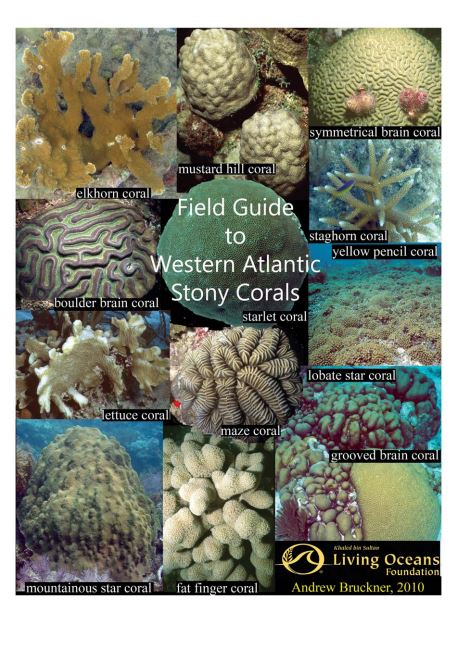
This Field Guide to Western Atlantic Stony Corals is a compilation of photographs of the dominant scleractinian and hydrozoan corals observed on reefs throughout the region. Depending on taxonomic sources, between 65‐75 species have been identified. This guide identifies all known genera and the 49 dominant coral species common throughout shallow Caribbean reefs. Rare coral species are not included. Taxa that have been divided into multiple species (e.g. Colpophyllia, Meandrina, Dichocoenia, Agaricia agaricites, Stephanocoenia) are reported as single species due to taxonomic uncertainty. Common names appearing in this guide follow the nomenclature used in Reef Coral Identification (Humann and Deloach 2002). Whenever possible, taxa with similar growth forms or corallite arrangements are placed together to facilitate identification.
Corals consist of one or more polyps that secrete an underlying skeleton consisting of corallites joined together by a coenosteum. The corallite is basically a tube subdivided by a series of vertical plates or ridges known as septa‐costae. These septa seldom join at the center of the corallite; instead they usually have ‘teeth’ that intertwine to form a columella. The arrangement, shape and size of the corallites are unique features which distinguish species.
There are six different types of corallite arrangements seen in stony corals. There is one genus (Scolymia) consisting of solitary corals each containing a single polyp. All other corals form colonies through a process known as budding. Phaceloid corals have corallites that are long and tubular, each with their own walls. Plocoid corals have corallites with their own walls, which are separated by an obvious coenosteum. Cerioid corals have polyps with common walls. The polyps of flabellate colonies are located in long valleys, but the walls are not shared with
adjacent valleys. Meandroid colonies have long valleys each containing multiple corallites and shared walls between each valley.
Corals also exhibit various growth forms. Colonies can form cylindrical or flattened branches (branching), encrusting or laminar plates (plating), upright leaf‐like or whorled plates (foliaceous), erect columns (columnar), hemispherical or dome‐like boulders (massive) and encrusting, boulder like (submassive) growth forms. Growth forms can vary within individual species. For instance, certain species that form massive boulder‐like structures in shallow water may form horizontal plates in deeper environments.