Published in Marine Pollution Bulletin, November 2019
By Maria Beger, Hans Wendt, Jonah Sullivan, Claire Mason, Jimaima LeGrand, Kate Davey, Stacy Jupiter, Daniela M. Ceccarelli, Alex Dempsey, Graham Edgar, David A. Feary, Douglas Fenner, Marian Gauna, Hannah Grice, Sahar Noor Kirmani, Sangeeta Mangubhai, Sam Purkis, Zoe T. Richards, Randi Rotjan, Rick Stuart-Smith, Helen Sykes, Naushad Yakub, Andrew G. Bauman, Alec Hughes, Jason Raubani, Adam Lewis, and Leanne Fernandes
Abstract
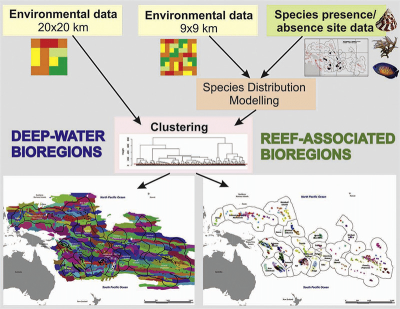 Existing marine bioregions covering the Pacific Ocean are conceptualised at spatial scales that are too broad for national marine spatial planning. Here, we developed the first combined oceanic and coastal marine bioregionalisation at national scales, delineating 262 deep-water and 103 reef-associated bioregions across the southwest Pacific. The deep-water bioregions were informed by thirty biophysical environmental variables. For reef-associated environments, records for 806 taxa at 7369 sites were used to predict the probability of observing taxa based on environmental variables. Both deep-water and reef-associated bioregions were defined with cluster analysis applied to the environmental variables and predicted species observation probabilities, respectively to classify areas with high taxonomic similarity. Local experts further refined the delineation of the bioregions at national scales for four countries. This work provides marine bioregions that enable the design of ecologically representative national systems of marine protected areas within offshore and inshore environments in the Pacific.
Highlights
- Bioregionalisations in the Pacific are at too coarse a scale for national marine spatial planning, especially for deep water.
- We delineate 262 deep-water and 103 reef-associated Pacific marine bioregions at a kilometre scale using data-based methods.
- The marine bioregions enable the design of ecologically representative national marine protected areas in Pacific nations.