Published in Journal of Earth Science
Abstract
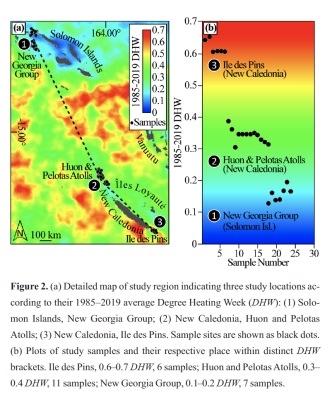 Coral reefs are in terminal decline. For conservation to be effective, naturally depauperate reefs must be distinguished from those recently degraded by humans. Traditional reef monitoring is time consuming and lacks the longevity to make this distinction. Success in using foraminifera as bioindicators for reef health has hitherto levered their response to nutrients. Because ocean heat waves are the dominant driver of coral bleaching and death, there is compelling motivation to develop new foraminiferal bioindicators that inform on temperature stress over meaningful timescales. This study focuses on identifying which foraminifera respond systematically to the temperature stress that kills corals. Statistical models were used to compare endosymbiont-bearing foraminiferal families, collected along a heat-stress gradient spanning the Solomon Islands and New Caledonia, to live coral cover at the same sites. Results indicate that Amphisteginidae foraminifera and coral cover show a significant decline in abundance as heat stress increases along the transect sites. Furthermore, ocean productivity and salinity, both recognized environmental influences on foraminifera, are shown to be subordinate to temperature in their sway of this ecological patterning. These findings indicate the potential for using foraminifera to develop new indices capable of quantifying long-term thermal impacts on reefs.