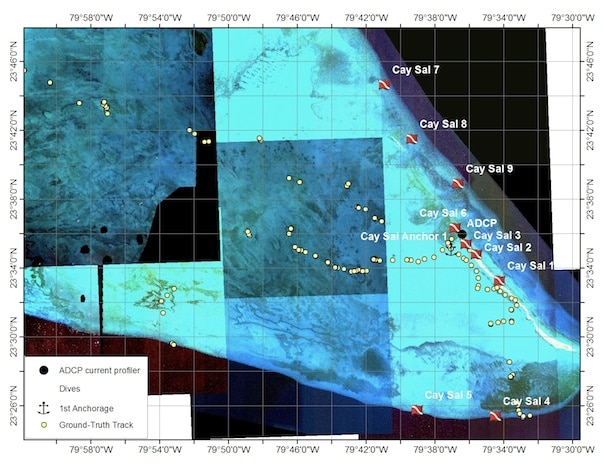
During the last four days at our first anchorage site near Anguilla Cay, the expedition team covered a large amount of ground, including nine research dives. You can see the various research sites on the map below labeled as red dive flags. The yellow dots also represent where the groundtruthing team took measurements during their research runs.
Before pulling anchor to head North to our next area for research dives on Sunday, the team picked up the Acoustic Doppler Current Profiler, or ADCP, from the seafloor with help from the Golden Shadow’s crew and the ship’s stern elevator.

Chief Scientist Andy Bruckner and Director Phil Renaud were happy with the results from this first trial and plan to leave the ADCP down longer on its next deployment. The ADCP provides us with measurements of temperature, oxygen levels, conductivity and turbidity over time. Most importantly, the sensor records current measurements that add to our understanding of life on the bank, such as the types and sizes of the corals that grow in this area.
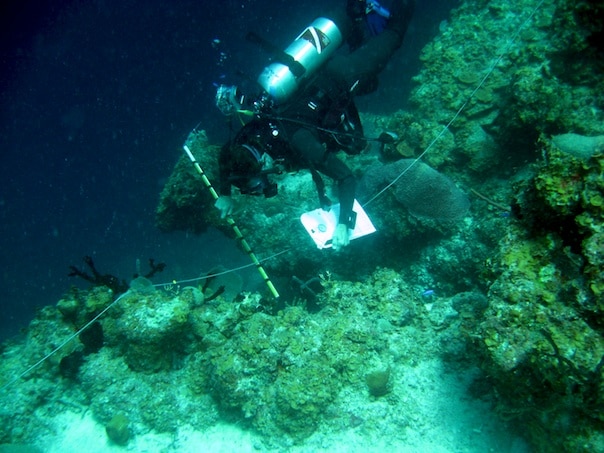
Due to the rough seas and winds that picked up, the team stayed on board the Shadow for the hour-long transit to our new research area. Once set at anchor, the dive teams boarded the Golden Osprey for a short trip over to the Blue Hole, a roughly 80-meter deep depression in the seafloor. Coral and fish surveys were conducted near the edge of the hole, and some of our divers ventured a bit lower.
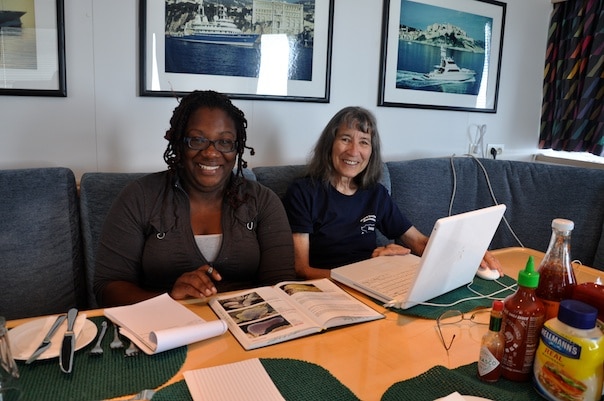
On Monday, the weather proved too rough to conduct any research dives operations and the Golden Osprey was forced to stay closer in to the islands for protection. The brief intermission was a double-edged sword for the team: it gave everyone a day to rest, but also meant there was plenty of time for entering data – the less glamorous side of research diving.
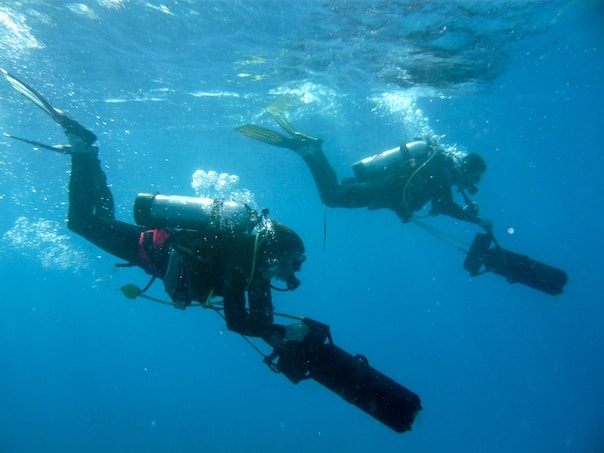
Even though the seas were too rough to conduct research dives, Andy and Phil used the opportunity to test out our new Diver Propulsion Vehicles, or DPVs, and went for a short dive of the stern of the Golden Shadow. The DPVs allow divers to cover much more territory underwater than would be possible by just swimming. We’re hoping to be able to use them to scope out the best areas for conducting our research surveys.
The last few days have been a swirl of activity both underwater and on board as we all settle into our routines. In the coming days, we hope to complete another 7-8 more research dives from our new anchorage point. For now, the team is anxiously tracking the weather forecasts and we hope to return to the Blue Hole tomorrow morning.
Post by Liz Smith
Don’t forget to follow along on Facebook to get blog updates and see more photos! You can also follow the expedition on our Global Reef Expedition main page, where there is more information about our research and our team members.
(Image credit: 1,4: Amanda Williams; 2, 3: Liz Smith)