Due to repetition, most of the time each of our reef fish surveys is similar to the previous survey. This is not unusual. One of the purposes of doing such studies is to find the “typical” species composition, sizes, and abundance of fish one would find in a given area. Special note may be taken on out of the ordinary observances. This recently occurred when members of our fish research team, Ken Marks and Dave Grenda, were reviewing some data taken on the Spanish Hogfish (Bodianus rufus).
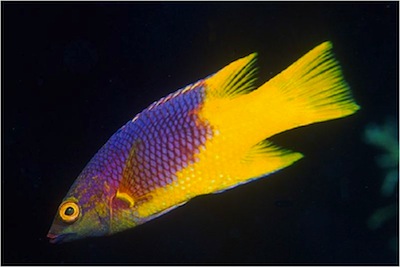
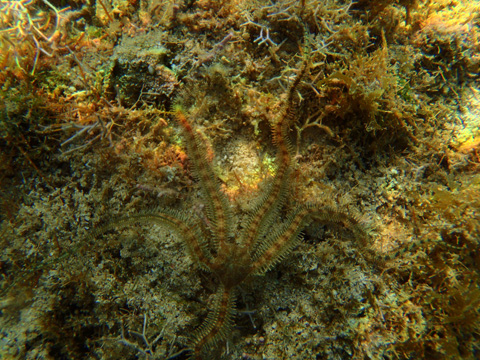
Spanish Hogfish are in the wrasse family (Labridae). Like other wrasses, the juveniles play a major environmental role on the reef as “cleaners”. This means that they feed on the parasites and dead tissues on larger fish. Often, they will find a prominent area on the reef, such as a coral head, and set up a “cleaning station” that larger fish recognize and will visit for cleaning. As they mature, Spanish Hogfish root around in the sediment with their snouts, like a hog. They eat benthic invertebrates such as brittle stars, urchins, crustaceans, and mollusks.
Fish in the wrasse family (Labridae) have an interesting reproductive strategy. They are known as protogynous hermaphrodites. This is a type of sequential hermaphroditism that has three steps; juvenile phase, initial phase, and terminal phase. Most juvenile wrasse begin life as female. During these phase changes, the fish changes sex from female to male. Also during the phase changes, the fish changes shape and become more colorful. The juvenile and initial phase fish are female.
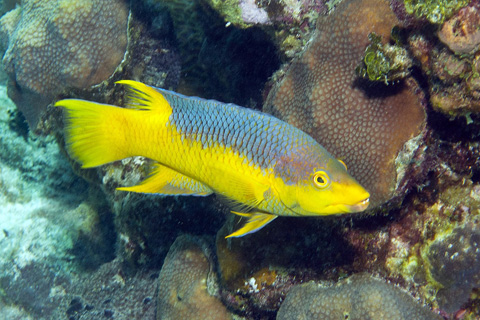
The terminal phase is the largest and most colorful and is always a sexually mature male. The male has a harem of initial phase females. In an effort to make sure he is the only one to mate with them, he tries to keep them sequestered and defends them vigorously against other terminal phase males. The terminal phase is usually the least abundant, in a given area. This is what grabbed the attention of Ken and Dave. During their surveys in south Andros, they noticed the number of terminal phase Spanish Hogfish was larger than the juvenile or initial phases.
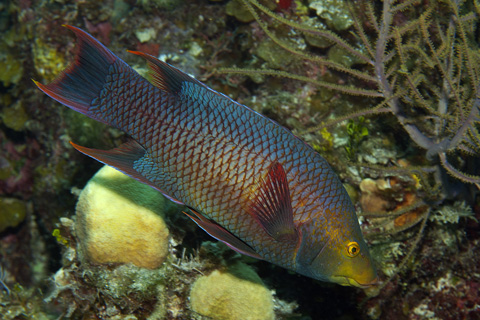
What is the reason for this occurrence? Ken and Dave think there are a couple of possibilities. Perhaps there has been a population shift or for some reason there is a lack of juvenile recruitment to this small area. There are still many more surveys to take and data to compare (click here to read our “Fish Spotting” blog).
On another topic, our research staff wanted to find a way to share with you some of the more fun things that they see or would like to see while they are diving…a Friend of the Day! Since a wrasse was the topic of today’s discussion, Amanda Williams (Benthic Survey Diver) thought that the Creole Wrasse (Clepitcus parrae) should be the Friend of the Day. Unlike other wrasse that feed on benthic invertebrates, the Creole Wrasse is usually found in the water column feeding on plankton (copepods, jellies, and tunicates). They are found in large schools feeding near shallow reefs and drop offs in Bermuda, S. Florida, and the Caribbean. This is one of Amanda’s favorite creatures because, “Almost every time I dive I see Creole Wrasses travelling in a 2-way street fashion, sort of like ant trails. Amazing how long they go!” (click here to see her Creole Wrasse video).
Written by Jack Seubert
(Photo/Images by: 1 – 4 Ken Marks)
To follow along and see more photos, please visit us on Facebook! You can also follow the expedition on our Global Reef Expedition page, where there is more information about our research and our team members.