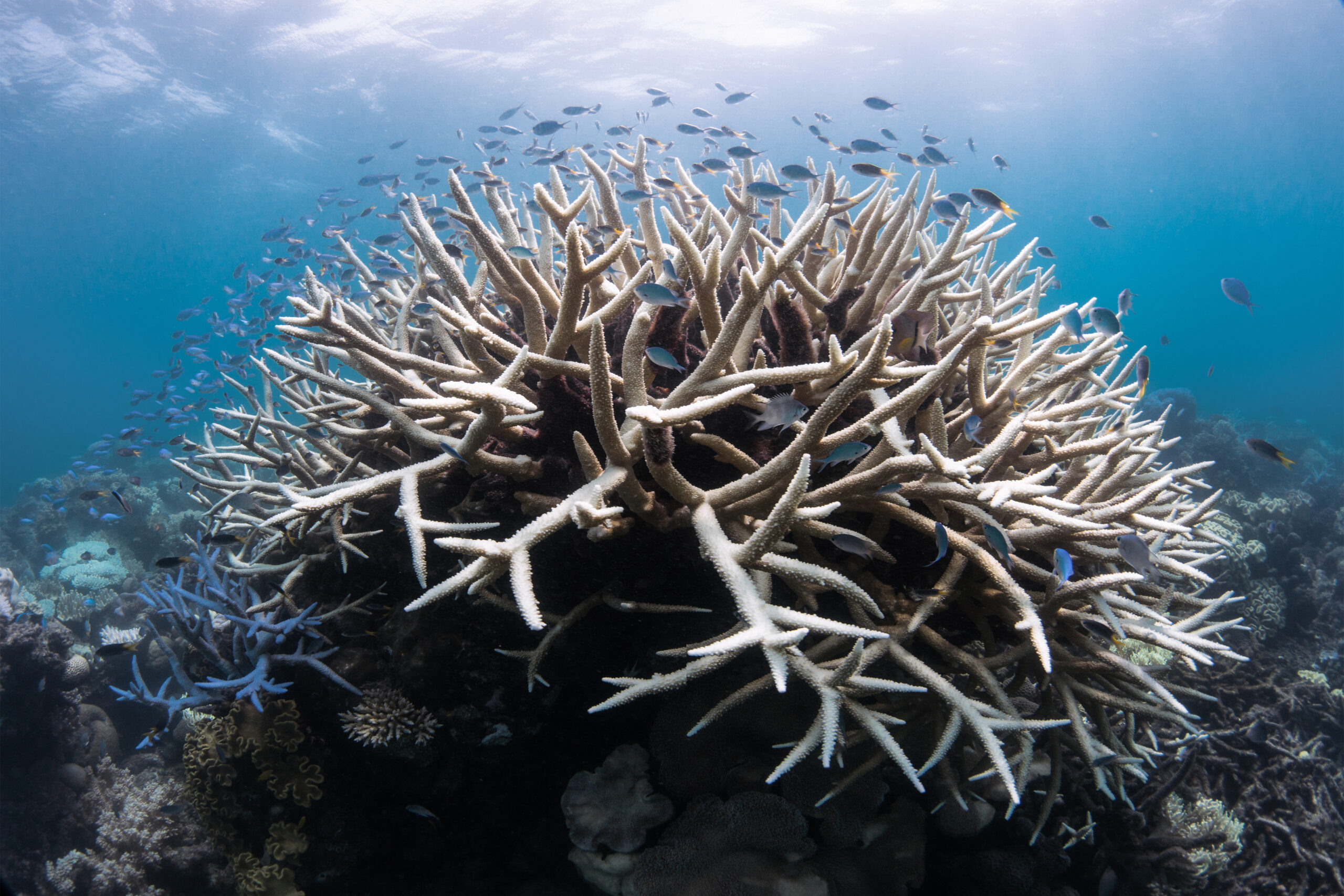
Rest assured life as a coral reef ecology researcher is not always glamorous. Sometimes it’s not easy to be a marine scientist. Sometimes a plan does not always come together. For example, the Chief Scientist, Dr. Andrew Bruckner, has two weeks to accomplish his plan to wrap up the Foundation’s last leg of the Bahamas Expedition. Three or four dives a day is the plan for most of the next two weeks. Sunday was no exception. There are ten scientists that work in two person buddy teams. Each scientist has their own set of surveying criteria and goals that they must repeat for each 65 minute dive (click here to read the Science Plan). The research team readied their gear, while Dr. Bruckner and Amanda Williams scouted out the first dive site.
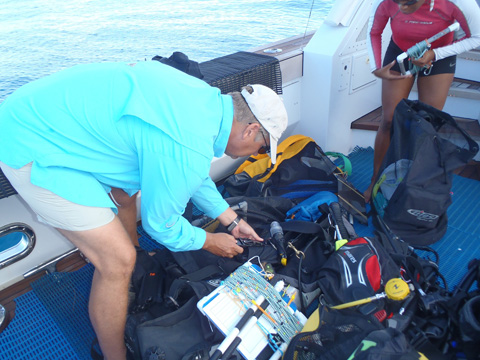
Along with their SCUBA gear, weight belts, etc., they carry a tremendous amount of equipment that adds up and becomes quite cumbersome. The dive started out fine in light currents. However, the dive came to an end just before mid-tide. This is the time when the most amount of water is moving between tides. The Captain said the strong current was moving more than 2.5 knots (almost 3 m.p.h). Although this may not seem like a big deal, most people cannot swim this fast even without bulky SCUBA and survey equipment. To put this into perspective, Michael Phelps swam for an Olympic record in the 200 m (656 feet). He finished in 1 min. 43 sec. That means he was swimming a little more than 4 miles an hour. Three miles per hour is a strong current.
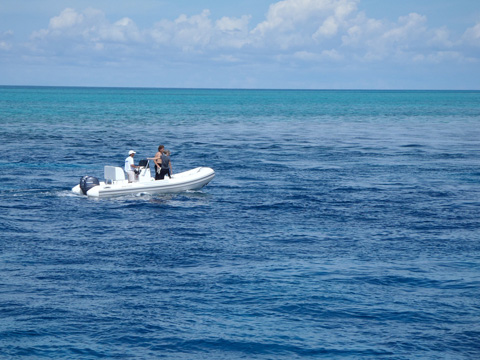
Even with a long tagline (a length of rope set out behind the boat to aid divers when surfacing in strong current) deployed behind the boat, three researchers were swept away a little too fast, due to their bulky loads and the strong current. The chase boat quickly picked them up and all researchers were safely returned to the Golden Osprey, although a little tired perhaps.
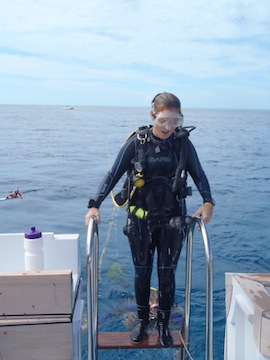
After our surface interval, or time between two dives, it was time to do it all over again. However our Dive Safety Officer, Nick Cautin, looked behind the boat and noticed the water was still rushing by as fast, if not faster, than before the surface interval. He volunteered to check it for safety. He donned his SCUBA gear, with extra weight of course, and entered the water and descended. Make that, he tried to descend. By the time he was 3 feet down in the water column, he was 20 feet behind the boat. He ascended, grabbed the tagline, shook his head and called off the dive for safety reasons. Good call Nick!
After a late lunch, we returned to the same dive site. The current had slackened and the researchers had a great second dive. However, there was not time for a third dive, which sometimes happens when you do research. Two successful dives are better than none.
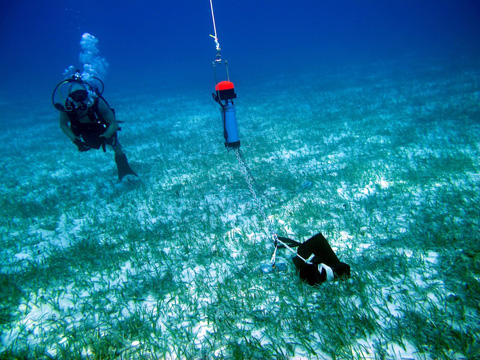
Just before dinner, Dr. Bruckner and Capt. Renaud successfully redeployed the Recording Doppler Current Profiler (RDCP) and it was set to record for about 24 hours, just south of Andros Island. The RDCP is an important tool for measuring current speed and direction from the sea floor to the surface (click here to read our RDCP blog). This is essential information to researchers, as currents play a vital role in, among other things, dispersing larvae and flushing the reef thereby stabilizing water chemistry and temperature levels. The RDCP was retrieved today and the data will be analyzed later.
Written by Jack Seubert
(Photo/Images by: 1 – 4 Jack Seubert, 5 Amanda Williams)
To follow along and see more photos, please visit us on Facebook! You can also follow the expedition on our Global Reef Expedition page, where there is more information about our research and our team members.