Expedition Log: BIOT – Day 26
My initial thoughts after a diving on BIOT’s reefs can be summed up in a few words: remote, largely inaccessible, seemingly untouched, and flourishing with life.
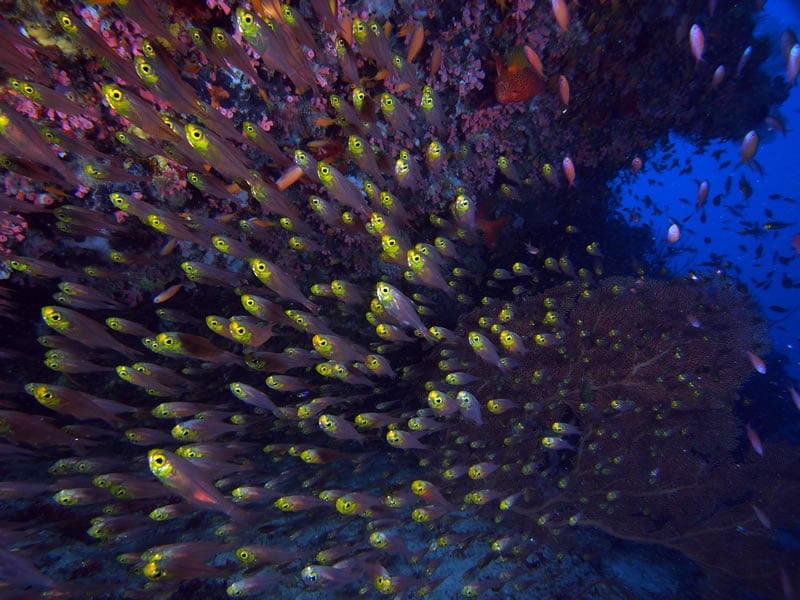
BIOT’s Reefs teeming with life like these Golden sweeper Parapriacanthus ransonneti.
Amid the sun-drenched, aquamarine waters was a myriad of geometric shapes and patterns and a kaleidoscope of colors. Sea fans and soft corals resembling delicately branched trees, covered in vibrantly colored “flowers”. Stony corals, some basketball-shaped and bearing a close resemblance to the human brain, and others looking more like mushrooms from a scene in Alice in Wonderland.
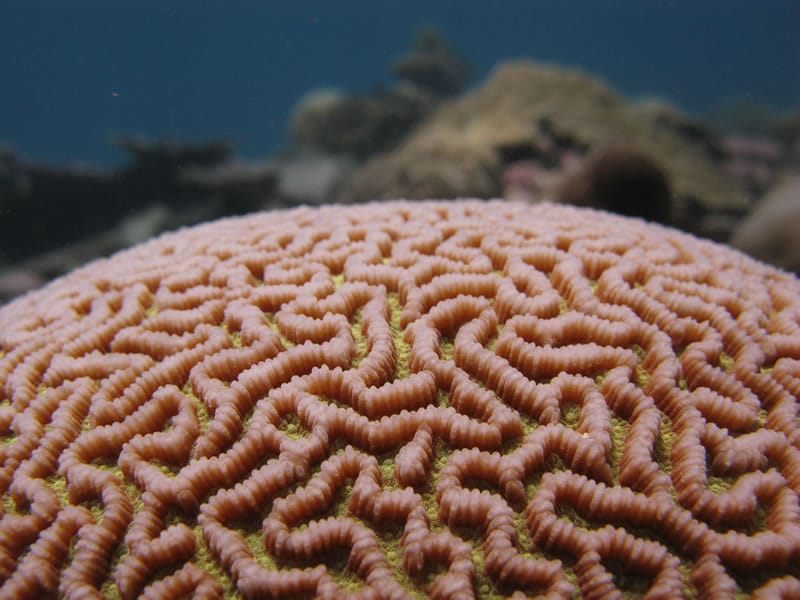
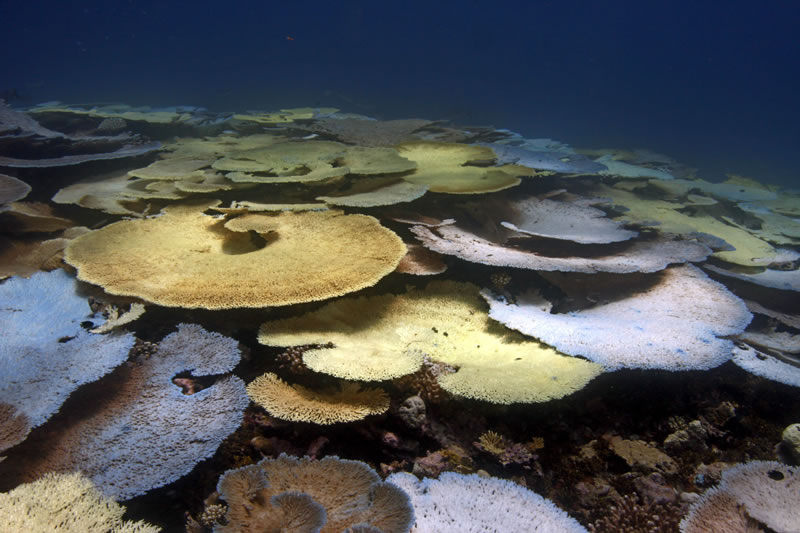
Chagos Brain Coral (Ctenella chagius), a coral only found in Chagos, and a reef covered in large table Acropora showing the first signs of bleaching.
(click-thru on images for greater detail)
Thousands of invertebrates hidden among the corals and sponges – sea urchins, starfish, sea cucumbers, with their spiny skin and sticky tube feet for locomotion; soft-bodied sea slugs and their hard-shelled gastropod cousins; cleaner shrimp smaller than your fingernail, cockroach-like slipper lobsters, coral crabs, and many other strange creatures found nowhere else on the planet.
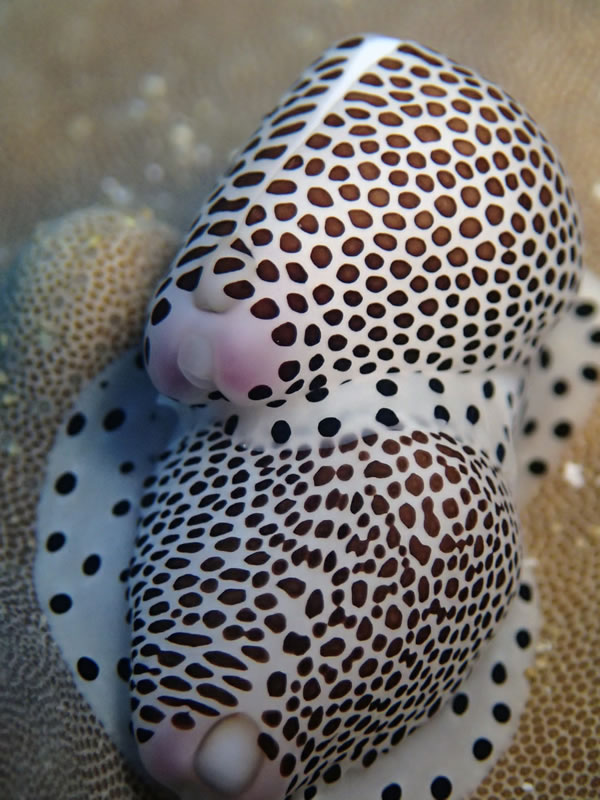
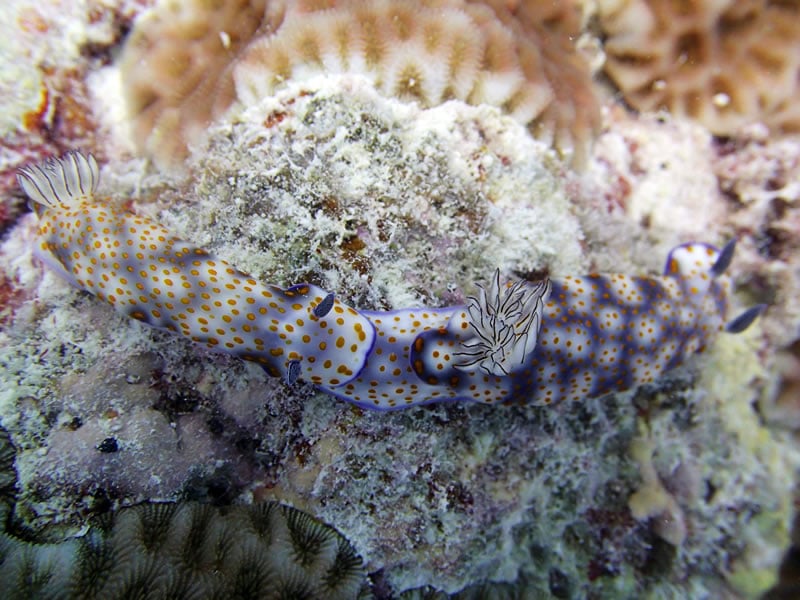
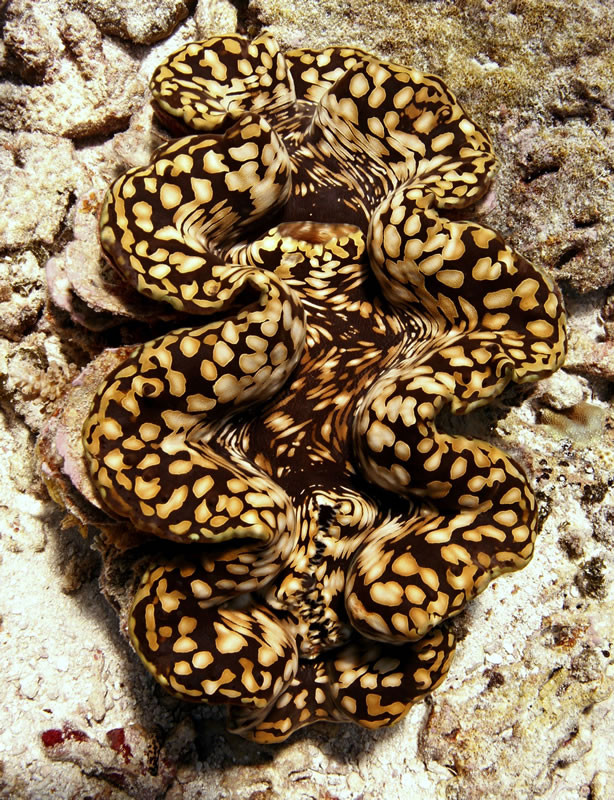
Delicate invertebrates were at home on the reef, like these snails, a pair of mating nudibranchs, and a stunning giant clam.
(click-thru on images for greater detail)
On nearly every dive we found at least one octopus, with sucker-covered arms and body camouflage: skin containing chromatophores that changed color from black or brown to orange, yellow or blue, in a blink of an eye, hiding them from view, yet still in plain sight if you watched them closely. The water column was ablaze with dazzling colors and an array of shapes, such as the pancake-shaped butterflyfish and angelfish, the venomous spiny lionfish and menacing grey reef shark.

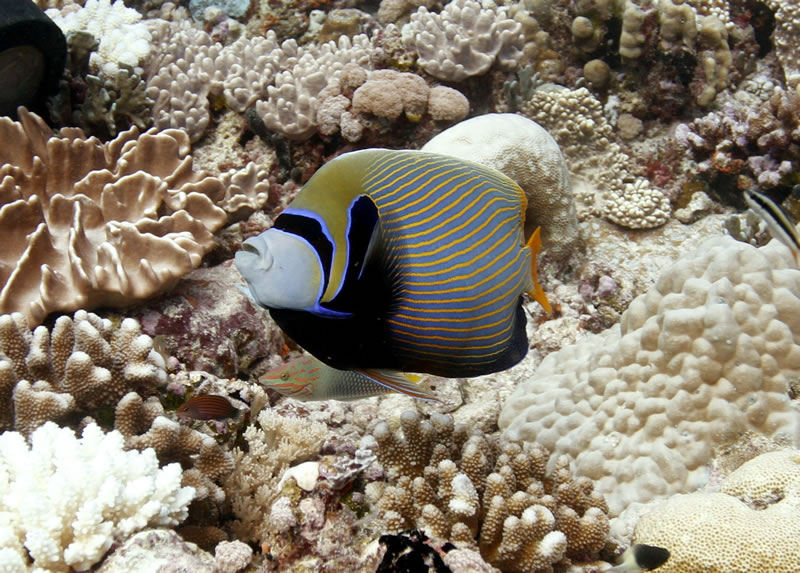
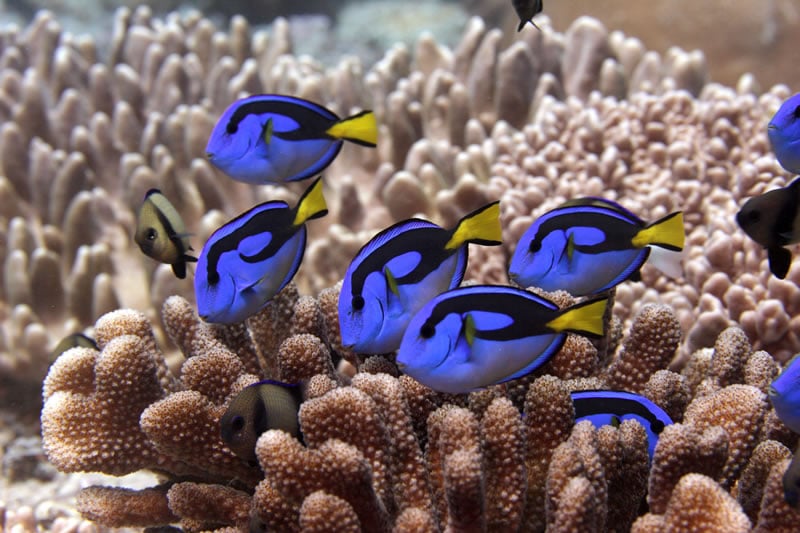
Raccoon butterflyfish, emperor angelfish, and blue tangs add their colorful flair to the reef.
(click-thru on images for greater detail)
Clouds of silvery bait fish darting in unison from one side of a coral head to the other, corralled into a crevice by a hungry school of jacks.


Schools of silvery baitfish and blue fusiliers (center) swarm the reef.
(click-thru on images for greater detail)
The British Indian Ocean Territory (Chagos Archipelago, or BIOT) seems to represent a final frontier for Indian Ocean coral reefs in terms of its ability to support rapid recolonization following catastrophic damage, and potential for growth and continued survival of corals under future scenarios of climate change. Most shallow reefs (0-5 m) we surveyed were dominated by very high cover (60-80%) of stout-branched corals and small massive corals. Mid depths (5-15 m) had high numbers of large, completely live table acroporids (primarily Acropora cytherea), many of which were over 2 m diameter and nearly two decades in age. Often, adjacent corals overlapped and formed multiple “canopy” layers suggestive of the dense vegetation in a tropical rainforest. Deeper reefs also supported healthy communities of corals, including many important massive frame-building corals, as well as extensive fields of branching, plating and leaf-like (foliaceous) corals. Dense coral growth often extended well below the depth of our surveys (30-35 m).
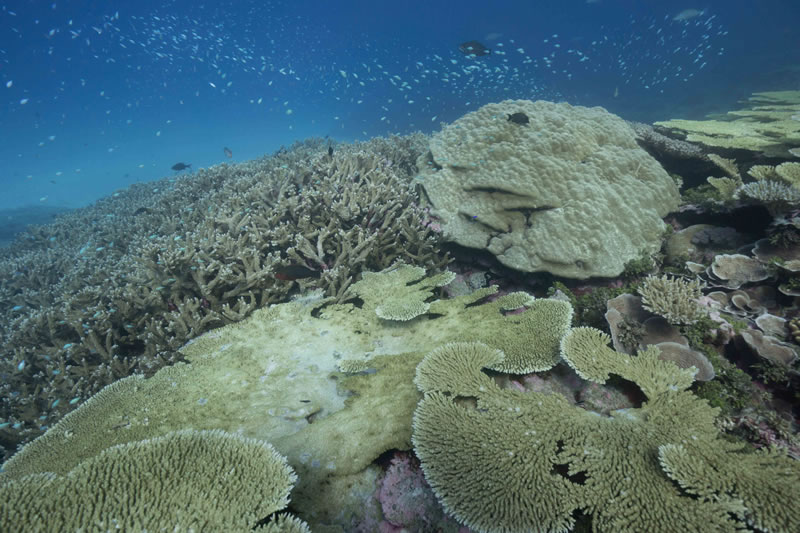
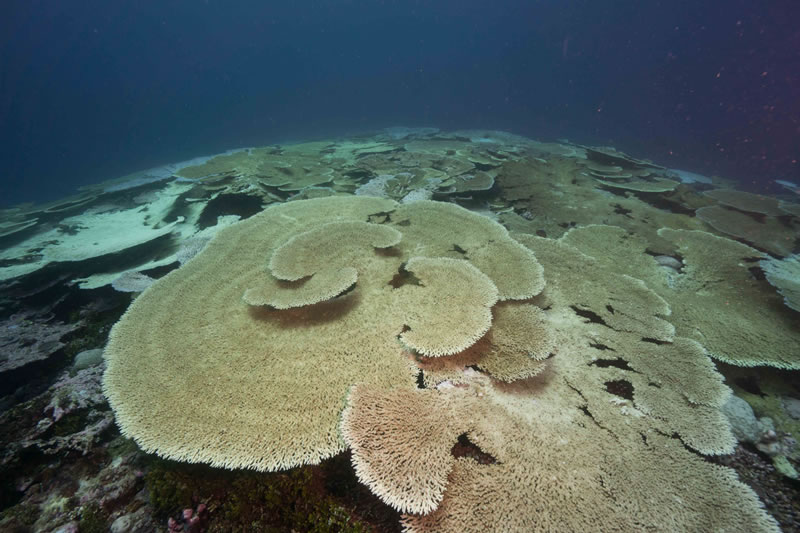
Big, healthy, beautiful Porites and branching and table Acropora blanketed the reefs of BIOT.
(click-thru on images for greater detail)
Photos: 1 Andrew Bruckner; 2-3, 6-9 & 11 Derek Manzello; 4-5, 10 & 12 Anderson Mayfield; 13-14 Phil Renaud