We completed another full day of research today with two dives in the morning about an hour away from our anchorage, and an afternoon dive nearby just off the point of Anguilla Cay. Our team continued with their surveys of fish, corals and other benthic life at each of the dive sites and the groundtruthing team returned from another successful day of data collection. I caught up with Ken Marks, the Data Manager for the Atlantic & Gulf Rapid Reef Assessment (AGRRA) program. He shared with me his observations and photographs of what our researchers are seeing at the dive sites…
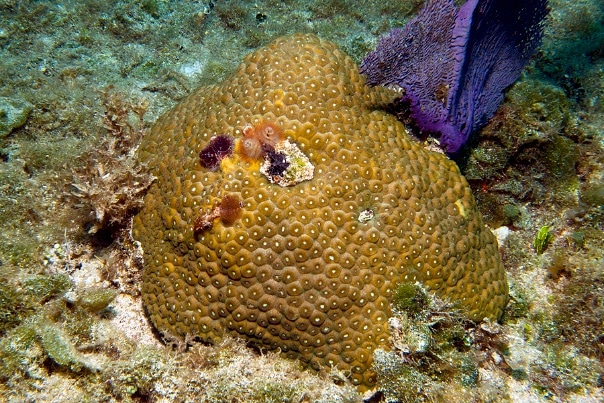 This coral is a Montastraea cavernosa and it’s about the size of a basketball… or rather, half a basketball since it’s more of a dome. Also, a lot of these coral colonies have tubeworms on them called Christmas Tree Worms. You can see two of their orange spirals just above the white ‘old mortality’ spot near the center. They have two spiraled filtering mechanisms that stick out of the tube and if you get too close to them, their primitive eye spots will detect your shadow. They’ll pull back in to save their stretched out gills that they use for feeding and breathing. Sometimes you see coral colonies completely littered with these little Christmas Tree Worms.
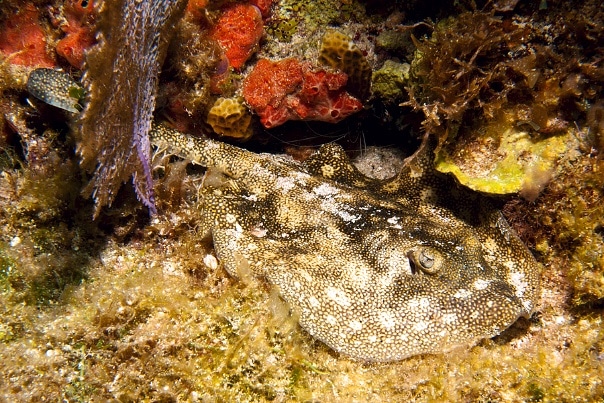 This is a Yellow Stingray that our divers have been reporting seeing occasionally. Everybody had seen them except me thus far, so this is the first one that I finally got to see on this trip! One of the groups that I work with on fish surveys is the Reef Environmental Education Foundation (REEF) and the yellow stingray is one of the species they have been tracking. We don’t know why yet, but the overall sighting frequency – the percentage of dives on which you might expect to see this species – has been steadily decreasing over at least the last decade. So, something is impacting them because we’re seeing less and less of them. We’ve figured out the ‘what’ but we haven’t figured out the ‘why’ yet.
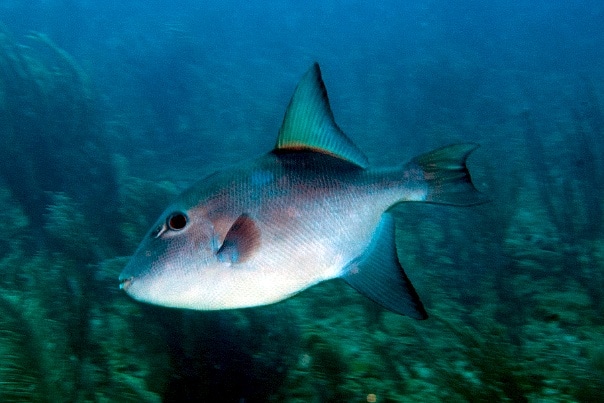 This is an Ocean Triggerfish. They are actually more of a pelagic fish, which means that they live higher up in the water column rather than near the bottom. We tend to see more Ocean Triggerfish out in open water, but because our first two dives were fairly close to the edge of Cay Sal Bank and nearer the open sea, these were very common. They’re neat fish to see.
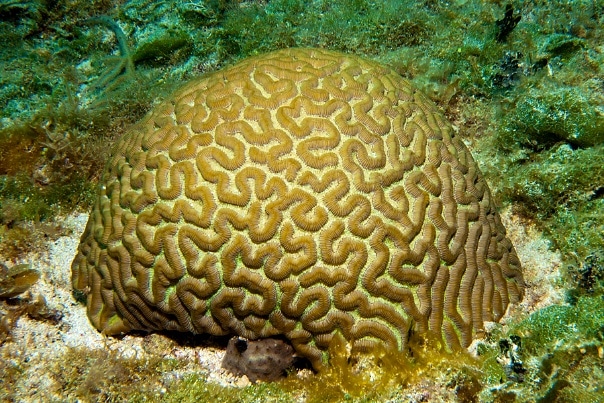 This coral is a small colony of Colpophyllia natans. I’m glad we got a picture of it. Our coral expert Judy Lang had thought she had seen small recruits of this species, but when they’re that small and just a few polyps in size, they’re very difficult to identify to species. Judy was going with her gut that it was Colpophyllia natans, but thought that it could be something else. When she saw this photo, it was confirmed that this site did actually have some of the larger Colpophyllia.
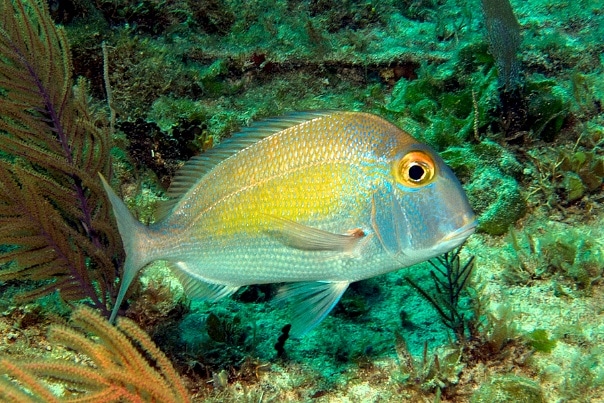 This is a species of fish called a Sheepshead Porgy. The distinctive feature on him is that upper lip overlaps the lower by a bit and there is a little itty-bitty dark spot on the top of his pectoral fin. That’s how you can tell him apart from another porgy called the Saucereye Porgy who’s also got a blue line underneath his eye. We’re interested in several of the porgy species because they are predators of the longspined urchins called Diadema which are important herbivores on the reef.
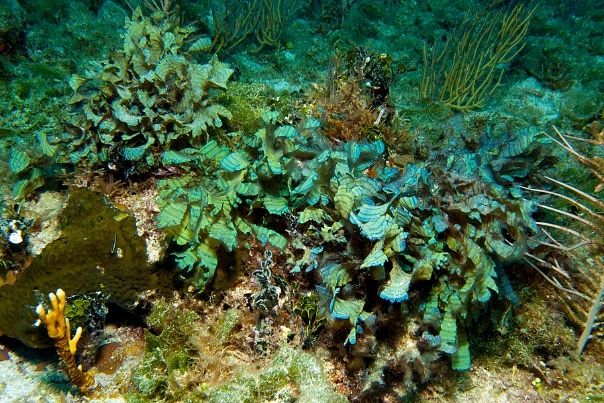 This is a big clump of algae – a fairly pretty algae – called Stypopodium. It’s kind of papery thin with little dark lines that run across it. I’m including this photo just to show everyone some of the large amounts of macroalgae we’re seeing down here on the bank.
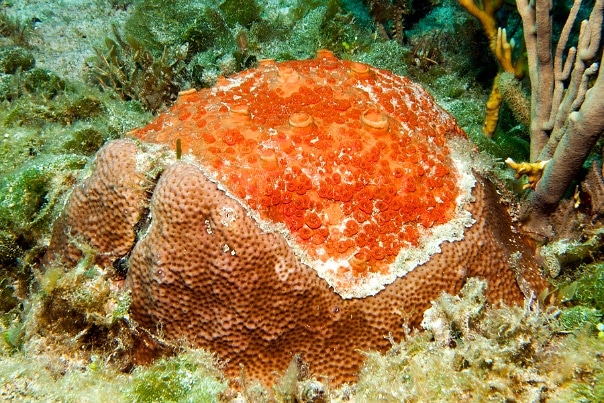 This is a Siderastrea coral. The size is just a little bit bigger than a grapefruit – not very big at all. The difficult thing with cameras, especially underwater, is that you don’t get a sense of scale. That’s why when we do scientific research, we always put a ruler or a meter-stick in the frame for reference. For pretty photos it kind of mucks it up, but for scientific photos, it’s a necessity.
This particular Siderastrea’s top surface has died due to an infestation of Red Boring Sponge, Cliona delitrix – the bright red mass in the center. All of the live tissue of a coral is on the surface, so that middle part where the sponge has grown is just the structure there from previous generations of the polyps. It’s kind of like a tree where the center is structural heartwood and living portion is near the bark. This sponge gets into the coral, secretes an acid and creates chambers kind of like an ant mound. These chambers weaken the colony significantly and over time the center of it may collapse. Judy had seen a colony of this species of coral with the inside nearly scooped out. It appeared that after a collapse of the sponge that possibly some Parrotfish may have come by, realizing how soft and eroded the inner part of the coral was and were scraping away at it, trying to get to the sponge or the algae that was growing on it.
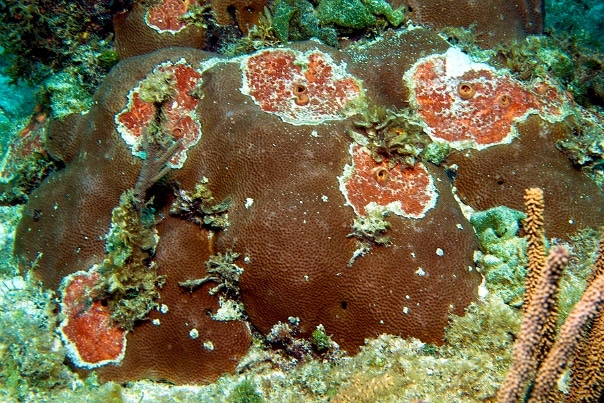 This here is a larger Siderastrea colony with six separate infestations of the sponge that you see as bright red circular patches.
These are just some of the species we’re seeing in this area. Our first two dives of the day had some nice higher profile spurs with larger corals, good fish diversity and exceedingly clear water. We had 100-foot plus visibility, so it felt like a pleasure dive at some place I’d pay to go see. You could see all of the other scientists working across the site.
On the third dive, we could see the current from the surface and by the time we got in the water, it had picked up enough that it was pretty well raging. It was like being on a treadmill, so we had to do all of our fish transects into the current, so that we could survey steadily and on the way back rolling up tapes, we were pretty much getting blown back to the starting point. We don’t tend to like to do the real high current dives – it takes a lot of energy and shortens your dive cause you’re using your air quicker, but sometimes you’ve got go out and do them, current or no current.
As for tomorrow: another day, another three dives.
Many thanks to Ken for sharing his observations with us! Don’t forget to follow along on Facebook to get blog updates and see more photos!
Post by Ken Marks and Liz Smith
(Images credit: Ken Marks)