search-icon
Wobbling Coastlines of the Chagos Islands

Expedition Log: BIOT – Day 18

I’m spending the week walking the coastlines of as many of the islands of Peros Banhos atoll as I can with an accurate global positioning system (GPS). The challenge we face when extracting the position of the coastline from aerial or satellite imagery is that coconut palms and other foliage have a tendency to overhang the coastline. I’m here trying to precisely audit the contour of the coastline, even when it is obscured by trees. When I get back to the lab, I’ll use the GPS information to guide to compare the shoreline in the 1970’s to the present day in order to assess coastline erosion.
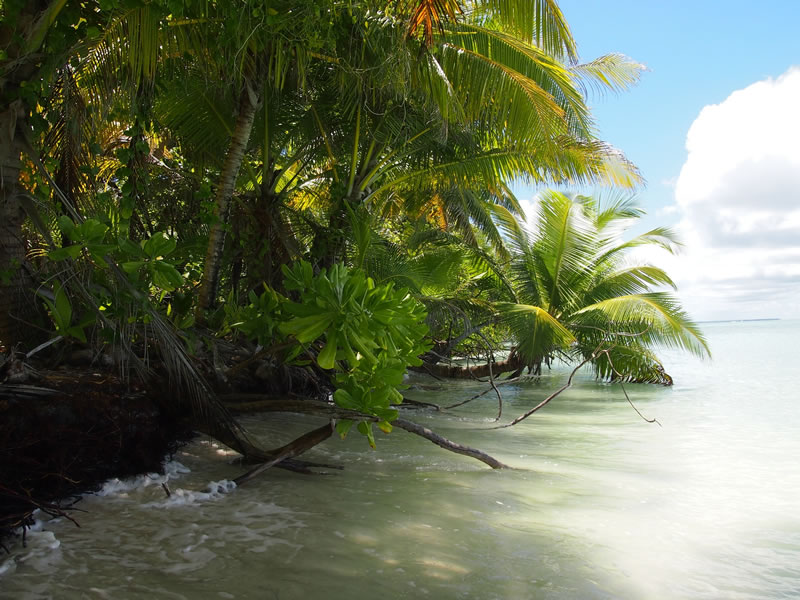
High tide on Ile Grande Soeur highlights the susceptibility of the Chagos islands to sea-level rise. Here the coastline is undercut and in the process of being lost to the Indian Ocean

High tide on Ile Grande Soeur highlights the susceptibility of the Chagos islands to sea-level rise. Here the coastline is undercut and in the process of being lost to the Indian Ocean.

Coastlines are dynamic environments and their morphology is influenced by a host of environmental controls, including sea-level rise, on time-scales of minutes to millennia. Coral islands are low and flat with maximum elevations typically in the range of only a few meters. Being only slightly above sea level carries several implications. First, the islands are vulnerable to extreme events such as catastrophic storms as well as global environmental change and sea-level rise in particular. Second, atoll islands have small land area and few natural resources. Supplies of freshwater maybe limited, and groundwater is often brackish. Besides the damage inflicted by sea-level rise itself, coastal erosion, surface flooding, and saltwater intrusion into soil and groundwater all conspire to threaten the habitability of atoll islands around the world.
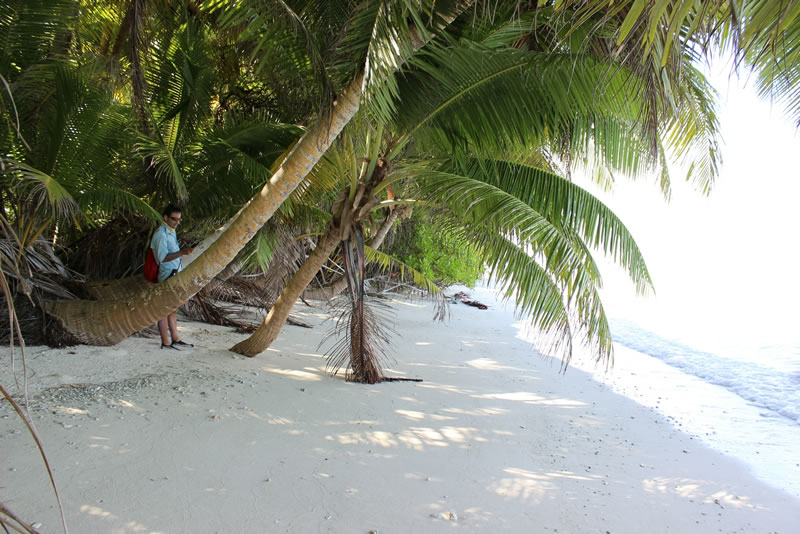
Coconut palms overhanging the coastline as I walk beneath conducting the GPS survey on Ile Poule, an island on the southwestern rim of Peros Banhos
Coconut palms overhanging the coastline as I walk beneath conducting the GPS survey on Ile Poule, an island on the southwestern rim of Peros Banhos.

The project I am working on was made possible by the discovery of a set of vintage aerial photographs acquired by the US Navy in the 1970’s over the coral islands of the Chagos Archipelago. These photographs have been generously provided to us by Prof. Charles Sheppard, a collaborator on this project.
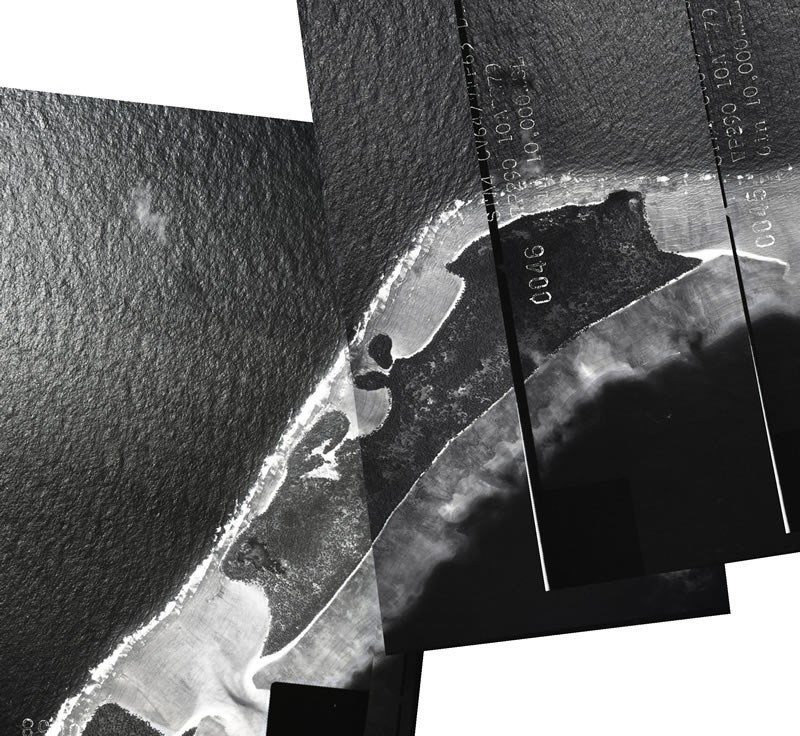
a 1973 aerial mosaic of Ile Diamant, an island situated on the northwest rim of Peros Banhos
A 1973 aerial mosaic of Ile Diamant, an island situated on the northwest rim of Peros Banhos.

My aim will be to pair the archive aerial images with recently acquired ultra-high resolution Worldview-2 satellite images, also in-hand, in order to quantify the coastal shift of a series of atoll islands in the last forty years.Chagos represents a unique natural laboratory where the impact of sea-level rise on island morphology can be examined without the compounding effects of human construction. The results from this study will therefore offer insight into the natural ability of atoll islands to persist in the face of rising sea level, a question of scientific interest, but also pertinent to the millions of people who live on low-lying tropical islands. I hope that the learnings from the work will allow for a better understanding of the response of low-lying coral islands in general to sea-level change.


Photos: 1,2 – Sam Purkis.
Related Posts

Introducing Our New Website: A Fresh Look for the Foundation’s Future

As we celebrate the Khaled bin Sultan Living Oceans Foundation’s 25th anniversary, we are proud to unveil our newly redesigned website—a modern home for our science, conservation work, and educational programs. This launch marks an important moment for the Foundation as we honor our long history and look toward the future of ocean conservation.

For more than two decades, the Foundation has worked tirelessly to improve the health of our living oceans. We have advanced ocean science, led one of the largest coral reef research missions in history, restored mangrove forests with local communities, created award-winning education programs, and shared the wonders of the ocean with people around the world. Our new website reflects the organization we are today—focused on conserving coral reefs, restoring mangrove forests, and improving ocean literacy—while still highlighting the legacy of work that brought us here.

The redesigned site…

Read More

Connecting People, Art, and Oceans: Championing Conservation at the 2025 IUCN Congress

The IUCN World Conservation Congress brings together thousands of leaders and decision-makers from governments, non-profit organizations, civil society, Indigenous groups, and the private sector to shape global conservation policy and action. This influential gathering serves as a platform to share knowledge, build partnerships, and advance initiatives that protect our planet’s biodiversity.

As a member of the International Union for Conservation of Nature (IUCN), the Khaled bin Sultan Living Oceans Foundation was honored to take part in the Congress, joining a global community of leaders, organizations, and changemakers committed to protecting nature and advancing sustainable futures.

Read More
Privacy Overview

This website uses cookies so that we can provide you with the best user experience possible. Cookie information is stored in your browser and performs functions such as recognising you when you return to our website and helping our team to understand which sections of the website you find most interesting and useful.  You can view our complete Privacy Policy here.

Strictly Necessary Cookies

Most of our cookies are used to improve website security and reduce spam. These cookies should be enabled at all times. They also enable us to save your preferences for cookie settings.

3rd Party Cookies

This website uses Google Analytics to collect anonymous information such as the number of visitors to the site, and the most popular pages. Keeping this cookie enabled helps us to improve our website.