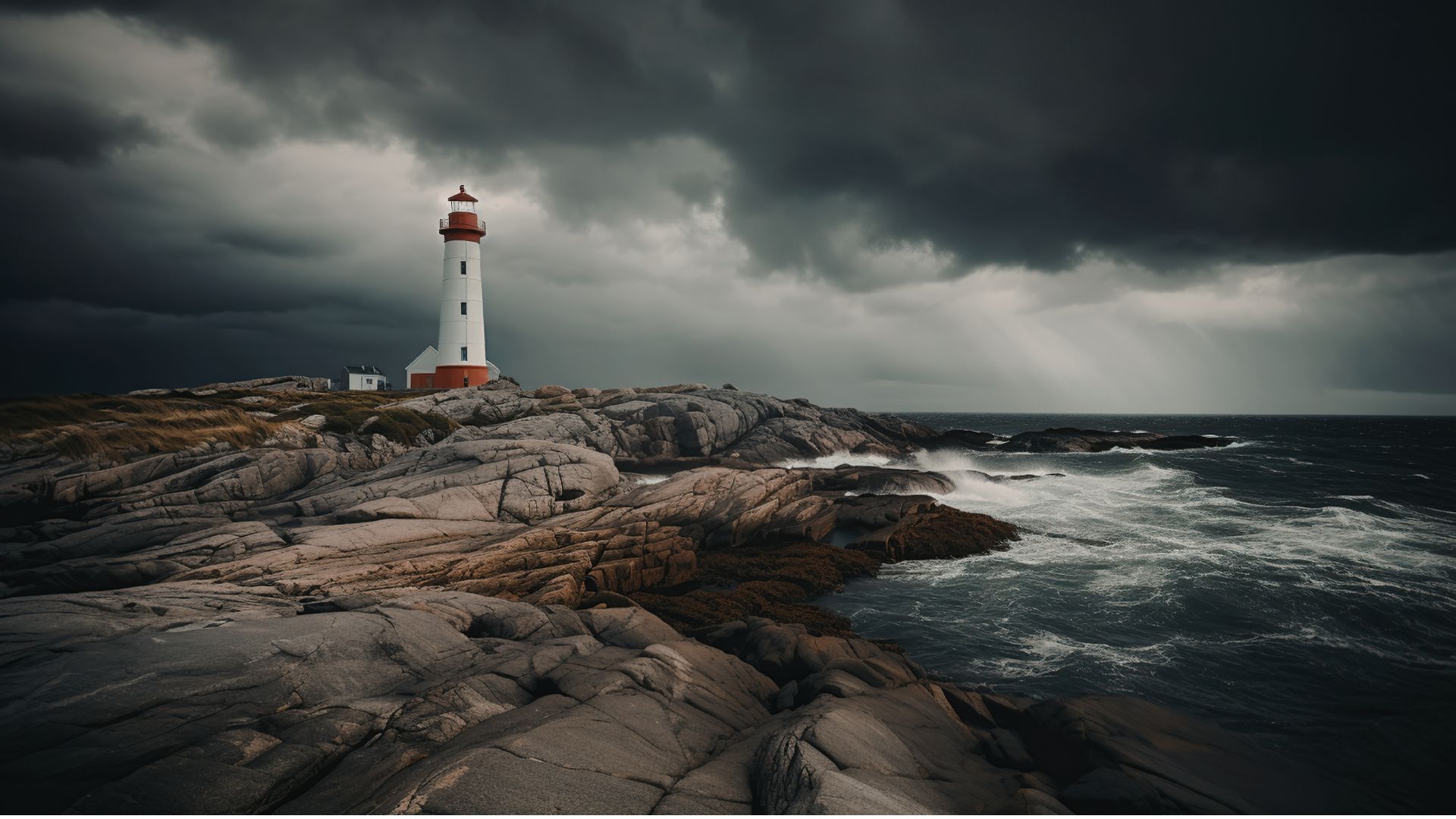
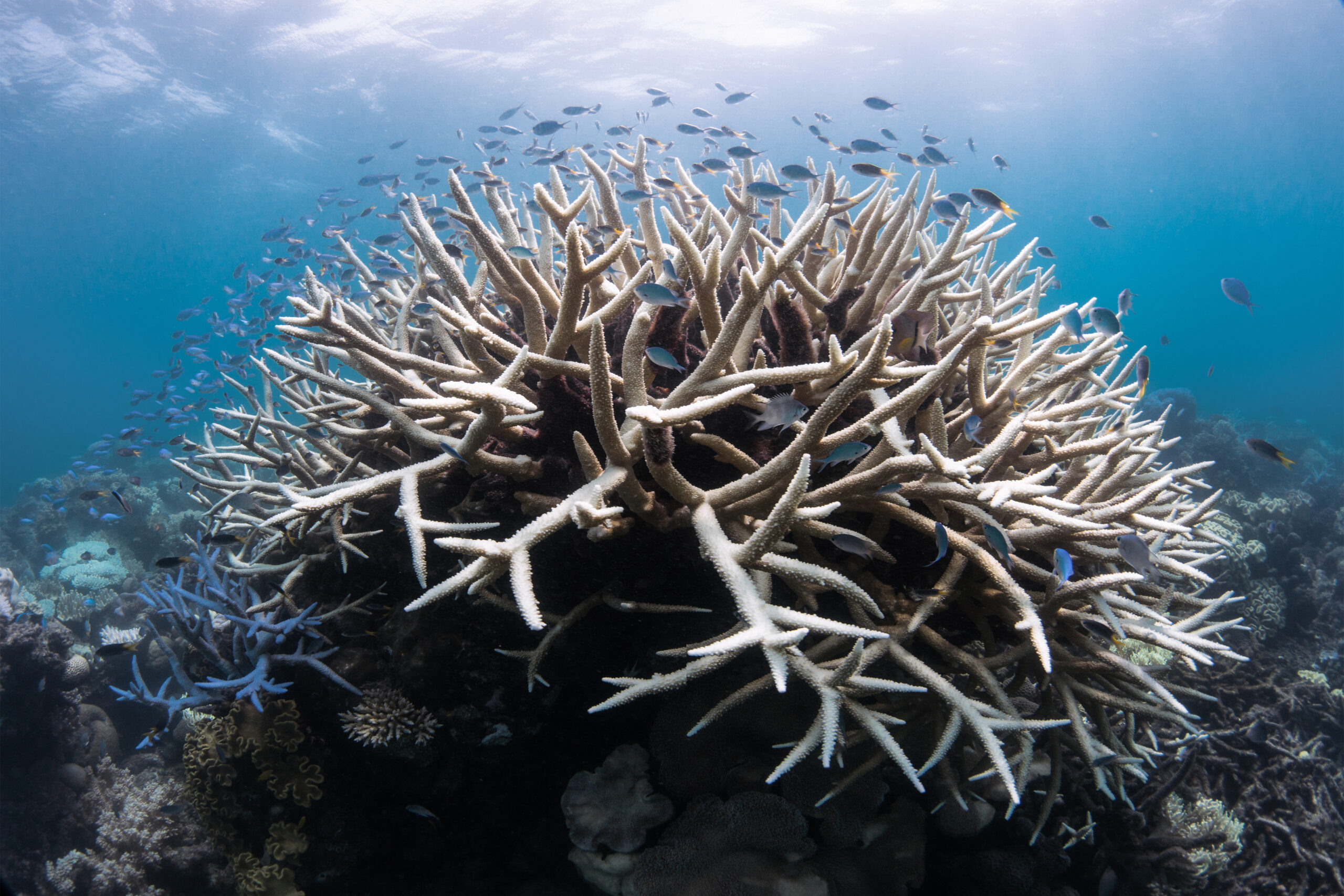
After just one dive at San Cristobal Island, the team decided the water was too rough, so the Golden Shadow moved on. We woke Monday to overcast skies at Floreana, the southernmost of the five inhabited islands. Monday brought three dives at the Corona del Diablo, the “Devil’s Crown,” a ring of jagged rocks on the island’s south side formed by a partially submerged basalt volcanic cone. Strong currents sweep around and through the formation, which is only a few meters deep inside and full of life.
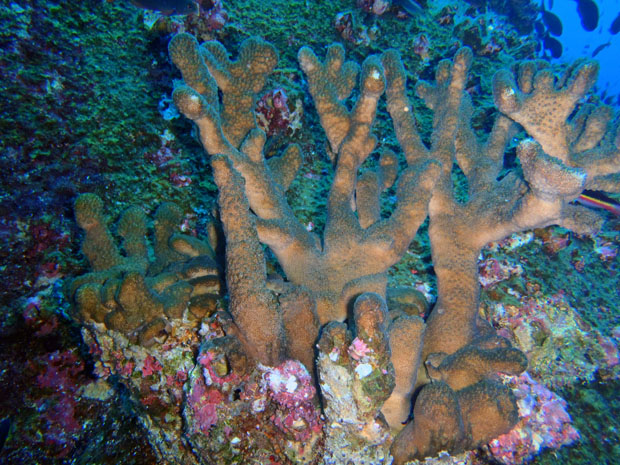
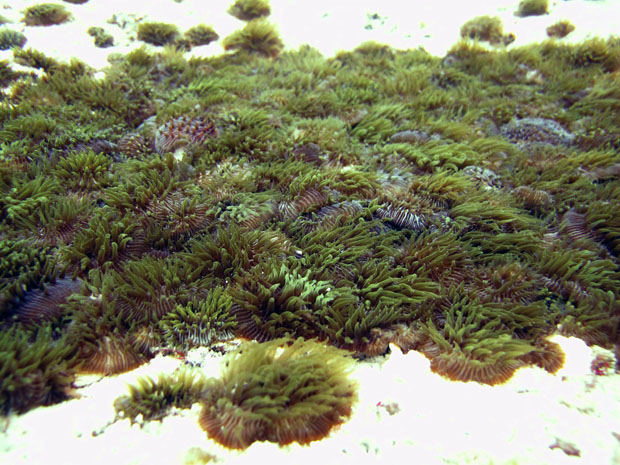
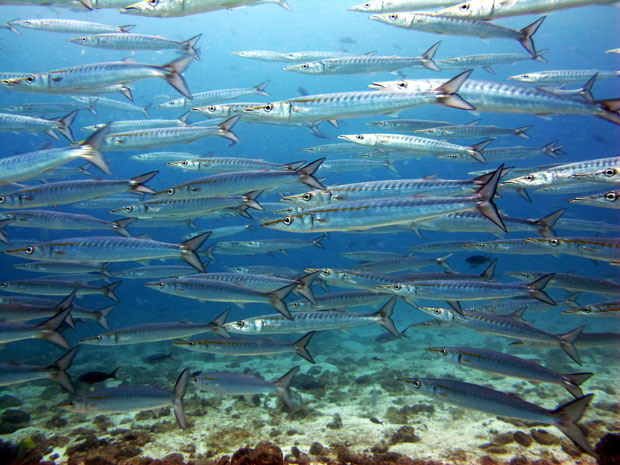
Floreana corals seemed to be recovering here in the Devil’s crown, including large stands of Pavona and Porites, one of which was four meters by two meters. Outside the Devil’s Crown we found some Pocillopora, a few Cycloseris colonies, which are very rare, and extensive beds of both Psammocora and Diaseris, each stretching for over a hundred meters. This was the first time we had found Diaseris alive, in abundance. Sea turtles, rays, a school of barracuda and multiple parrotfish over two feet long all made appearances during out time at Floreana corals.
Of all the islands, Floreana (home to the Devil’s Crown) has the strangest human history. In the 18th century, an Ecuadorian officer used giant mastiffs to rule over some 80 convicts, but an island-wide rebellion eventually forced the “Dog King of Charles Island” (Floreana was originally named after British King Charles) to flee to the mainland.
A small group of German settlers in the 1920s and 30s brought more than their share of drama, including a self-styled “baroness” named Eloise Wagner de Bosquet who arrived with two male companions and immediately started infuriating everyone else. She disappeared on a boat one day with one of her “friends,” supposedly sailing for Tahiti, and was never seen again. The other companion disappeared himself aboard a small boat soon after. His dessicated body was found months later on Marchena Island, weighing less than 10 kg.
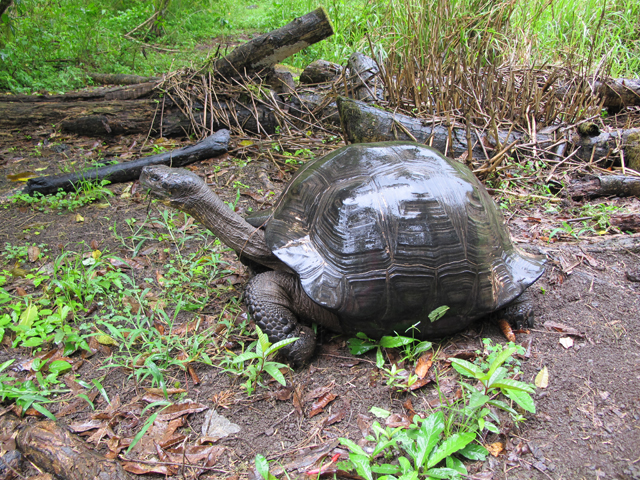
When Darwin visited, he wrote how the inhabitants hunted wild pigs and goats—both destructive invasive species that are still being controlled and eradicated today–but that their main staple was the island’s subspecies of giant tortoise. Most had already been killed already, especially by whaling ships that would stop by the islands for fresh water and meat. Locals told Darwin how a single whaling ship could take away as many as 700 tortoises, which would be kept alive in the hold for fresh meat months later. Unsurprisingly, the Floreana giant tortoise has been considered extinct until this January, when a DNA study found at least 84 Floreana tortoise offspring alive on Isabela Island.
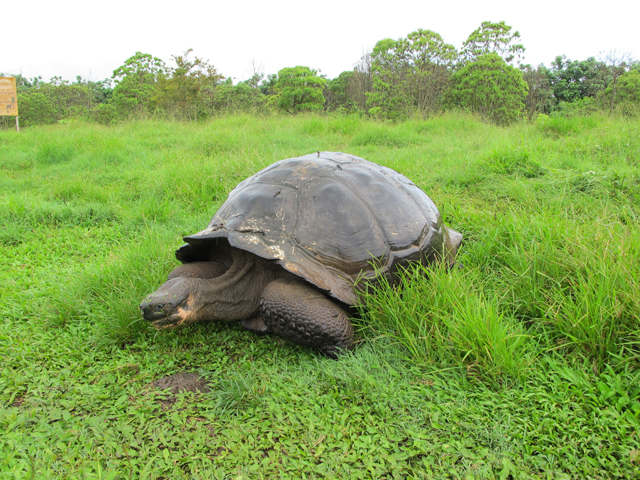
Floreana was where Darwin first learned that the tortoises on different islands had differently shaped shells, a key clue in his thinking on evolution. Saddle-shaped shells, high in the front and the back, evolved on arid islands where the tortoises have to lift their heads to browse tall vegetation like cacti. (The name “Galapagos” is actually said to come from an old Spanish word for riding saddle.) The animals’ necks and legs are also longer on these islands. Tortoises with semicircular domed shells come from lusher islands with vegetation that grows low to the ground.
For a bit of fun, use this Wikipedia link to learn more about other Galapagos giant tortoise subspecies.
(Photos/Images by: 1 Derek Manzello, 2-3 Brian Beck, 4-5 Andrew Bruckner)
To follow along and see more photos, please visit us on Facebook! You can also follow the expedition on our Global Reef Expedition page, where there is more information about our research and team members.