Returning from their third dive of the day, most of the science team was happy to wash and pack away their gear, before heading for a hot shower and dinner. For two members of our dive team, however, the day’s work was only half done. As the sun slowly set on the horizon, Living Oceans Fellows Joao Monteiro and Anderson Mayfield headed to their night dive location to see reef creatures at night.
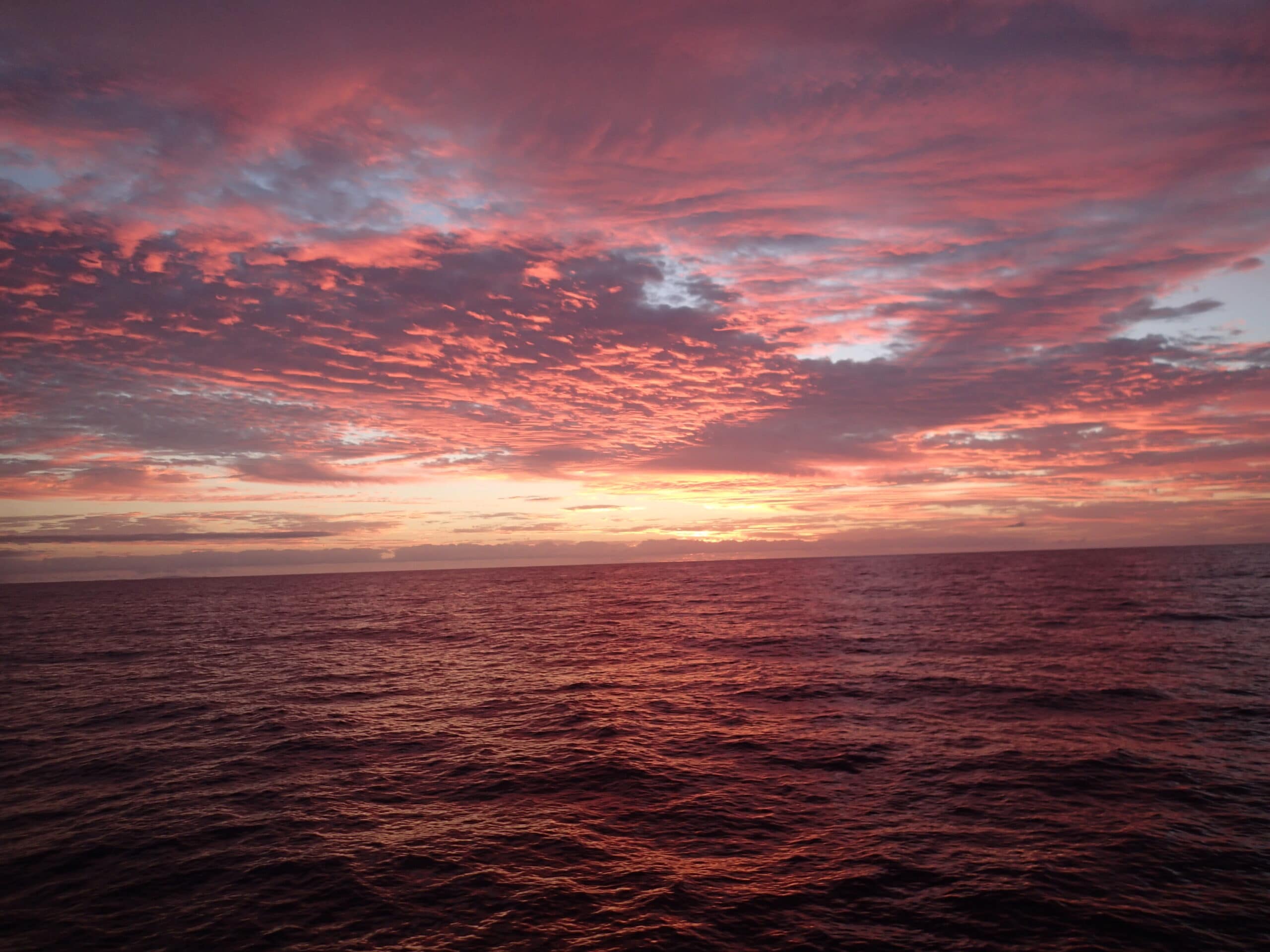
The sun sets on another day of ocean research for most of the team, while Joao and Anderson head out on their night dive to see reef creatures at night.
Observing Reef Creatures at Night
Joao and Anderson dive at night to examine how well the photosynthetic machinery of the symbiotic dinoflagellates, living within the coral, is functioning. This study requires that the same corals are sampled at night as during the day. Earlier, Anderson and Joao had visited the same site and located individuals of their study species, Pocillopora, and painstakingly marked these corals with lights and a string to guide the two divers between corals in the dark. Clutching sample bags, and a fluorometer to measure the fluorescence of a coral in response to a high intensity artificial light, Joao and Anderson hop from coral to coral using their guide lines.
Coral reefs and reef creatures at night can take on a completely different character. Many species of fish are much more active. Some are easily spotted as they are startled by the diver’s flash lights, while others are drawn towards the lights, to feed on plankton and small invertebrates that are highlighted. On this particular dive, Joao was lucky enough to encounter a Striped eel Catfish (Plotosus lineatus).
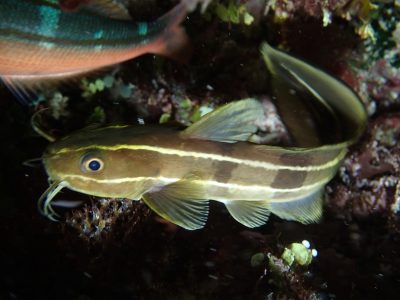
The striped eel catfish (Plotosus lineatus) is much more active at night, and tends to hide during the day.
This fish uses its barbels, the whisker-like protrusions around its mouth, to locate prey items in the sediment, especially in the dark. The fish species possess spines on the dorsal and pectoral fins which can inflict painful wounds.
The water around divers at night takes on a different character as this video shows. Small planktonic organisms dance and jerk in the cat and mouse game of predator and prey. In the corner of his light, Joao spotted this free swimming worm twisting and writhing through the water column.
The delay of reaching their hot shower is tempered for Joao and Anderson by the adventure and wonders of observing reef creatures at night.
Photos: 1 – Anderson Mayfield, 2 – Joao Monteiro
Video: Joao Monteiro