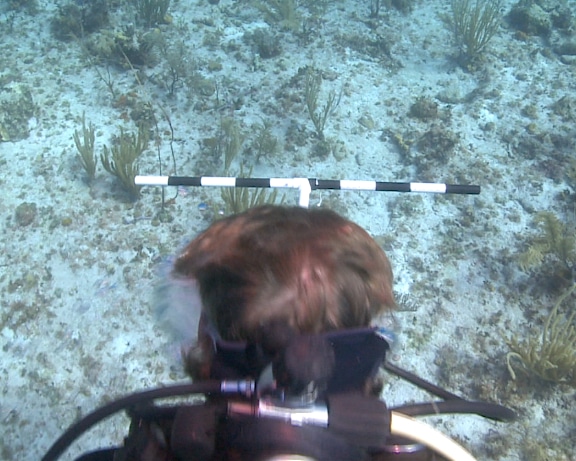
Have you ever wondered if reef fish communicate, sleep or defend a territory? Scientific divers, Ken Marks and Dave Grenda, are on our team to survey and observe Caribbean reef fish in a quest to better understand how they contribute to reef health. Ken and Dave have been participating in the Global Reef Expedition as our onboard fish experts. Their assignment on each dive is to record a number of attributes about the fish populations in the Inaguas and Hogsty Reef. To achieve this objective, on each dive they reel out a 30-meter measuring tape, while swimming along holding a T-shaped meter stick used to estimate fish size and distance. This process is repeated a few times during each dive. The diver records the species, sizes, and abundance of fishes encountered along the transect line. This type of survey is known as a ‘belt transect’ and gives researchers a sample of Caribbean reef fish density and biomass in a specific location.
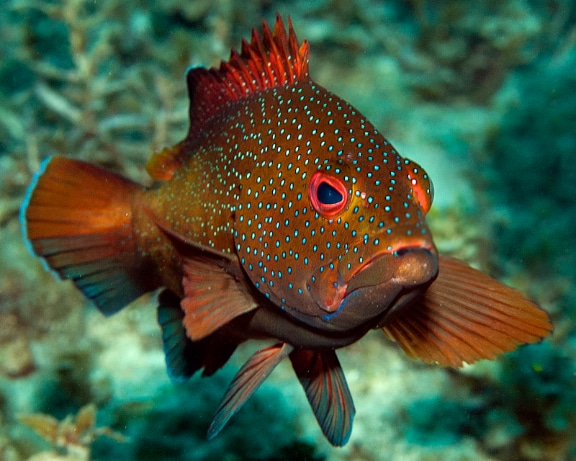
During each transect, the surveyors focus on groups of fish that live on the reef and play important roles in the ecology of the reef as a whole. For example, surgeonfishes (Acanthuridae), parrotfishes (Scaridae), and chubs (Kyphosidae) are key herbivores (plant eaters). They graze algae off of the reef, which helps maintain open areas that benefit coral settlement and growth. One step up in the food chain, the predators of these herbivores are also recorded. They include snappers (Lutjanidae), morays (Muraenidae), and fish in the grouper subfamily (Epinephelinae) including groupers, coneys, graysbys, and red hinds. Fishes including butterflyfishes (Chaetodontidae), grunts (Haemulidae), and angelfishes (Pomacanthidae) are recorded as commercially significant either as food fish, or for the aquarium trade. Some species of jacks (Carangidae), wrasses (Labridae) and filefishes (Monacanthidae) are also commercially significant. Many Caribbean reef fish species bridge two or more of these ecological categories. In addition to conducting belt transects, Dave also records all fish species observed during each dive, and their size and abundance. This enhances the scientific value of our database.
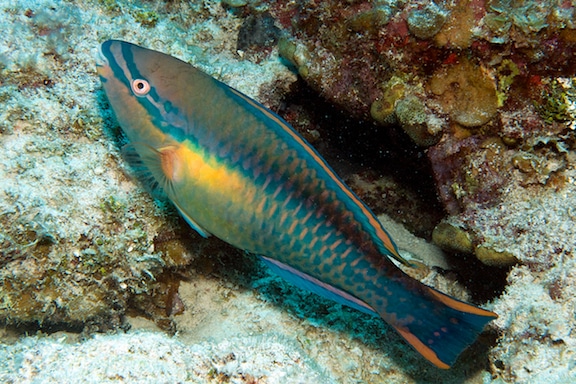
So far, Ken and Dave have noted a couple of interesting things about the Caribbean reef fish they have seen on Hogsty Reef and Great Inagua. On other Caribbean reefs, there are typically more grasbys than coneys. Generally, the divers would count ten grasbys for every one coney. On this leg of the Global Reef Expedition, the complete opposite has been observed. Curiously, coneys are abundant here, far outnumbering the grasby population. In addition, the princess parrotfish in the Inaguas are far more plentiful than the very similar striped parrotfish. The opposite is true in most other parts of the Bahamas and the Caribbean. The reasons for these number reversals are not readily apparent and the mystery intrigues our scientists. The divers have also noted a virtual absence of grunts and porgies. Dave and Ken believe this may be because the Inaguas do not have the large seagrass beds needed to support their primary diet of nocturnal invertebrates.
The data on Caribbean reef fish being collected by Ken and Dave will be synthesized with scientific data our team has been recording on habitat types, coral cover, coral diseases and invertebrate populations, so that reef ecologists can assess the overall health and resilience of the Hogsty Reef and Inaguas coral reef ecosystems.
Written by Kit van Wagner
(Photo/Images by: 1 Doug Allan, 2– 3 Ken Marks)
To follow along and see more photos, please visit us on Facebook! You can also follow the expedition on our Global Reef Expedition page, where there is more information about our research and our team members.