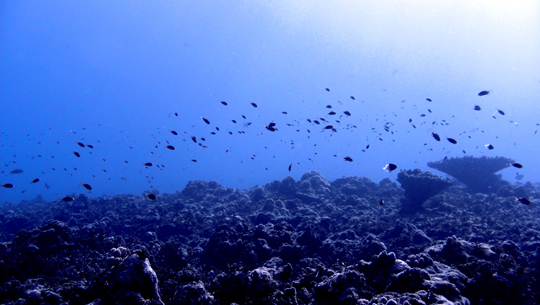
At first sight, Huahines’ reefs appeared to lack vertical relief; the bottom was barren and without much life. It was obvious to all of us that a disturbance had impacted these reefs sometime in the past. Locals indicated it was the result of an invasion of hungry crown-of-thorn-sea stars in 2008 and a cyclone in 2010.
A closer look at Huahines’ reefs over the last couple of days, however, immersed us in a world of miniature creatures. A wide variety of young and healthy-looking corals thrived in the small crevices and crannies, and thousands of tiny fish constantly emerged from invisible refuges, crowding the blue water column like swarms of busy bees.
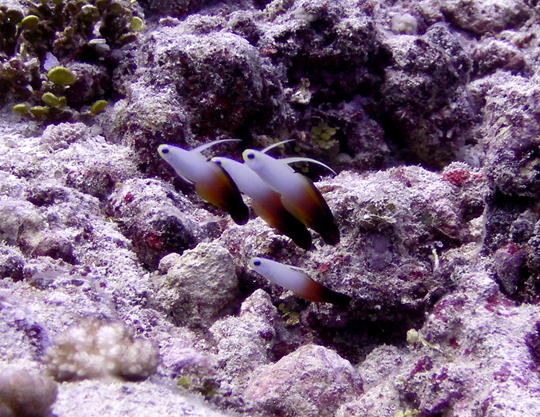
Huahines’ reefs are perhaps not the safest place for large fish, since there are virtually no places to hide. But for small fish and juveniles of larger species, like these Nemateleotris magnifica, a pile of rubble is more than a home, it’s a palace for four!
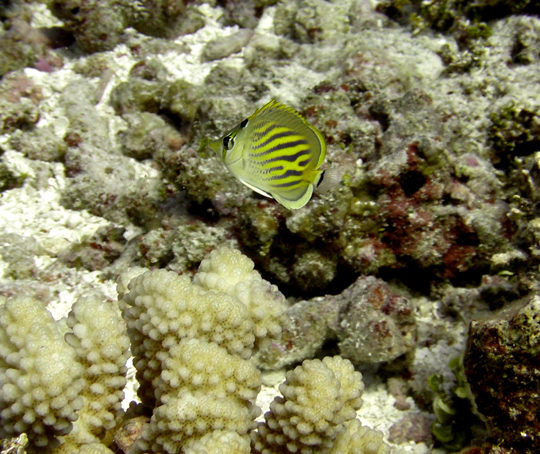
This butterflyfish, for example, found a safe place to escape my camera lens, retreating into a hole where I could hardly fit my thumb. This small hole will provide a safe refuge until it reaches a larger size, and can venture out safely to feed on coral polyps.
The wide variety of tiny life forms thriving on Huahines’ reefs was a lesson for our divers’ eyes, who were accustomed to healthy and colourful-looking reefs with large corals and large fishes. Although the reef appeared degraded from a distance, the landscape was scattered with juvenile corals that should grow up in a few years time and carpet the bottom. Huahines’ reefs remind us that not only healthy reefs, but also those that are on a slow path to recovery, must get all our help and protection to ensure they can rebound and provide a home for larger fish in the future.
(Photos by: Dr. Sonia Bejarano)
To follow along and see more photos, please visit us on Facebook! You can also follow the expedition on our Global Reef Expedition page, where there is more information about our research and team members.