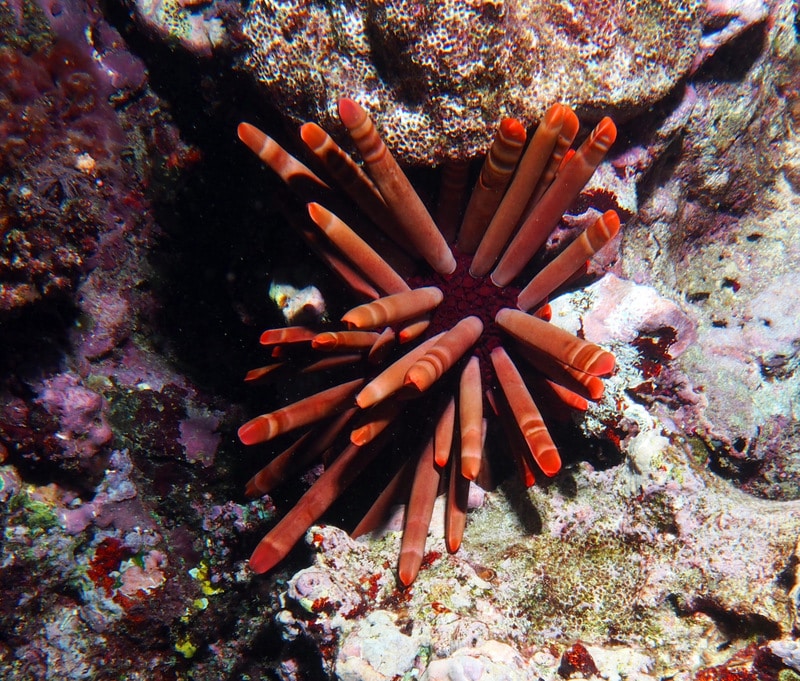
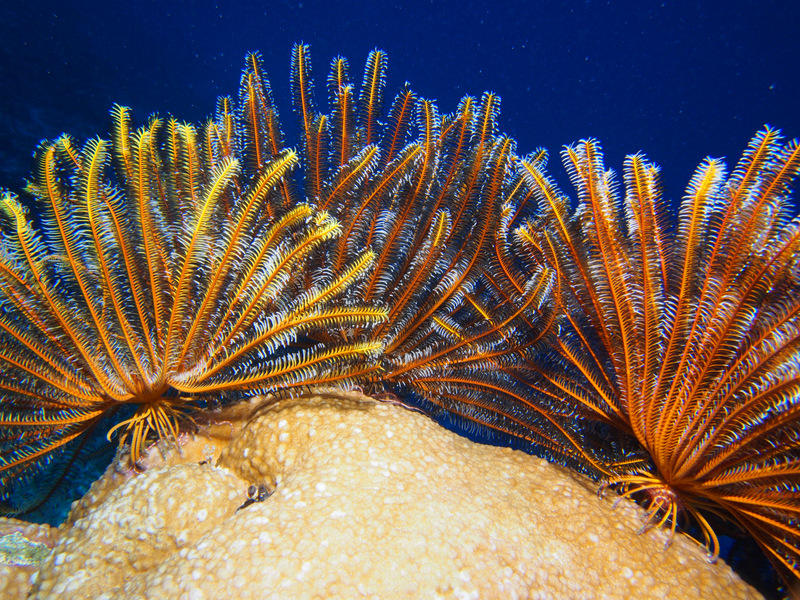
One of the most unusual group of animals found on the reef are the echinoderms. So named because of their “spiny skin”, these animals are pentamerous or radially symmetrical (five point). Found only in the sea, they include sea urchins, brittle stars, basket stars, crinoids, sea cucumbers and starfish. One of their most remarkable trait is their ability to regenerate their tissue, organs and limbs. They also have a unique water vascular system – basically a network of fluid filled canals that control gas exchange, feeding, sensory reception and locomotion.

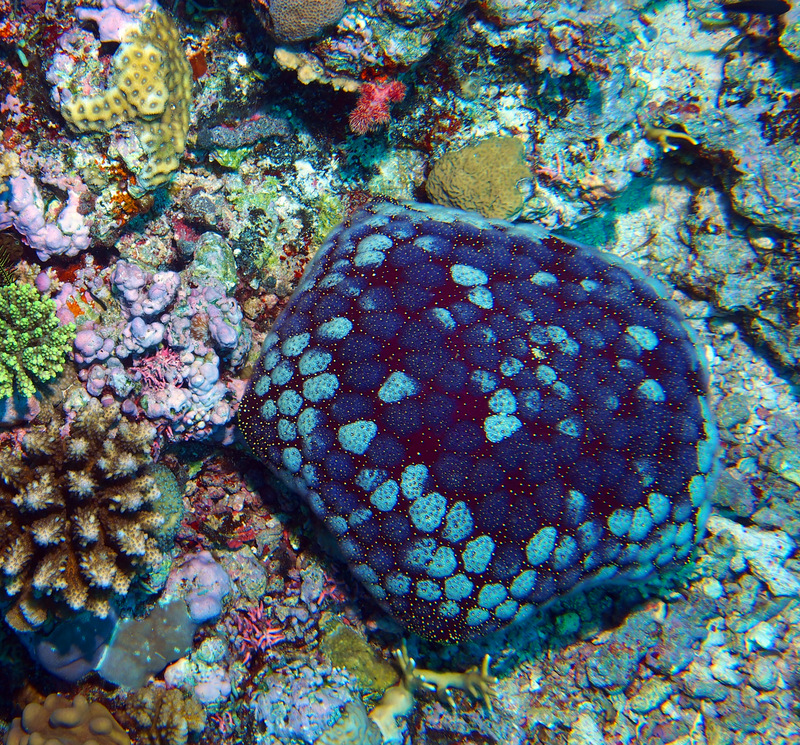
While most of these are extremely important to the health of the reef, they often undergo large population explosions which can have devastating consequences to the reef. Most notorious are the echinoderms that eat coral. In the Pacific, two are of most concern – the cushion star (Culcita) and the Crown-of-Thorns starfish (Acanthaster or COTS). COTS in particular, are the most voracious coral predators found on Indo-Pacific reefs.
Killer Starfish Outbreaks of COTS in French Polynesia and Cook Islands

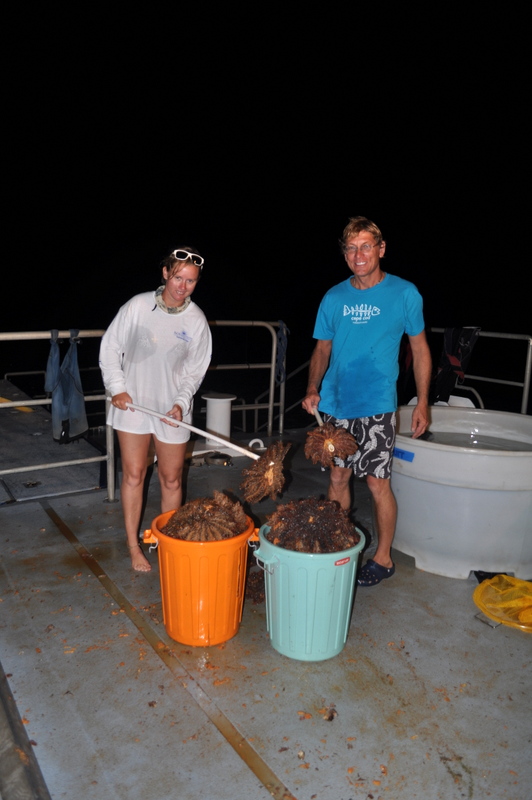
During the GRE, we’ve found outbreaks of these killer starfish in both French Polynesia and Cook Islands, have seen the devastation they can cause, and have documented both the aftermath and subsequent recovery. In the Cook Islands, the population explosion of these killer starfish was such a concern that we conducted a clean-up, removing as many of the animals from the reef as possible.
On the first seven islands we visited in the Lau Province, we found no more than one or two COTS in each location. We did observe several reefs that are thought to have been badly damaged by COTS 4-5 years earlier, as evidenced by the structure of the coral community (type of species present, their sizes and the presence of dead skeletons in growth position).
We arrived in Cicia, and dove several spectacular reefs. One of the most magnificent areas was in front of the village. Very high coral cover made up of a diverse assemblage of large (old) table acroporids, staghorn corals and many other species. From the reef crest to 30 m, most of the bottom was carpeted in coral, often several canopy layers thick. As we neared the end of the dive, I found an area with a number of stark white coral skeletons. The first thought was COTS!! None were out feeding, though. We did a night dive, which is when COTS usually emerge from refuges within the reef. We identified a few immediately, and after more searching found an area with dozens of these killer starfish.
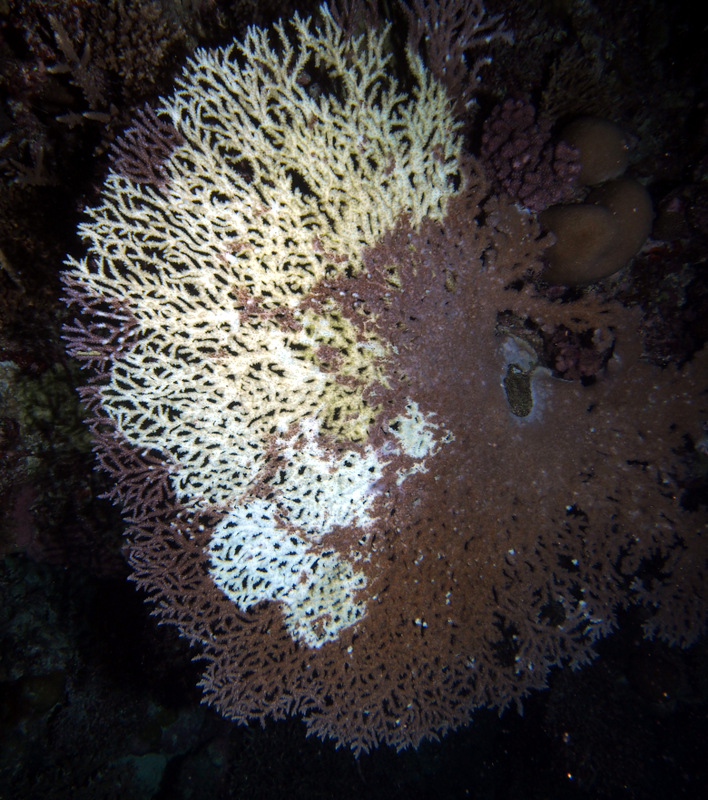
Our dives the following day focused on identifying the pattern of coral mortality. It was confined to a restricted area, a few hundred meters along the barrier reef with no signs of COTS to the north or south. Alex, my dive buddy and I then spent two dives collecting these killer starfish. Our catch, 229 over a two hour period!! It was much more difficult than in the Cook Islands because they had retreated deep into the reef.
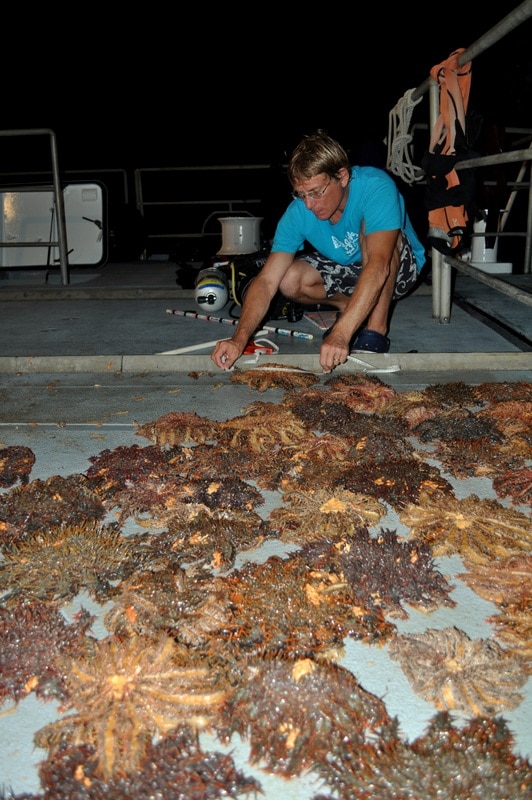
We measured each of these (being careful of their spines) to get a sense of the age of the population. Many juveniles and small adults – possibly an indication we had caught the beginning of an outbreak. The damage to corals also extended over a limited area and was all fairly recent. We did not find many corals that have been dead for long (a few months to years) – most were either white or covered in fine green algae and cyanobacteria. What was most interesting is that their distribution was opposite of what we’d seen in French Polynesia and the Cook Islands. The deep reef was still intact. Most of the killer starfish were found at the edge of the reef crest in 3-8 m depth, and only a few had begun to move deeper (10-15 m depth).
Photos/Images by: 1-5 Andrew Bruckner; 6-7 Amy Heemsoth
To follow along and see more photos, please visit us on Facebook!