search-icon
Lagoon Reefs of Fakarava

We have had many interesting dives within the lagoons around the Tuamotu Archipelago, but the Fakarava lagoonal habitats have been the most unique. There are thousands of small patch reefs that extend from the water’s surface to depths as great as 55 m.  Some of these lagoon reefs have an emergent island with vegetation, while others have a small emergent sand patch with some rubble and coral boulders, and others are totally submerged. Each type is unique in structure. In cases where the top of the submerged reef is 2-3 m below the surface, there is a community dominated by unusually large boulder-like Porites, some which can be over 15 m in width.  Porites corals are sometimes described as finger corals or massive corals.
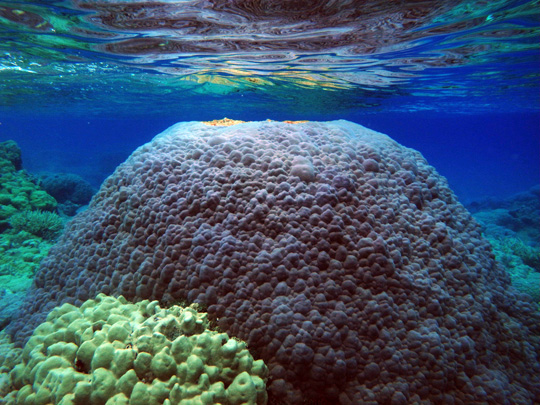
A Porites colony close to the surface with a dead top in lagoon reefs of Fakarava


As the Porites colonies grow up to sea level, the tops of the colonies are exposed during very low tides, and they die, and then become colonized by branching corals (Acropora, commonly called elkhorn, table, or staghorn corals, and Pocillopora, commonly called cauliflower or brush corals).
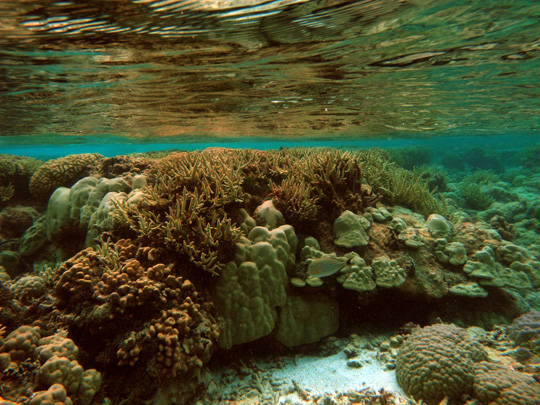
Porites in shallow water that has been colonized by branching corals


Over time, the Porites colonies continue to expand outward, towards deeper water, but the colonies in the center of these lagoon reefs die completely and are replaced by a branching coral community.  Eventually, the center resembles reef flats found on the atoll’s outer rim, with dense stands of small Acropora colonies, fields of large tree-like Acropora and an outer rind of Porites colonies. The surrounding slope is very steep, composed of sand, coral rubble and boulders that break off  from the rim of the reef flat.  The base of these structures is comprised of accumulations of old, dead coral colonies that rolled down the slope, and is covered by woven macroalgae, known as Microdictyon.
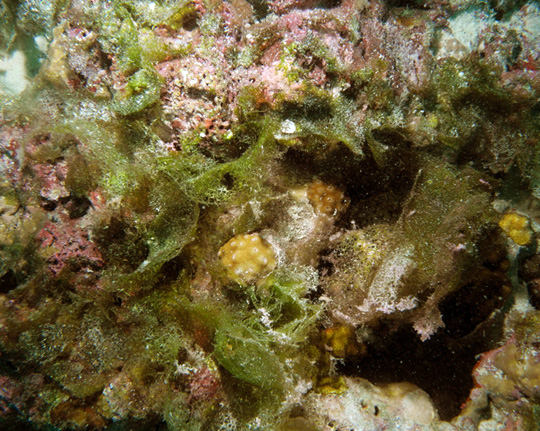
Microdictyon algae, crustose coralline algae and a small coral


The boulders of these lagoon reefs have very little coral growth, presumably because recruitment is inhibited by steep slopes and debris covering the slope. The water is also much more turbid in the lagoon reefs than outer reefs at the same depth due to the high photosynthesis of the benthic communities and the poor flushing of the atoll. There is, however, often a dense aggregation of finely branched, tall and spindly Acropora colonies that can survive in this environment because the wave exposure is so low and the colonies are too tall to be buried by sediments.
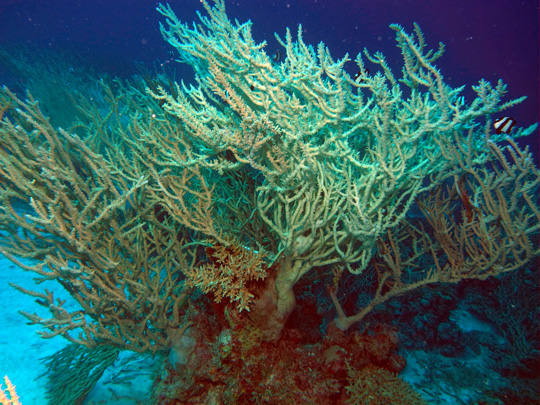
Delicate, upright, branching "spindly" Acropora colonies at the base of a lagoonal patch reef
Delicate, upright, branching “spindly” Acropora colonies at the base of a lagoonal patch reef

(Photos by: Dr. Andy Bruckner)

If you liked this blog, you might also like: Lagoon Life from our Colombia mission.
Related Posts

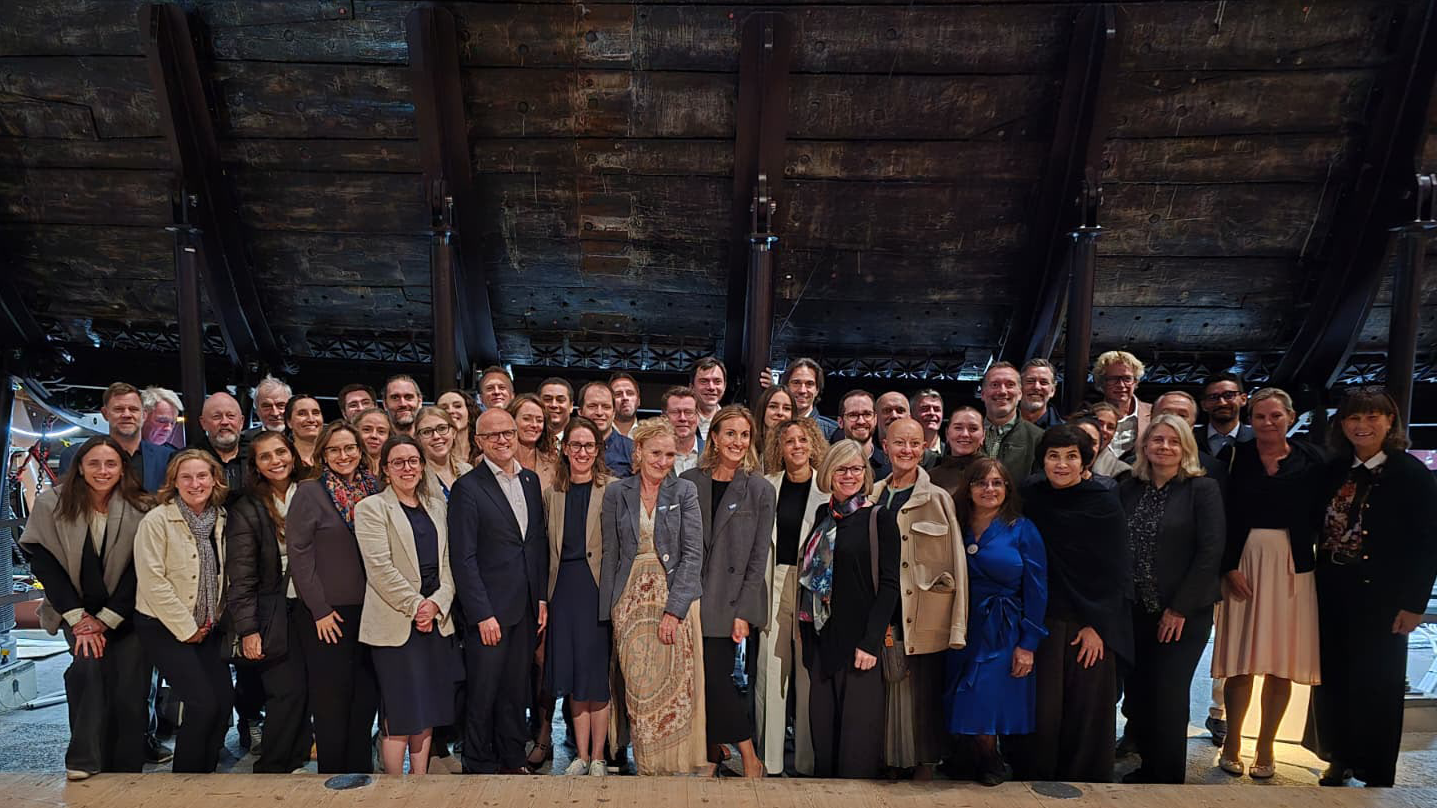
From Dialogue to Action: Ocean Foundations Gather in Stockholm

What can philanthropy accomplish when foundations working across ocean science, conservation, and sustainable development come together around a shared purpose?

That question was at the heart of the 6th UN Ocean Decade Foundations Dialogue, held September 7–9 in Stockholm, Sweden. The Khaled bin Sultan Living Oceans Foundation joined philanthropic organizations from around the world for three days of discussion, collaboration, and planning focused on accelerating progress during the second half of the UN Decade of Ocean Science for Sustainable Development.

Facilitated by UNESCO’s Intergovernmental Oceanographic Commission (IOC), the UN Ocean Decade Foundations Dialogue is a growing network of more than 30 philanthropic organizations committed to advancing ocean science, collaboration, and action. Since its creation within the framework of the Ocean Decade, the Dialogue has provided foundations with a space to exchange ideas, develop partnerships, and explore how philanthropy can help advance a healthy and resilient ocean.

Hosted by the Voice of the Ocean Foundation (VOTO), this year’s gathering began with From Depth to Action, an Opening Forum that brought nearly 100 leaders from the Swedish and international ocean community together at…

Read More

Meet IFAN: Helping Bring Navigate with Care to the Next Generation

If you’ve ever seen a lighthouse flashing from the shore or a brightly colored buoy bobbing in the water, you’ve seen Aids to Navigation at work.

Aids to Navigation, often called AtoNs, help mariners navigate safely. They can mark channels, warn of hazards, help vessels determine their position, and provide other information people need to make safe decisions on the water. Around the world, these systems help guide everything from small recreational boats to large commercial or container ships. 

But safe navigation isn’t only about protecting vessels and the people aboard them. The choices mariners make can also affect the animals and ecosystems beneath and around them.

That connection between maritime safety and ocean conservation is at the heart of this year’s Science Without Borders® Challenge—and of our partnership with this year’s theme sponsor, the International Foundation for Aids to Navigation (IFAN).

Read More
Privacy Overview

This website uses cookies so that we can provide you with the best user experience possible. Cookie information is stored in your browser and performs functions such as recognising you when you return to our website and helping our team to understand which sections of the website you find most interesting and useful.  You can view our complete Privacy Policy here.

Strictly Necessary Cookies

Most of our cookies are used to improve website security and reduce spam. These cookies should be enabled at all times. They also enable us to save your preferences for cookie settings.

3rd Party Cookies

This website uses Google Analytics to collect anonymous information such as the number of visitors to the site, and the most popular pages. Keeping this cookie enabled helps us to improve our website.