With the help of our partners FRIENDS of the Environment in the Bahamas and the University of the West Indies Discovery Bay Marine Lab in Jamaica, we have successfully completed the third year of J.A.M.I.N. and second year of B.A.M. Mangrove Education and Restoration Programs.
Looking back on the past year, we have made great strides to advance and strengthen our programs. For one, we have partnered with several new organizations to bring new and exciting opportunities to students and teachers in our programs.
In Jamaica, we partnered with Seville Heritage Park to provide mangrove education and restoration programs to high school students at Marcus Garvey Technical School in St. Ann’s Bay. Students were taken on field trips to Seville Heritage Park to learn about and restore this mangrove ecosystem. Marcus Garvey Technical School is another new addition. Grade 10 Biology students just completed their first year of the J.A.M.I.N. program. Congratulations Marcus Garvey students!
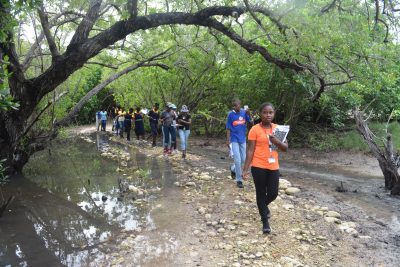
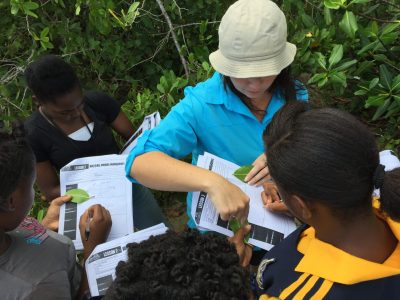
Students from Marcus Garvey Technical School on J.A.M.I.N. field trip at Seville Heritage Park
In the Bahamas and Jamaica, we partnered with (NCSU) to bring current mangrove science to the classroom. Students in the year 2 programs participated in ongoing mangrove research being conducted by NCSU PhD Candidate, Ryann Rossi. As part of her research, Ryann is looking at the cause of the die-off of mangroves in The Bahamas. She suspects that the die-off is due to a type of mangrove fungal disease.
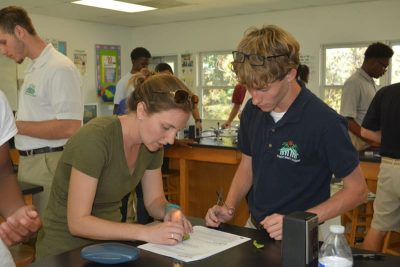
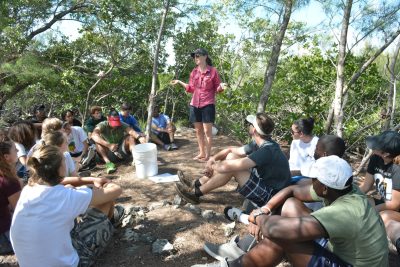
Ryann Rossi, PhD Candidate at North Carolina State University teaches students in the B.A.M. program about mangrove disease.
While monitoring their mangroves, students collected potentially diseased leaves from inside their plots. Later in the lab, students grew the diseased leaf pieces on an agar plate to determine whether or not the same disease existed on the mangroves in their plots. Students found the same disease causing fungus in their plots. All the data that the students collected was reported online to Ryann, contributing to her research.
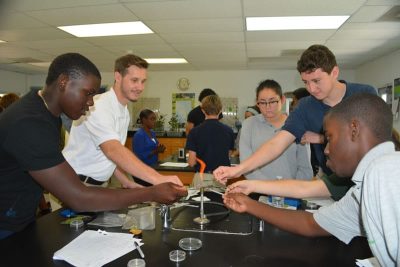
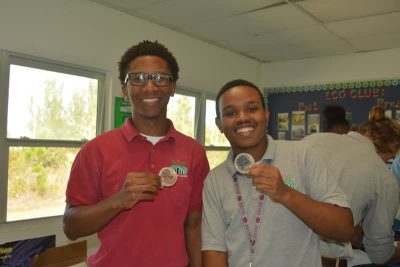
Students at Forest Heights Academy prepare their leaf samples and place them in agar plates.
Another great accomplishment from this past year is the expansion of the B.A.M. and J.A.M.I.N. programs from a one-year program into a two-year program. During the first year, grade 10 Biology students learn about and restore mangroves through project-based learning. For students who pass their exams and coursework, they advance to grade 11 Biology and continue in the second year program. Students in this program apply the knowledge that they learned in the previous year to implement more advanced skills that will aid them in monitoring and managing mangroves.
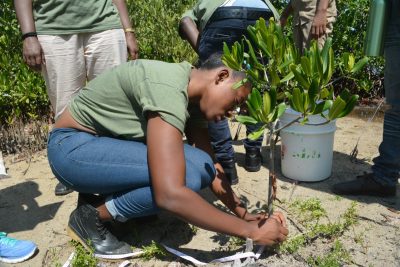
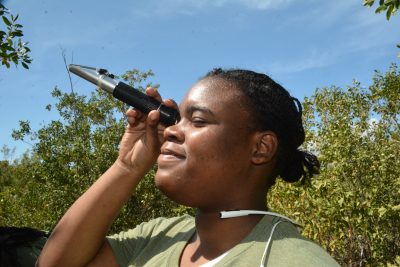
J.A.M.I.N. Year 2 students from William Knibb High School use scientific tools to monitor the mangroves.
Overall, we have added new partners to our programs, adding the ability to participate in current science and new opportunities for our partner schools. We have also successfully piloted a new second year program. Although there is still much work ahead, I couldn’t ask for a better way to conclude our programs for this school year.
I would like to say a special thanks to all of the teachers who participated in our Mangrove Education & Restoration programs (Michelle Bailey, Lindsey Borsz, Andrea Dunn, Collette McKenzie, Kayshan Moss, Fulvia Nugent, and James Richard). You all have busy schedules and yet you still take the time to bring new opportunities to your students. I thank you for your dedication.