search-icon
Stringing it Together

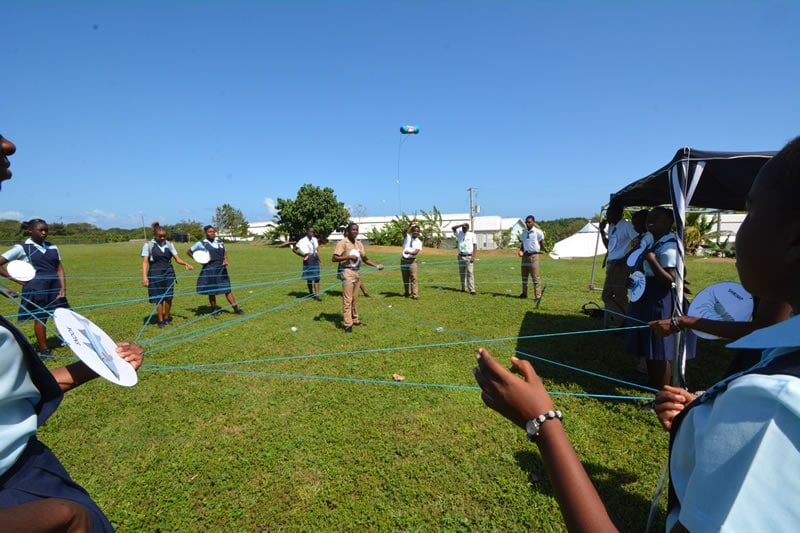
Today, we returned to Holland High School to continue instructing students about the mangrove food web. We took students outside to participate in a hands-on food web activity. Each student received a different mangrove organism that they were to represent. I instructed them to stand in a circle facing each other wearing their organism card around their head.

I asked students, “Where does energy from a food chain usually begin?”

The students responded, “The sun!”
mangrove food web activity at Jamaican mangrove project 1
Students throwing a ball of yarn, which represents energy being passed along to the organism that eats it.

I asked the student that represented the sun to stand in the middle of the circle. Then I asked, “Which organisms receive energy from the sun? Please raise your hands.” Several students raised their hands.

I instructed, “Okay, so the sun is going to hold the end of the string in one hand and throw the ball of yarn with the other. Sun you may pass your energy along to one of the organisms that raised their hand.” The sun passed the ball of yarn (energy) to the seagrass.
mangrove food web activity at Jamaican mangrove project 2
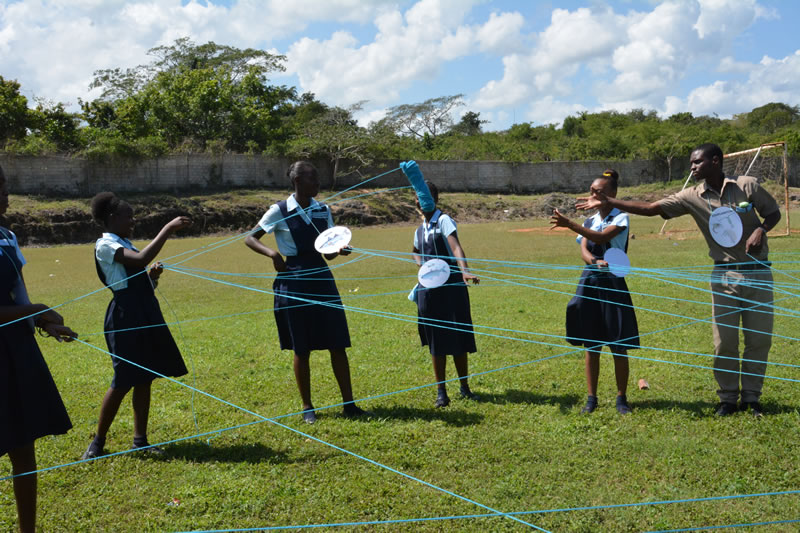
Student throwing the ball of yarn to another student.

Going through the same steps, the seagrass passed the yarn to the sea urchin, which then passed it to the lobster, to the snook, to the heron, and finally to the crocodile. I asked students, “Does anything eat the crocodile?“

A clever student responded, “Humans miss.”

I said, “Very good answer. Yes, humans do eat crocodiles. Are humans a part of the food web?”

In unison they answered, “Yes!”

Then I asked, “What did you just create?”

Several students replied, “A food chain!”

I coached, “Let’s continue to create another food chain. Since this one is finished, where does the food chain begin again?”

The students responded, “The sun!”
mangrove food web activity at Jamaican mangrove project 3
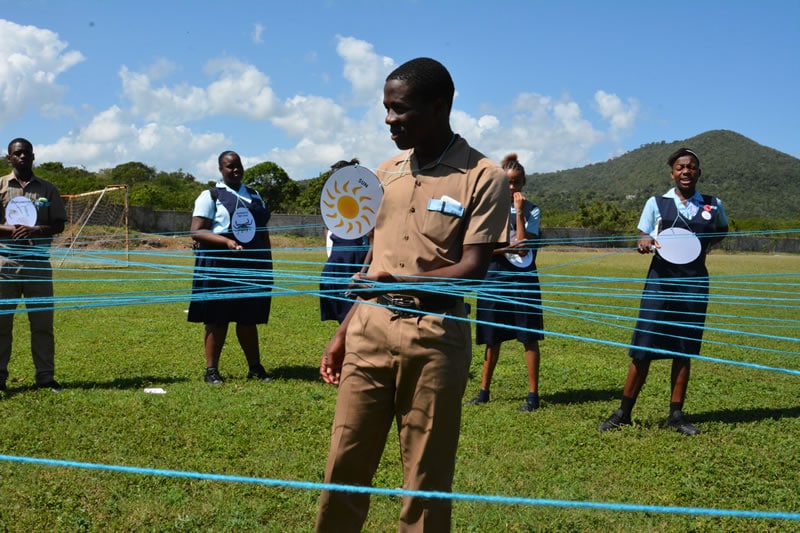
The sun getting tangled in the web surrounding him.

The students continued to pass the ball of yarn until each student was holding at least one piece of it. Then I asked them, “What did you create?”

They returned, “A food web!”
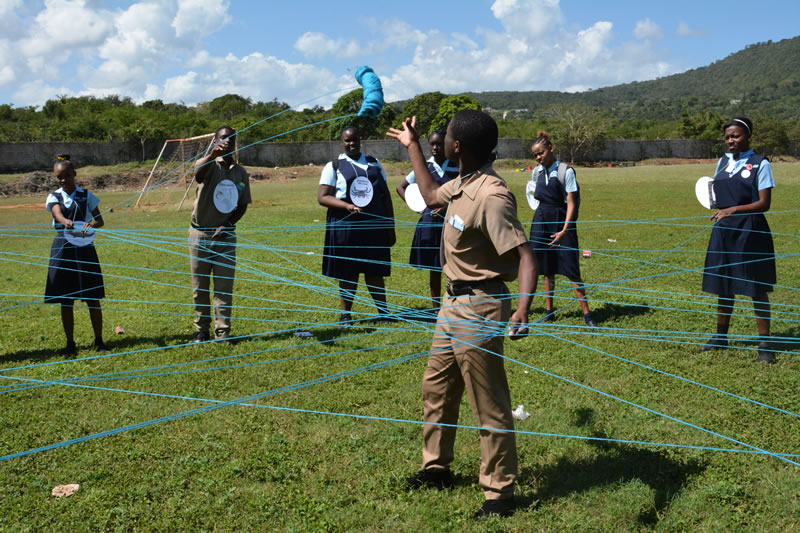
mangrove food web activity at JAMIN - Jamaican mangrove project
The food web is becoming more complex.

We continued to discuss different “what if” scenarios in relation to the food web. “What if we added an invasive species? What if we overfished snapper? What if an oil spill occurred?”

By the end of the activity, the students had a good idea of the interactions of the mangrove food web, how it can be disrupted, and the important role that humans play in it.
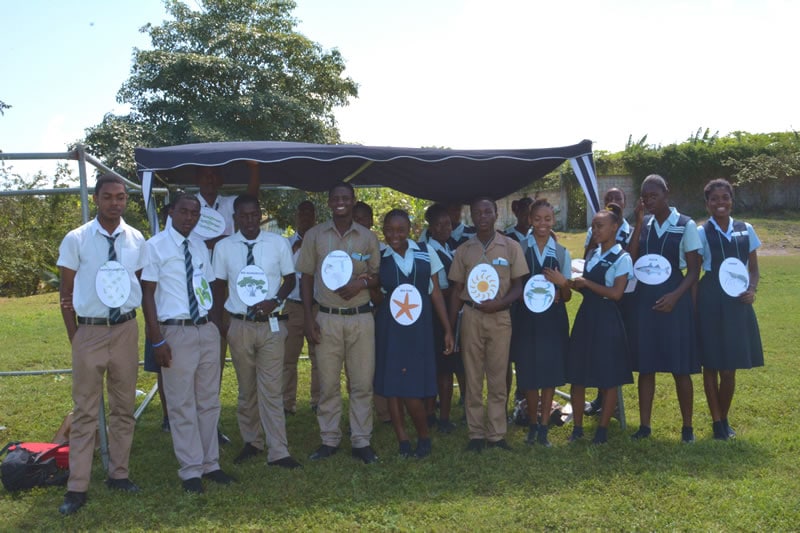
Jamaican high school students posing with organism cards for food web activity at Jamaican mangrove project
Holland High School students posing with organism cards.

Next month, we will conclude the J.A.M.I.N. project for the 2014-2015 school year. During this final phase, the students will plant the mangroves that they have been growing all year at the restoration site. At the same time, they will conduct a mangrove cleanup. Stay tuned for more news on the J.A.M.I.N. project. Until then, keep on J.A.M.I.N.!


Photos by Amy Heemsoth.
Related Posts

Introducing Our New Website: A Fresh Look for the Foundation’s Future

As we celebrate the Khaled bin Sultan Living Oceans Foundation’s 25th anniversary, we are proud to unveil our newly redesigned website—a modern home for our science, conservation work, and educational programs. This launch marks an important moment for the Foundation as we honor our long history and look toward the future of ocean conservation.

For more than two decades, the Foundation has worked tirelessly to improve the health of our living oceans. We have advanced ocean science, led one of the largest coral reef research missions in history, restored mangrove forests with local communities, created award-winning education programs, and shared the wonders of the ocean with people around the world. Our new website reflects the organization we are today—focused on conserving coral reefs, restoring mangrove forests, and improving ocean literacy—while still highlighting the legacy of work that brought us here.

The redesigned site…

Read More

Connecting People, Art, and Oceans: Championing Conservation at the 2025 IUCN Congress

The IUCN World Conservation Congress brings together thousands of leaders and decision-makers from governments, non-profit organizations, civil society, Indigenous groups, and the private sector to shape global conservation policy and action. This influential gathering serves as a platform to share knowledge, build partnerships, and advance initiatives that protect our planet’s biodiversity.

As a member of the International Union for Conservation of Nature (IUCN), the Khaled bin Sultan Living Oceans Foundation was honored to take part in the Congress, joining a global community of leaders, organizations, and changemakers committed to protecting nature and advancing sustainable futures.

Read More
Privacy Overview

This website uses cookies so that we can provide you with the best user experience possible. Cookie information is stored in your browser and performs functions such as recognising you when you return to our website and helping our team to understand which sections of the website you find most interesting and useful.  You can view our complete Privacy Policy here.

Strictly Necessary Cookies

Most of our cookies are used to improve website security and reduce spam. These cookies should be enabled at all times. They also enable us to save your preferences for cookie settings.

3rd Party Cookies

This website uses Google Analytics to collect anonymous information such as the number of visitors to the site, and the most popular pages. Keeping this cookie enabled helps us to improve our website.