Today was our first day back at William Knibb High School. I was eager to see the students and to hear updates about how they have been growing their mangroves propagules in the classroom. We (me and Camilo Trench, partner at the University of the West Indies Discovery Bay Marine Lab), walked down the airy hallways of the school, which are not enclosed and painted in purple, their school color. We were greeted by the friendly and familiar faces of the students that we taught last October. They waved and smiled at us as we walked past them carrying our equipment. They followed us into the classroom trying to figure out what was in the white buckets that we were carrying.
Our first objective was to teach students about food webs. Then we unveiled what was in the secretive white buckets. You see, we brought some special guests with us, including seaweed, seagrass, sea stars, sea urchins, anemones, sea cucumbers, turban snails, sponges, and crabs. We explained the organism’s classification based on common characteristics and how each of these organisms is connected in the mangrove food web.
Camilo Trench explains, “This animal is a sea urchin. It is part of the Phylum Echinodermata, which literally translates to ‘spiny skinned.’ Animals in this phylum have what are called tube feet, which help them to move and feed. If I would to allow the sea urchin to rest in my hand long enough, it’s tube feet would attach to my hand, acting like suction cups, which would put it along.”
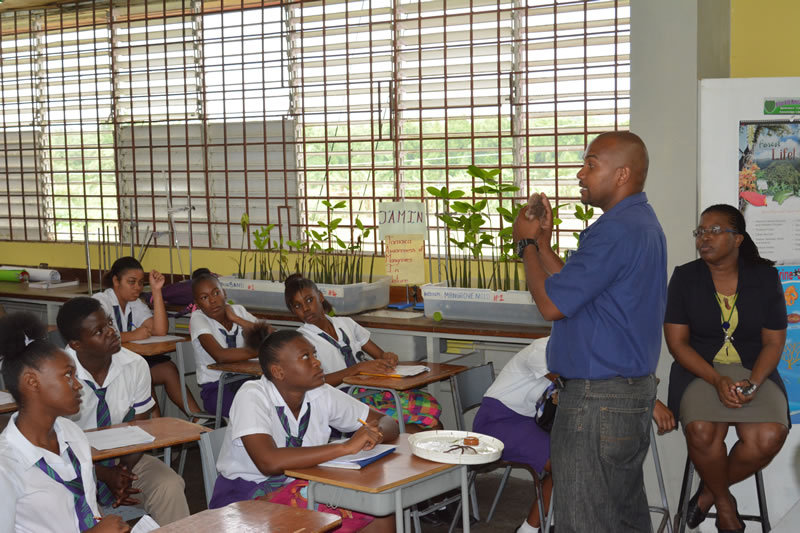
Camilo Trench teaching students about sea urchins.
Students were fascinated by the organisms, and for most, this was their first time seeing echinoderms in person. After we finished with the lecture, we allowed students to come up and gently touch the organisms. They craved more knowledge about them. We also got quite a crowd of students from other classes gathering outside our door trying to see all of the plants and animals that we brought with us.
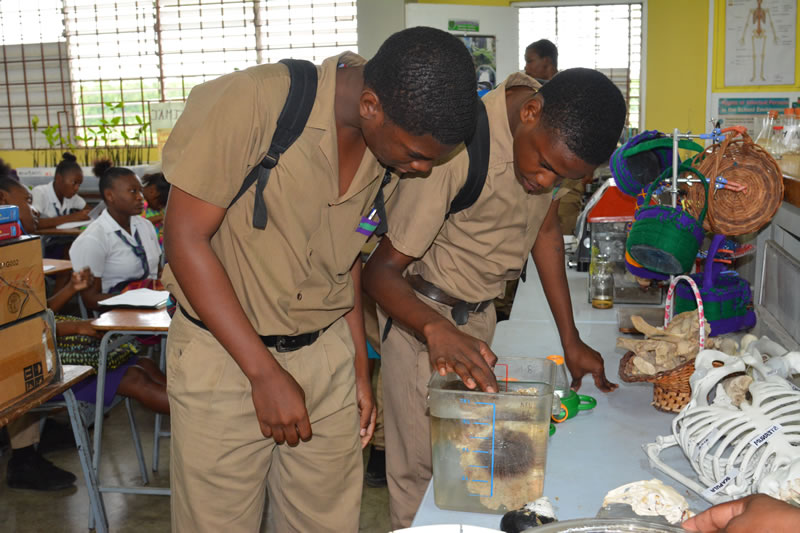
William Knibb students getting a closer look at some echinoderms; a sea urchin and an anemone.
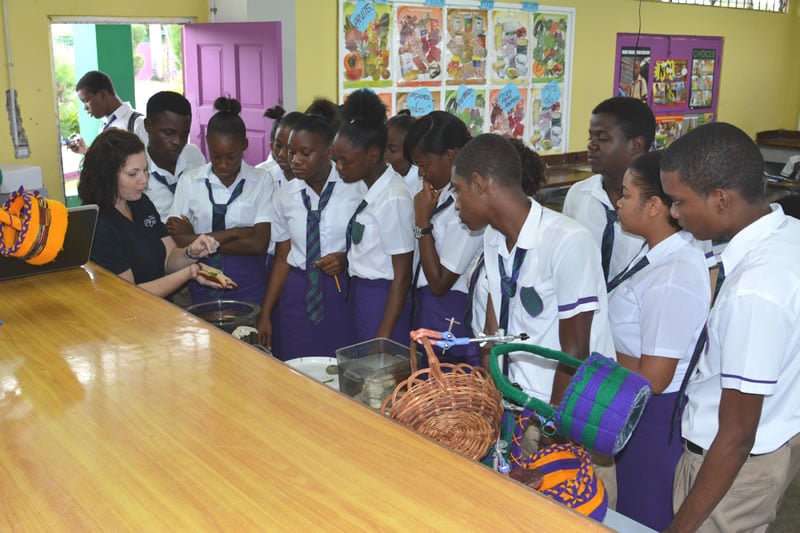
Students enthralled by additional facts about sea stars. Amy Heemsoth is teaching them about how sea stars have two stomachs.
Photos by Amy Heemsoth.