Mangrove Education and Restoration Program Blog
It is hard to believe that the first week of the Mangrove Education and Restoration program is complete. In partnership with FRIENDS, we have successfully implemented phase two of the B.A.M. program. Today, I arrived in Jamaica and now it is time to implement the second phase of J.A.M.I.N.
During this phase of the program, one of the first tasks that needs to be accomplished is collecting mangrove organisms for our show-and-tell session with the teachers and students. The ocean temperature is a little chilly this time of year, so I put on my wetsuit. After I put on my mask and fins, I’m ready to begin collecting critters. I sit on the cement ledge on the edge of Discovery Bay and plunge into the water. Burr! The icy water runs down my wetsuit and I surface to clear the salt water that enters my snorkel. It takes me a minute to get over the initial shock of the cold water. To warm up, I immediately start swimming around.
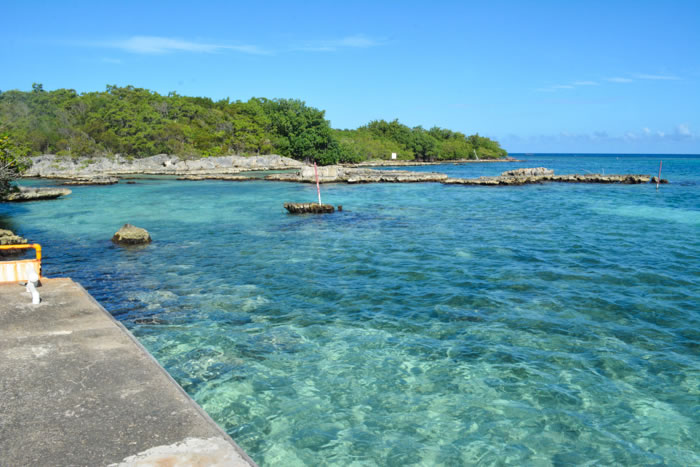
The area where I collect mangrove organisms at the Discovery Bay Marine Lab.
As my body heats up, I go back to the ledge to grab my collecting bucket. I add some salt water to it, so that I can immediately begin collecting organisms. I snorkel towards the tangled roots of the red mangrove trees that line the water’s edge. Shadows pass over me and it becomes darker and darker as I approach the roots of the trees. Initially, snorkeling here is a little spooky. I never know what could be hiding in the roots. Every once in a while, my wetsuit gets stuck on the root of the tree, which only adds to the eerie feeling of this underwater world.
As I begin to look around, it all starts to look familiar and the eerie feelings subside. There are sea stars attached the mangrove roots, so I snorkel over to them and gently remove them from the tree and add them to my bucket. I collect other animals attached to the roots including decorator crabs, sponges, snails, and an anemone. On the seafloor, just under the roots of the mangrove tree, I find brittle stars, sea slugs, sea urchins, tulip snails, and tunicates. Some of these animals are easier to find than others. For instance, to find the brittle stars, I have to flip over rocks where they are hiding.
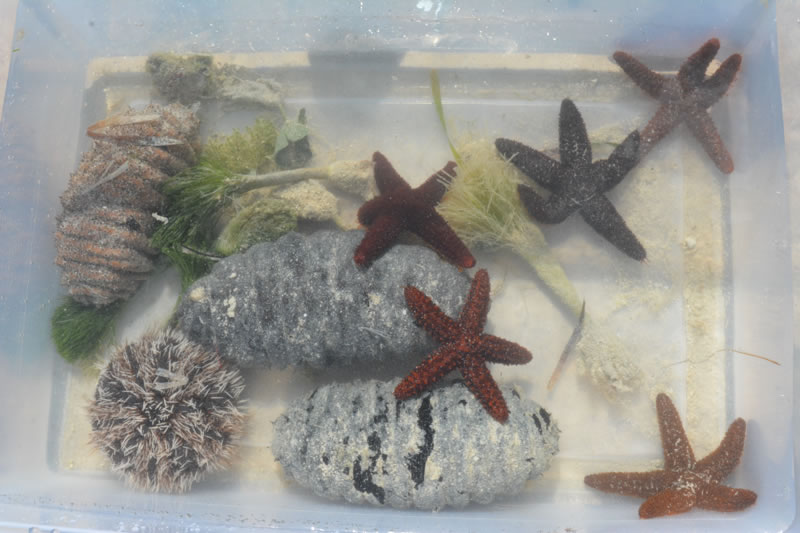
Sea stars, sea urchins, sea cucumbers, and macroalgae.
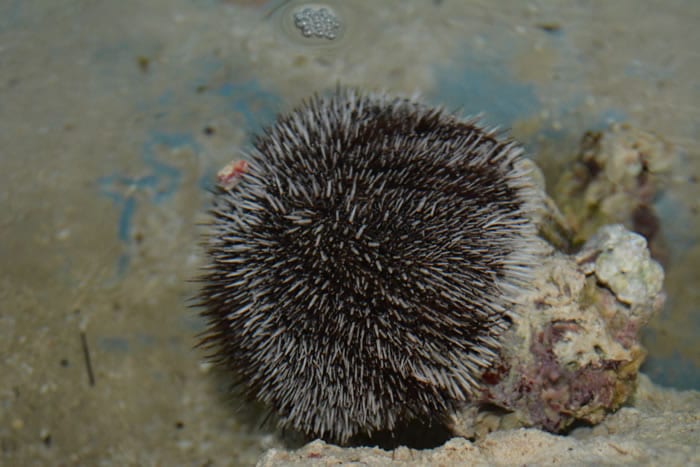
A sea urchin.
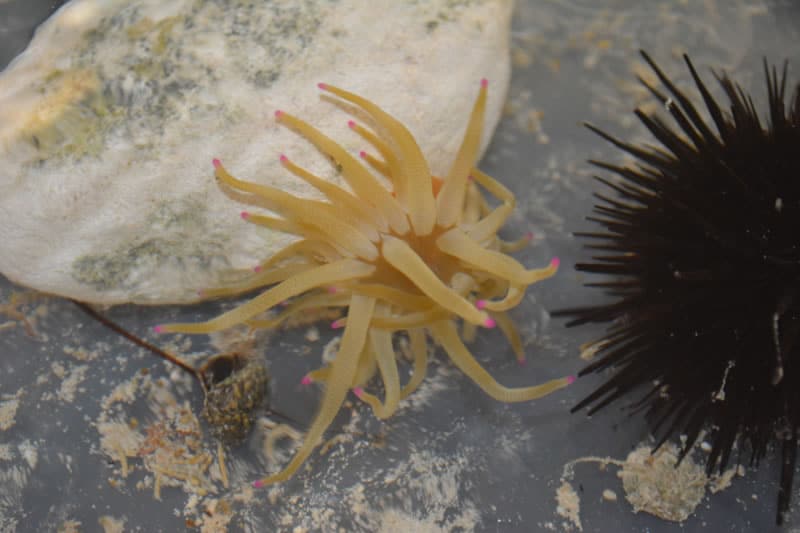
Sea anemone (left) and Sea urchin (right).
Although I’m not collecting fish in Jamaica, there are plenty of them. They hide in the roots of the mangroves weaving in and out of them as they swim around. Some of them are adults, but many are small juveniles. The mangroves provide a nursery ground for many species of fish, so it’s not surprising when I see lots of small fish.
The mangroves and seagrass beds intersect one another, so I collect other animals that can often be found in these two adjoining ecosystems, including upsidedown jellyfish, seagrass, macroalgae (seaweeds), and sea cucumbers. I cautiously pick up the upsidedown jellyfish, but I still get stung in a couple of places on my hand.
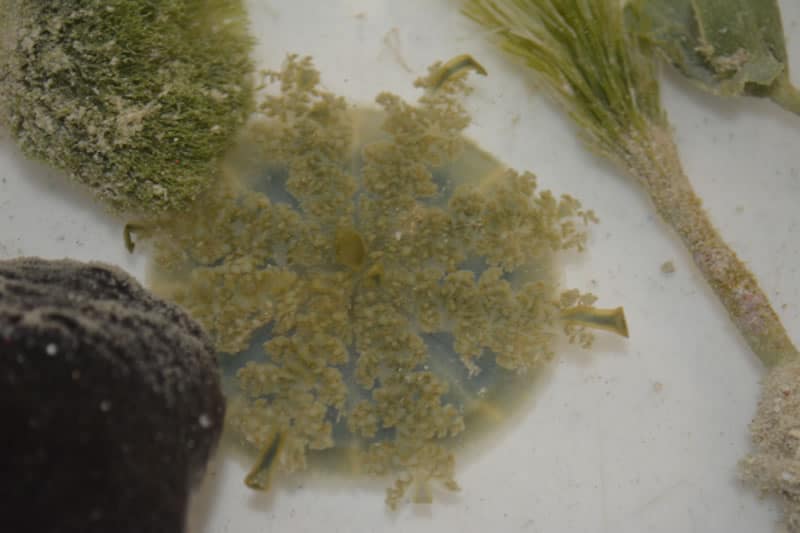
Upsidedown jellyfish (circular).
I don’t want to lose any of the mangrove organisms that I collected, so I carefully tilt the bucket to take note of everything. I decide that it is a good representation of animals that I want to showcase during this week’s mangrove food web activities. I slowly snorkel back to the cement ledge with my collecting bucket. After a towel off, I take the organisms to the wet lab, where I will place them in different holding tanks that are being cycled with salt water directly from the ocean. I separate the animals based on the following factors 1) animals that might harm each other, 2) animals that might eat other animals, and 3) animals that might hide in/on other animals.
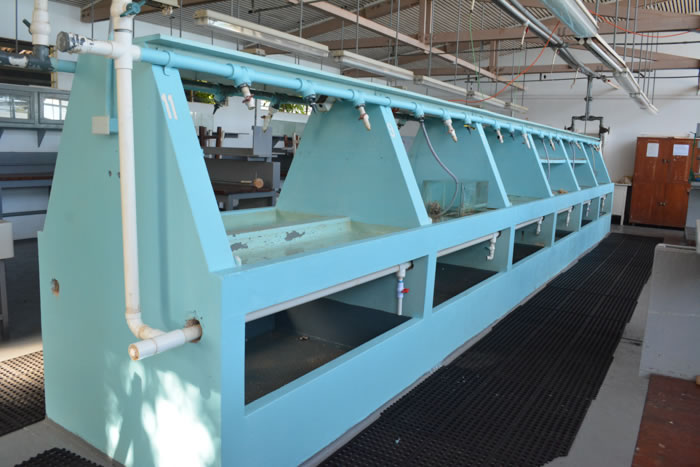
We keep the mangrove organisms in the Wet Lab at Discovery Bay Marine Lab.
Now, I’m ready to go to go to the schools to show these fantastic mangrove organisms to the teachers and students and explain how to classify them and describe how they fit into the mangrove food web.
Check out of photo gallery below to see our show-and-tell sessions with the different schools and professional development training with the teachers:
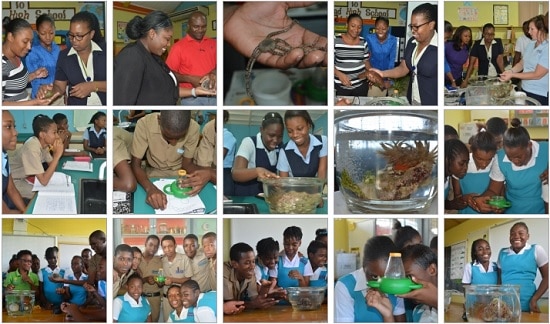
Photos by Amy Heemsoth