Happily, some minds were in fact blown on today’s first dive. The groundtruthing team had promised they found an incredible reef and they did not lie.
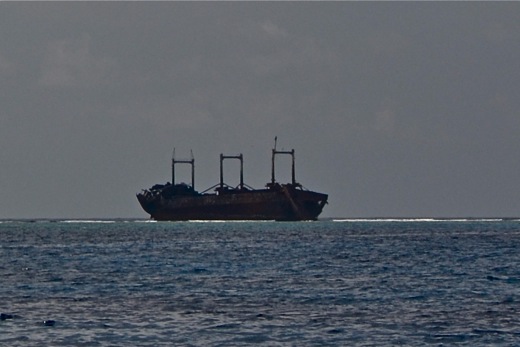
We were on the farthest side of the bank from where the Golden Shadow is anchored, the more eastern of two main lagoons. From where we hit the water we had our best view yet of a rusty old cargo ship that ran aground here sometime in the 1990s.
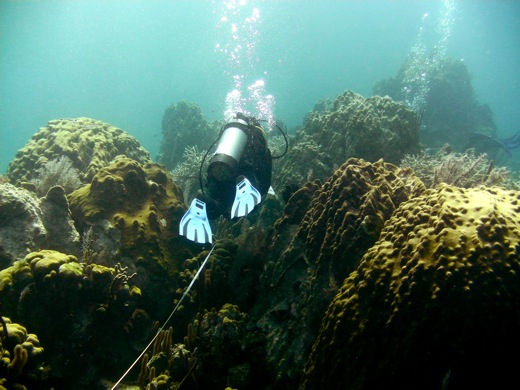
On the bottom we found a classic reef rising up from a sandy bottom about 12 meters down almost to the surface. We kicked past mound after mound of large star coral colonies. The fish were plentiful and of more species than any but the fish experts among us could count.
There weren’t any standout visitors like we have sometimes–No turtles or dolphins dropping in, no big grouper cruising through. Instead, we enjoyed a more constant awe at the reef itself, which was just striking for as far as you could swim. Still, we found far more disease than normal.
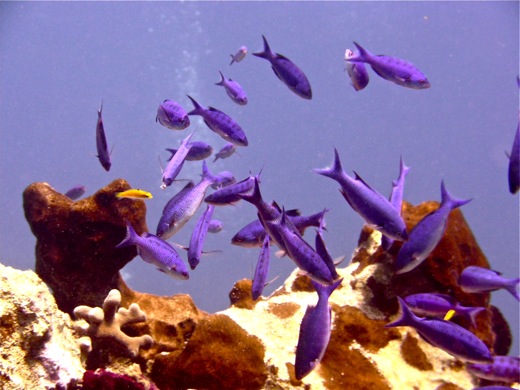
Toward the end of the dive, most of us were congregating at the shallower portion of the reef. Those who had finished their work were enjoying a few minutes of scenery. There was more broken coral rubble at the wave-swept crest, but still fish everywhere, like a big school of bright blue creole wrasses.
The next dive wasn’t much farther away—a kilometer or so closer to the hulk of that rusty ship. Yet the scene we found was completely different. There was less reef structure, and there were fewer fish.
Everything is relative. If we were diving somewhere else, or if we hadn’t just been to such a standout spot, it might have looked more attractive. But under the circumstances, it was a bit of a letdown. This site had more disease than the first and it all seemed to be quite recent. At the day’s third and final dive spot, we found yet more diseased corals, some of it recent, some older.
Why would reefs in such seemingly similar conditions have such strikingly different health levels? We really don’t know. Again, this is an area researchers are still trying to figure out.
All these reefs seem to be reeling to various degrees from a relatively recent bleaching event—where unusually warm temperatures weaken corals by causing them to expel the algae that provide most of their food. And water in semi-confined lagoons tends to get warmer than open water. In a weakened state, corals are more susceptible to disease. So, the disease pattern we’ve found could be tied to the way that water circulates through the lagoon. But again, we really can’t say yet.
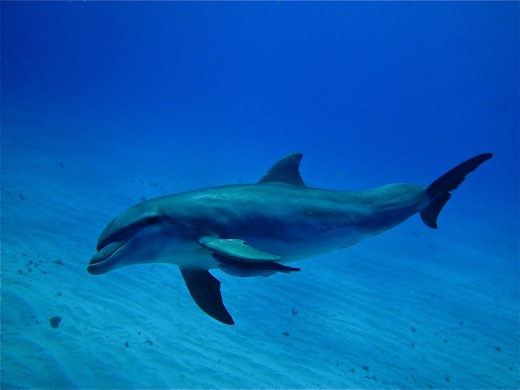
The conch team, working out on some sandy flats, had their most unbelievable dolphin encounter of the trip. This time the dolphins didn’t just make a couple of passes to see what was going on. They hung around for about 10 minutes, as if they might have enjoyed the strangers’ company. They swam close to our divers at times, and at others, they just hung unmoving in the water. It was truly amazing to see—and we all got to, because the team brought in some incredible video. We’ll be posting that footage later and will be sure to put a note on Facebook.
Tomorrow is our last day out. We’ll be doing two dives in the morning, then pulling anchor in the afternoon to head north for Jamaica. So look for one final update soon on what we find, and some final thoughts on what we’ve learned so far in the San Andrés Archipelago.
(Photos: 1-3 Mark Schrope; 4 Felipe Cabeza)
To follow along and see more photos, please visit us on Facebook! You can also follow the expedition on our Global Reef Expedition page, where there is more information about our research and team members.