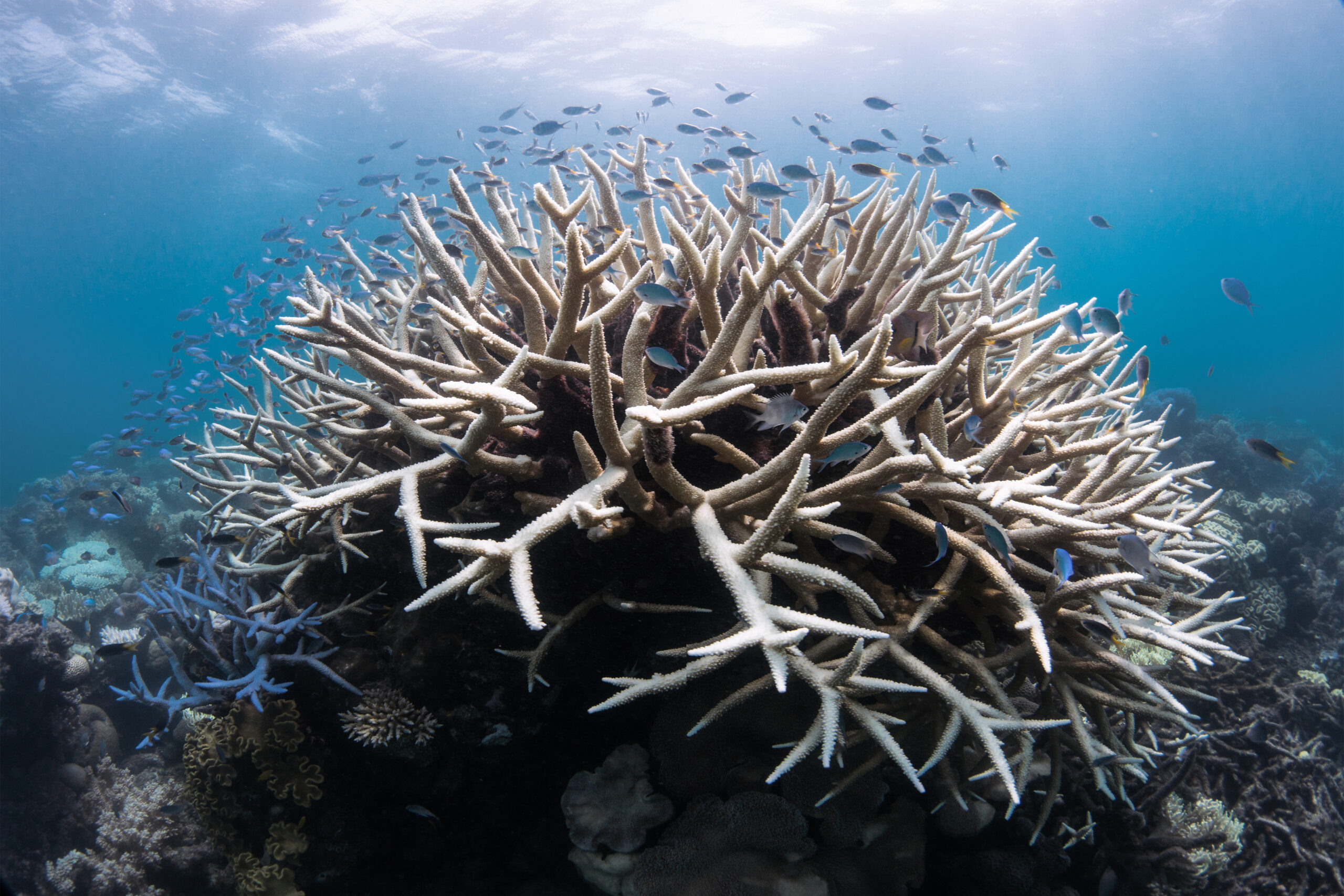
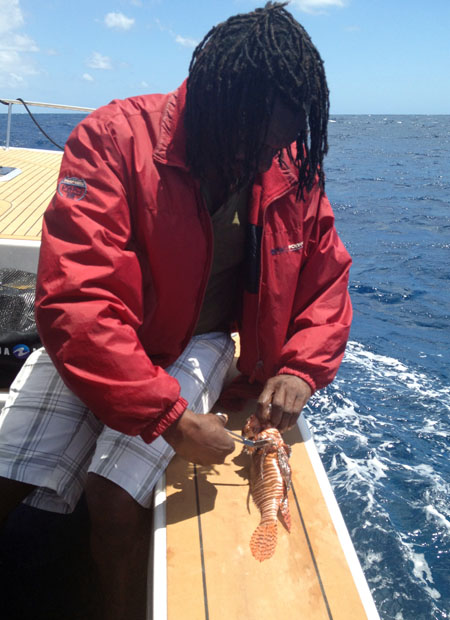
The first day of spring was the last day of diving for the Pedro Bank mission. Winston “Shucksman” Kerr, a local fisherman, guided us to two sites within sight of the Golden Shadow. No nurse sharks today, but lots of coral, and two reef sharks appeared on the second dive. Nathalie Zenny speared a lionfish, which Winston neatly trimmed of its spines on board the Calcutta.
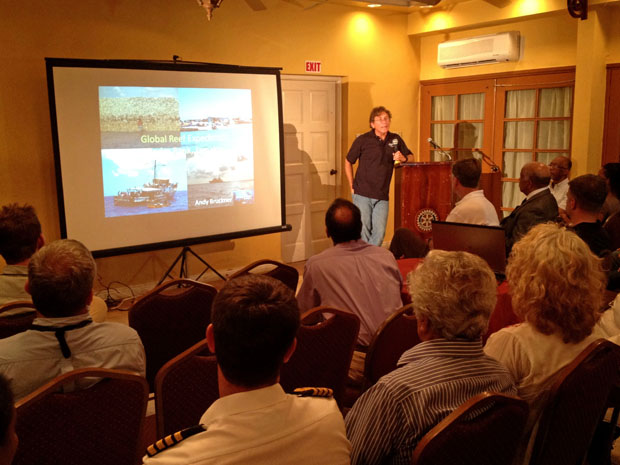
The afternoon was a flurry of activity. Nathalie, Llewellyn, Andy Bruckner and a few others went to Middle Cay for a community meeting to explain the mission of the Global Reef Expedition and the Living Oceans Foundation and discuss all things reef-related.
The reception was positive and the discussion that followed, on everything from fishing regulations to the fact that all parrotfish begin life as females (really!), was animated and productive, with plenty of good questions from the audience. Overall, the community seemed supportive of the idea of the fishing sanctuary around Southwest Cay. Healthy reefs (and the fish they hold) are clearly in everyone’s best interests. The question, now, is how to keep them that way, and if they’re not, how to help them recover?
Meanwhile, Phil, Brian and Nick recovered the current meter without incident, and the crew kept busy retrieving the various support boats we’ve been using. The Twin Vee and RHIB (rigid-hull inflatable boat) tender came aboard by winch, but getting the Calcutta onto the aft deck required the use of the Golden Shadow’s unusual stern elevator. Not many ships boast a submersible platform that can lift 12 tons – then again, not many ships have to launch and recover the largest single engine floatplane in the world. (The Golden Eye is in Florida at the moment.)
The anchor came up around 8 p.m., and as the sounds of guitars, singing and laughter filled the staff mess, the Golden Shadow motored all night to arrive in Kingston harbor, the seventh largest harbor in the world, at 7 a.m. on Tuesday. At a reception that evening at Morgan’s Harbour Hotel & Marina, Andy Bruckner summarized the mission’s findings for local media and officials, including Robert Pickersgill, Minister of Land, Water, Environment and Climate Change.
In general, Andy said, the corals on the bank seemed to be doing fairly well. Divers logged 36 different species, and signs of disease were relatively rare. We saw lots of large star coral colonies on almost every dive, many unblemished by the white plague that has hit the rest of the region. Elkhorn and staghorn corals, the other two coral species that traditionally dominated Caribbean reefs, weren’t as widespread, but we did find a few large living colonies of both.
On the other hand, while there was a high diversity of reef fish species, entire groups were absent, including large grouper, snapper and parrotfish. Barracuda were also ominously rare, along with butterflyfish and large schools of blue tang (surgeonfish). An interesting side note is that even with large herbivorous species in short supply, we found less fleshy seaweeds (macroalgae) compared to most other places in the Caribbean.
After the presentation, everyone said their goodbyes – some for good, some just until the next mission to Navassa Island, between Jamaica and Haiti. After that the Golden Shadow will head southwest to San Andrés Island, technically part of Colombia but closer to Nicaragua, before it transits the Panama Canal on its way to the Galápagos Islands. Stay tuned for more!
(Photos/Images by: 1-3 Julian Smith)
To follow along and see more photos, please visit us on Facebook! You can also follow the expedition on our Global Reef Expedition page, where there is more information about our research and team members.