Mangrove Education and Restoration Program Blog
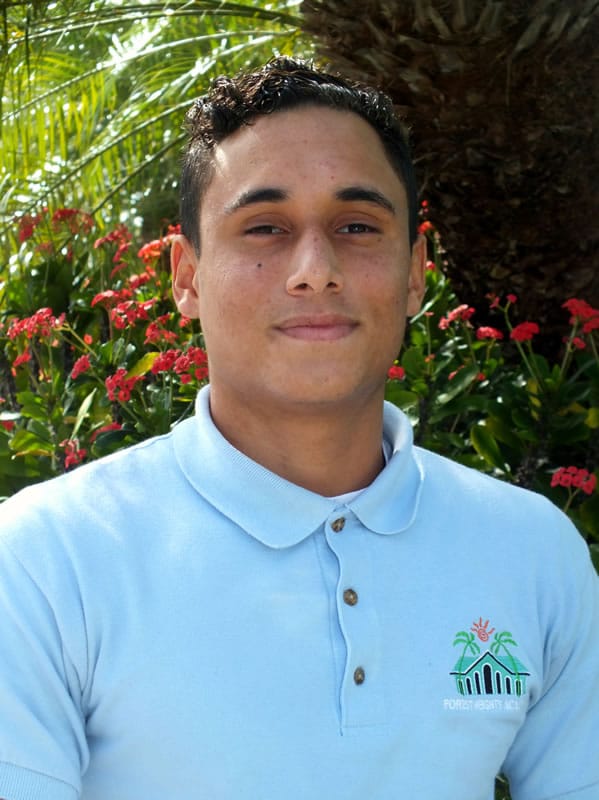
A guest blog by Donte James Richard, a high school student in The Bahamas, who is participating in the Foundation’s Bahamas Awareness of Mangroves (B.A.M.) program.
I am an eleventh grade student at Forest Heights Academy. This is the first year my eleventh grade class has participated in marine science, and at first I was unsure if I had made the right decision choosing marine science as my elective. This project swept away any indecisive thoughts I had. When we began our science experiments growing mangrove propagules in different substrates–sand, mud and pebbles–I was skeptical as to how it would turn out. The project itself seemed easy to complete, however with several different substrates and multiple students working on it was certainly an unusual project. At first having so many different personalities working on the project was trying, but it soon become one of the best collaborations my classmates and I have seen in a long time. I would definitely say that the project was well worth the time we spent recording and measuring the growth of our mangrove trees.
My favorite part of the mangrove experiment was having my hypothesis disproven. My original thought was that “If the different mangroves are grown under the same conditions in different substrates, then the mangroves grown in the muddy soil substrate would grow better than the mangroves grown in the other substrates.” I was completely wrong in my assumption. The mangroves grew better in some cases inside the sandy and rocky substrates. This opened my eyes to just how adamant and strong these trees are and how well suited to they are to this island geography.
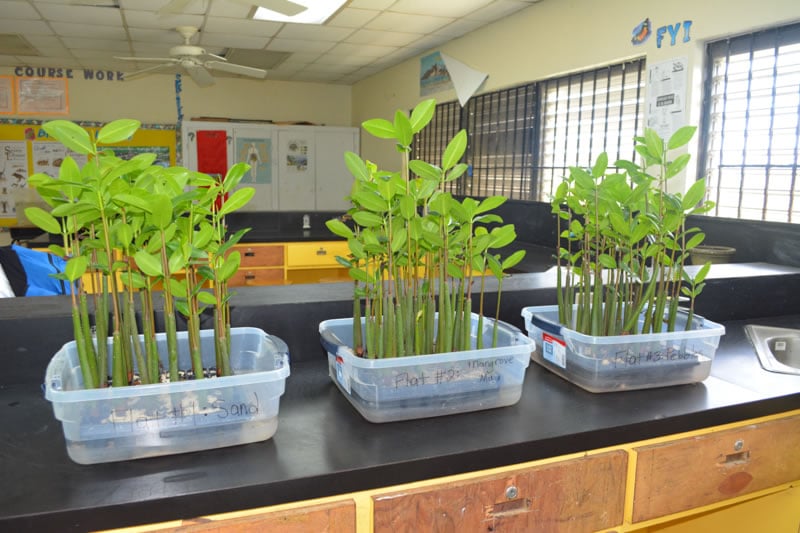
My mangrove experiment.
I thoroughly enjoyed measuring and recording the results of “my mangroves.” My classmates and I would have mini-competitions to see whose mangrove had the most leaves and had grown the largest. This not only gave us an initiative to care for the plants, but it also showed us a new respect for our seedlings. Seeing how long it is taking for our mangroves to grow truly scares me for the future of our mangrove ecosystems. If we continue to pollute and deforest these natural nurseries we may lose an essential part of our Island make-up.
Overall I feel that this project was a total success. I am grateful to the Khaled bin Sultan Living Oceans Foundation for not only allowing my class to participate in this experience but also being involved in the project and not just “leaving us to it.” I personally cannot decide if my favorite part of the project was classroom recordings or the fieldwork. While thoroughly enjoying the experience in the field where we collected our own propagules and traversed through the mud, I had a splendid time examining my seedlings and seeing how they grow. After participating in this project I hope my school and many others have opportunities to do projects like this for years to come.