Mangrove Education and Restoration Program Blog
As I quietly walk through the mangrove forest, all around me I observe an ecosystem teaming with life. I hear the shuffling of fiddler crabs as they scurry back to their holes in the ground, I smell rotten eggs (sulfuric acid), and I view the light filtering through the leaves of the mangrove trees. I think to myself, “How do I inspire students to become stewards of this serene and important mangrove ecosystem?” I think back to my most influential educational experiences and the most impactful ones were when I felt like I was making a difference. That is what I wanted to bestow on our youth, a sense of ownership and stewardship over the mangroves for years to come.
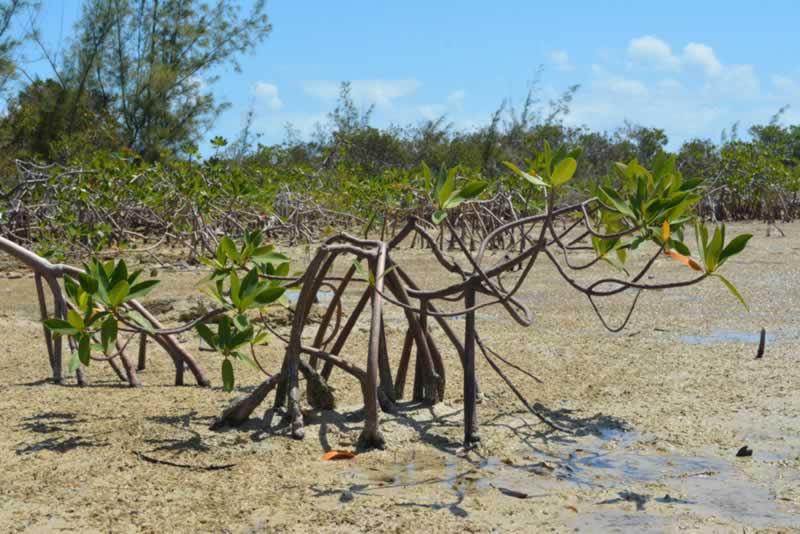
A mangrove on the edge of the forest.
I’m here in Jamaica implementing the final installment of our Mangrove Education and Restoration Program called the Jamaica Awareness of Mangroves in Nature or J.A.M.I.N. and the students are bubbling over with excitement.
In 2014, the Khaled bin Sultan Living Oceans Foundation developed a Mangrove Education and Restoration Program focused on providing an immersive, yearlong experiential education experience. After a successful pilot of the J.A.M.I.N. program, this year we implemented a program in Abaco, Bahamas named the Bahamas Awareness of Mangroves or B.A.M. We work with the University of the West Indies Discovery Bay Marine Lab in Jamaica and Friends of the Environment in the Bahamas to establish and implement these programs in secondary schools.
Each program is implemented in three installments and includes opportunities for professional development for teachers, and program evaluation and development. The core of the program takes place over eight months when students grow mangrove propagules in their classroom. This part of the program is executed using project-based learning, a teaching method, which allows students to explore real-world problems and acquire deeper knowledge over extended periods of time. Using this classroom approach, students will gain the knowledge and skills necessary to investigate the question at hand: Which type of media do mangrove propagules grow best in?
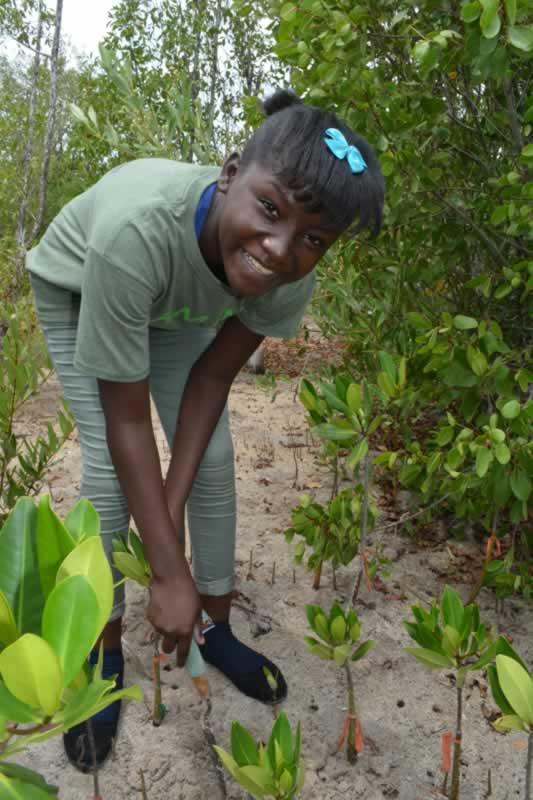
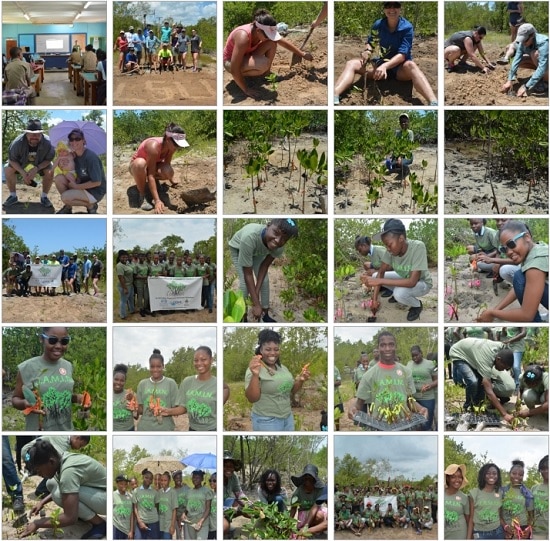
Tenth grade student from Holland High School pauses for a photo before she plants her mangrove propagule.
It’s now the end of the academic school year, and in the midst of the students’ busy testing schedules, they take time out from studying to graph and analyze the data that they collected and draw conclusions from it to answer the overarching question. Additionally, students will return to the mangrove restoration site to plant the mangrove propagules (a seed-like structure) that they have been growing in their classroom for the past 8 months.
Today, we are restoring the mangroves and it’s a bittersweet feeling. On one hand, it is the end of a successful program, and on the other, it signifies the culmination of a year working with students and teachers on mangrove education and restoration. As an educator, I often feel like a mother duck leading her ducklings to adulthood. Although I wasn’t in the classroom with these students everyday, I still feel like a proud mother duck watching many of these students move on to the next level of high school or going off to university to pursue degrees.
It’s spring in Jamaica and the sun is already out in full force at 7 am, so we planned an early morning restoration. Camilo Trench and Shanna Thomas, our partners at the University of the West Indies Discovery Bay Marine Lab, and I pack up the truck with shovels, gloves, lots of water, and the mangrove propagules, and we head to the restoration site in Falmouth.
For the past couple of weeks, Camilo has been gradually acclimating the seedlings from the fresh water (that they have been growing in for the past several months) to salt water, so that they can more easily adapt to their natural environment once we plant them.
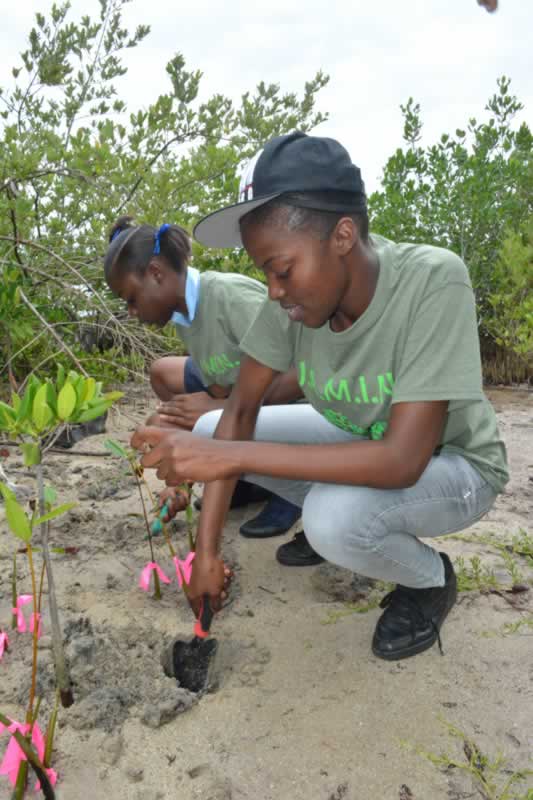
Students from Holland High School plant their mangrove seedlings at the restoration site in Falmouth.
When we get to the site, we come up with a plan on where to plant the propagules, and then we wait for the school’s bus to arrive. When it arrives, the students enthusiastically hop off the bus and they are smiling from ear to ear. We immediately hand out the J.A.M.I.N. program t-shirts and the students’ eyes light up. They are elated to receive them. Next, we go over the safety rules and we break the students into groups.
At the restoration site, there were many red mangroves that were removed near the water. The students are going to help restore these mangrove forests to their original state by planting their red mangrove seedlings.
They take great care in digging the holes and making sure that the seedlings are firmly in place before planting the next one. It’s ironic that just like I feel that these students are my ducklings, many of them feel like the seedlings are their ducklings that they have been caring for during the past 8 months. The students have taken ownership over these propagules, which I hope will leave a lasting imprint of the conservation of mangroves in their minds.
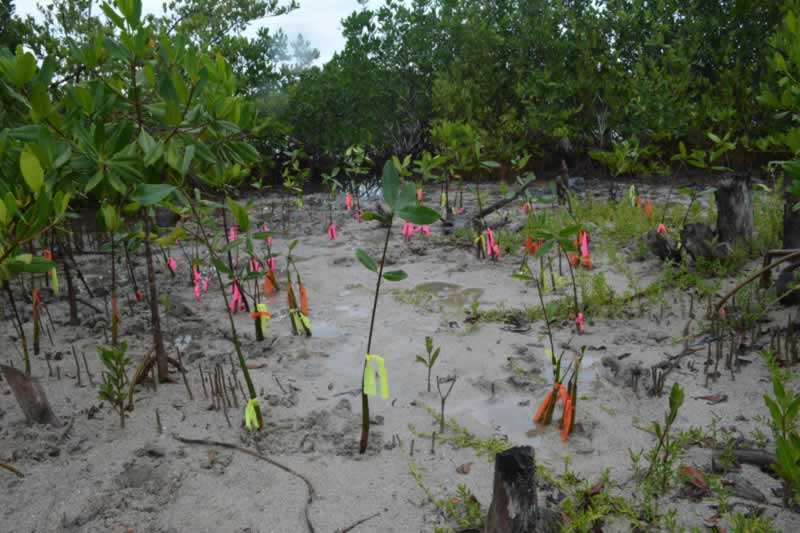
The aftermath of mangrove restoration – orange, pink, and yellow tagged propagules!
After the program, individual students thanked me for bringing this project to the school while others explained where they were going to university. One student told me that this project inspired her to study science and that she will be attending university next year to pursue an environmental science degree. I was completely touched by the students’ openness and gratitude.
When I look back at the entire project, the planting the mangrove propagules is symbolic. We literally planted mangrove seedlings to restore an area where they have been removed. Throughout this project, I feel that we planted much more than seedlings. We planted the seed of knowledge so that these students can bring about awareness of restoration and conservation of their mangroves for many generations to come.
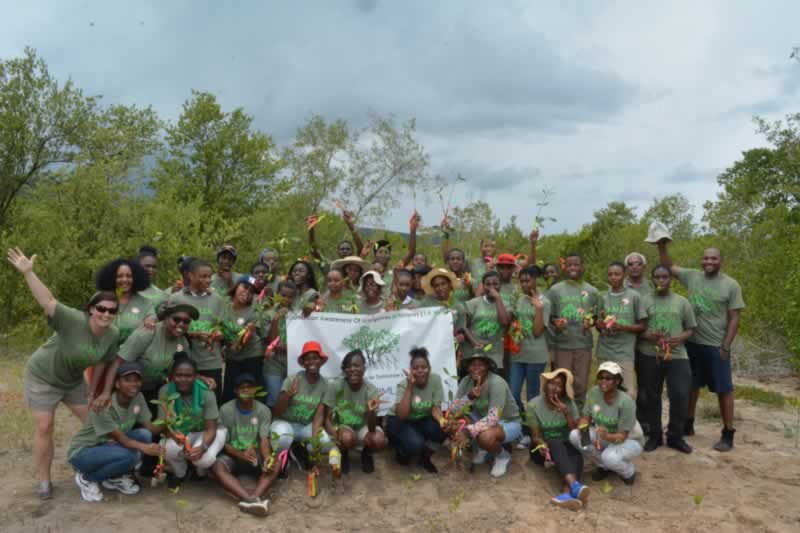
Participants in the JAMIN Program at William Knibb High School.
Check out our JAMIN Mangrove Planting photo album below…