
search-icon
A framework for mapping local knowledge on ciguatera and artisanal fisheries to inform systematic conservation planning

Published in ICES Journal of Marine Science

Abstract

Millions of people’s livelihoods rely on artisanal fisheries. However, in many regions fishers are increasingly facing ciguatera poisoning, a seafood-borne illness. The toxin, produced by benthic dinoflagellates, can spread through marine food webs and to humans by direct consumption. Ciguatera risk can play a major role in fisher’s activities but has never been considered in any marine spatial plans thus far. To fill this gap, we examined if integrating ciguatera in systematic conservation plans could affect these decisions. We developed through map-based interviews, a novel seven-step framework to collect and map local knowledge on ciguatera risk and fisheries activities with two innovations: (i) better mapping of fishing grounds by combining geomorphological habitat and fishing gear information, and (ii) integrating ciguatera risk directly into systematic spatial planning designs and scenarios conceived to maximize benthic habitat conservation while minimizing impacts to fishers. The approach is illustrated for Raivavae Island, in French Polynesia, Pacific Ocean. We found that integrating ciguatera significantly improved prioritization solutions with a 24–38% decrease of costs to fishers compared with scenarios based solely on fishery data. This framework was designed for scientists and managers to optimize the implementation of conservation plans and could be generalized to ciguatera-prone areas.
Related Posts

Ten Years of B.A.M.: Rooted in Partnership, Growing in Purpose

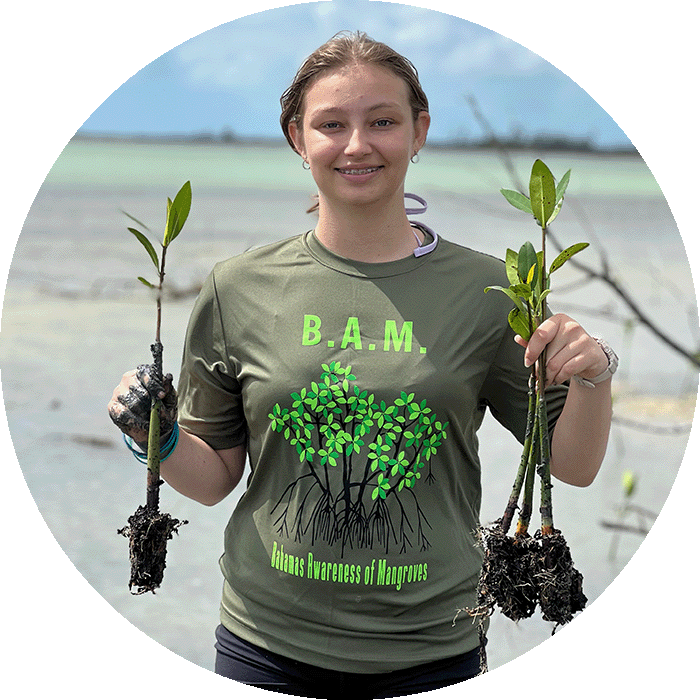
Ten years ago, the Bahamas Awareness of Mangroves (B.A.M.) program began with a simple but meaningful commitment: to connect Bahamian students with the mangrove ecosystems that shape and protect their island home.

Since 2015, B.A.M. has been implemented in partnership with Friends of the Environment, whose dedication to environmental stewardship in Abaco has made this program possible year after year. Together, we have worked alongside Patrick J. Bethel High School and Forest Heights Academy to bring hands-on mangrove science into classrooms and out into the field.

What makes ten years remarkable is not just longevity — it is consistency…

Read More

From Mangrove Mud to Meaningful Work: Desta’s J.A.M.I.N. Journey

Some students I remember for their grades, their quick answers, or a moment that made the whole class laugh. Others I remember for the way they stepped into the mangroves.

Desta was the kind of student who thrived outdoors. While some students hesitated at the edge of the mud, he walked right in. And when he inevitably got stuck — because everyone does — he didn’t get frustrated. He laughed. Covered in mud, holding mangrove propagules in his hands, he embraced the experience fully.

Even then, it was clear that he was connecting with the environment in a way that went beyond the lesson plan…

Read More