JMP
June 28, 2019
With climate change fast eliciting coral bleaching on global scales, marine biologists are using predictive modeling to help prioritize conservation efforts.
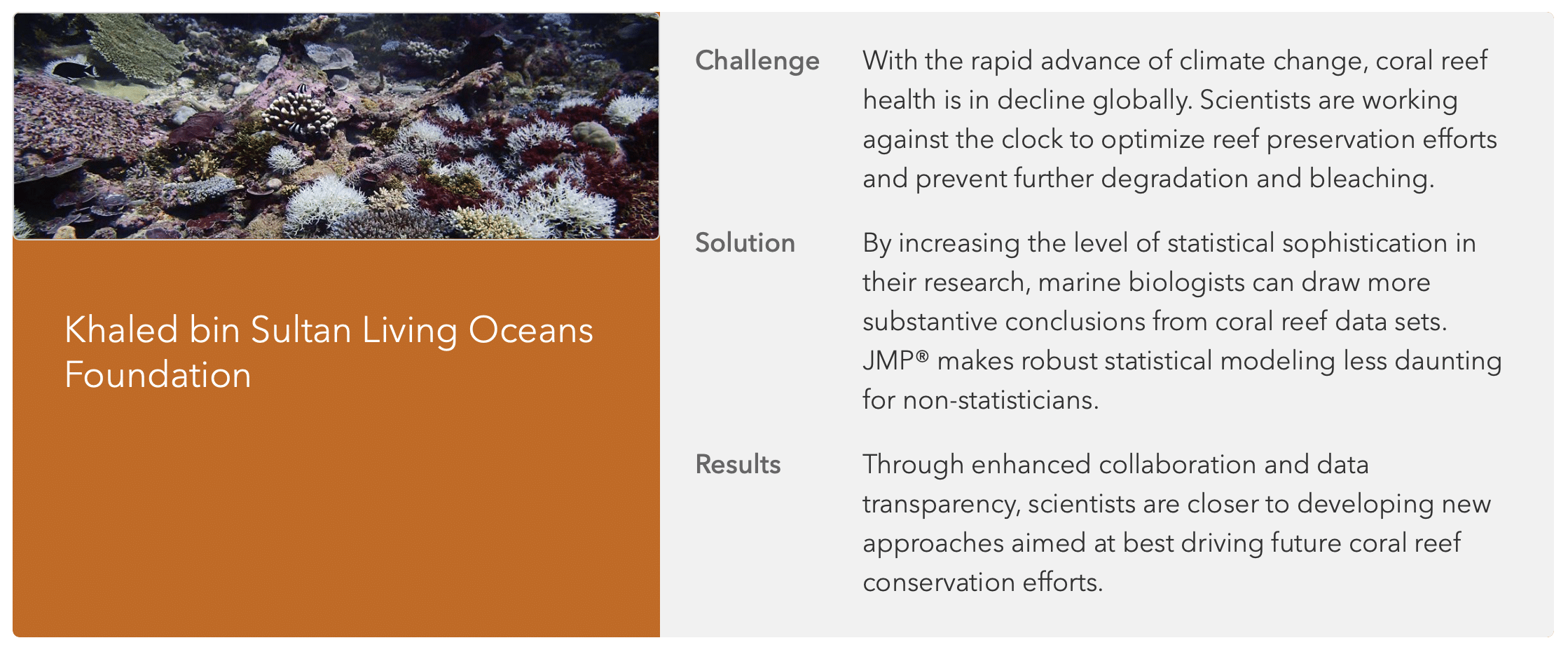
Though coral reefs constitute less than 2% of the Earth’s oceans, they play a critical part in ocean health and are among the most diverse ecosystems on the planet. Not only are they home to scores of marine species, but their immense impact extends to local economies, supporting fisheries, encouraging tourism, and protecting shorelines from erosion – an impact valued at billions of dollars each year. With an outsized role in both environmental and economic success, protecting these fragile reefs should be a global priority, yet coral reef health around the world continues to decline. Climate change, in particular, has accelerated the degradation of reefs, and scientists now estimate that more than half of the world’s coral reefs have been lost over the past four decades due to climate change and other human-associated factors. Although scientists broadly understand the causes of coral reef bleaching and (later) death, predicting specifically which reefs are most at risk, which are most resilient, and which should be prioritized for conservation continues to be among the field’s foremost challenges.
Organizations like the Khaled bin Sultan Living Oceans Foundation seek answers to these questions, and marine scientists the world over are investing in international coral reef research, conservation, and restoration efforts. With their support, Dr. Anderson Mayfield, PhD, has devoted his career to the study of reef coral physiology, arguing that scientists need a more rigorous, statistically driven approach if they are to understand – and mitigate – the breakdown of corals in response to environmental shifts before it is too late.