
search-icon
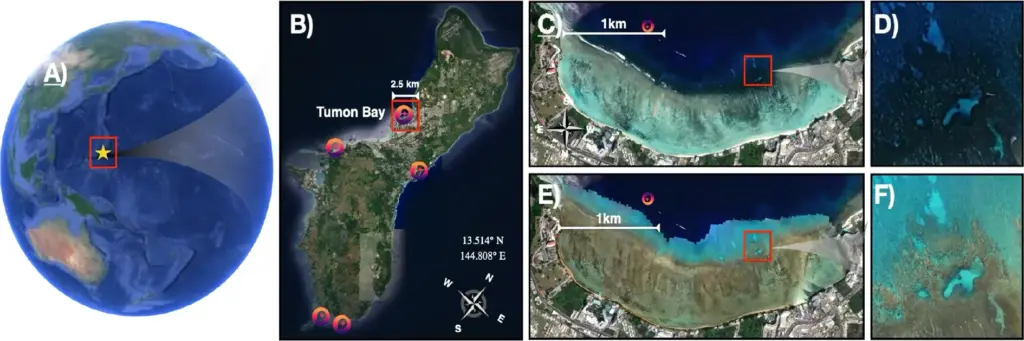
Cm-scale marine habitat mapping of entire Tumon Bay, Guam Coral Reef using NASA airborne fluid lensing and NeMO-Net pre (2022) and post (2024) Typhoon Mawar

Abstract

Introduction: 

High-resolution imaging of coral reefs is critical for understanding ecosystem dynamics and guiding conservation efforts yet monitoring these changes at ecologically relevant spatial and temporal scales remains challenging.

Methods: 

We present cm-scale benthic habitat maps for over 5 km2 of coral reefs in Tumon Bay, Guam, for 2022 and 2024, before and after Category 4 Typhoon Mawar (May 2023). NASA Airborne Fluid Lensing data were combined with in-situ ground-truthing and citizen-science annotations from the NeMO-Net platform. NeMO-Net’s original CNN was modified to an Attentive Residual U-Net (ARU-Net) with an EfficientNet-B3 encoder, class-weighted loss, and attention gating to classify seven habitat classes at pixel (cm) scale, using only ~1% of the 2022 dataset for training.

Results: 

Our model achieved 88% overall pixel-scale accuracy across seven ecologically relevant benthic classes. Full-coverage habitat maps for 2022 and 2024 reveal a 59% decline in massive coral, a 35% decline in coral fore-reef, and a 105% increase in algal cover, providing spatially explicit evidence of Typhoon Mawar’s reef impact.

Discussion: 

Coupling Fluid Lensing imagery with the NeMO-Net citizen-science platform and a modified ARU-Net yields accurate cm-resolved habitat assessments from sparse labels, supporting timely evaluation of disturbance and restoration outcomes in complex shallow-water reef environments.
Related Posts

Everything You Need to Know About the 2027 Science Without Borders® Challenge

Are you ready to combine your creativity with ocean science?

The 15th Annual Science Without Borders® Challenge is now open! Whether you’re participating for the first time or returning for another year, this guide will help you get started.

This year’s theme, Navigate With Care, invites students to explore how responsible navigation helps protect both people and life in the ocean. Through your artwork, you can compete for scholarships and international recognition while inspiring others to protect both people and life in the ocean.

Read More

Global Reef Expedition Data Contributes to Landmark Report on the World’s Coral Reefs

More than a decade after scientists aboard the Global Reef Expedition surveyed coral reefs across the Pacific, the data they collected continues to contribute to our understanding of the world’s coral reefs.

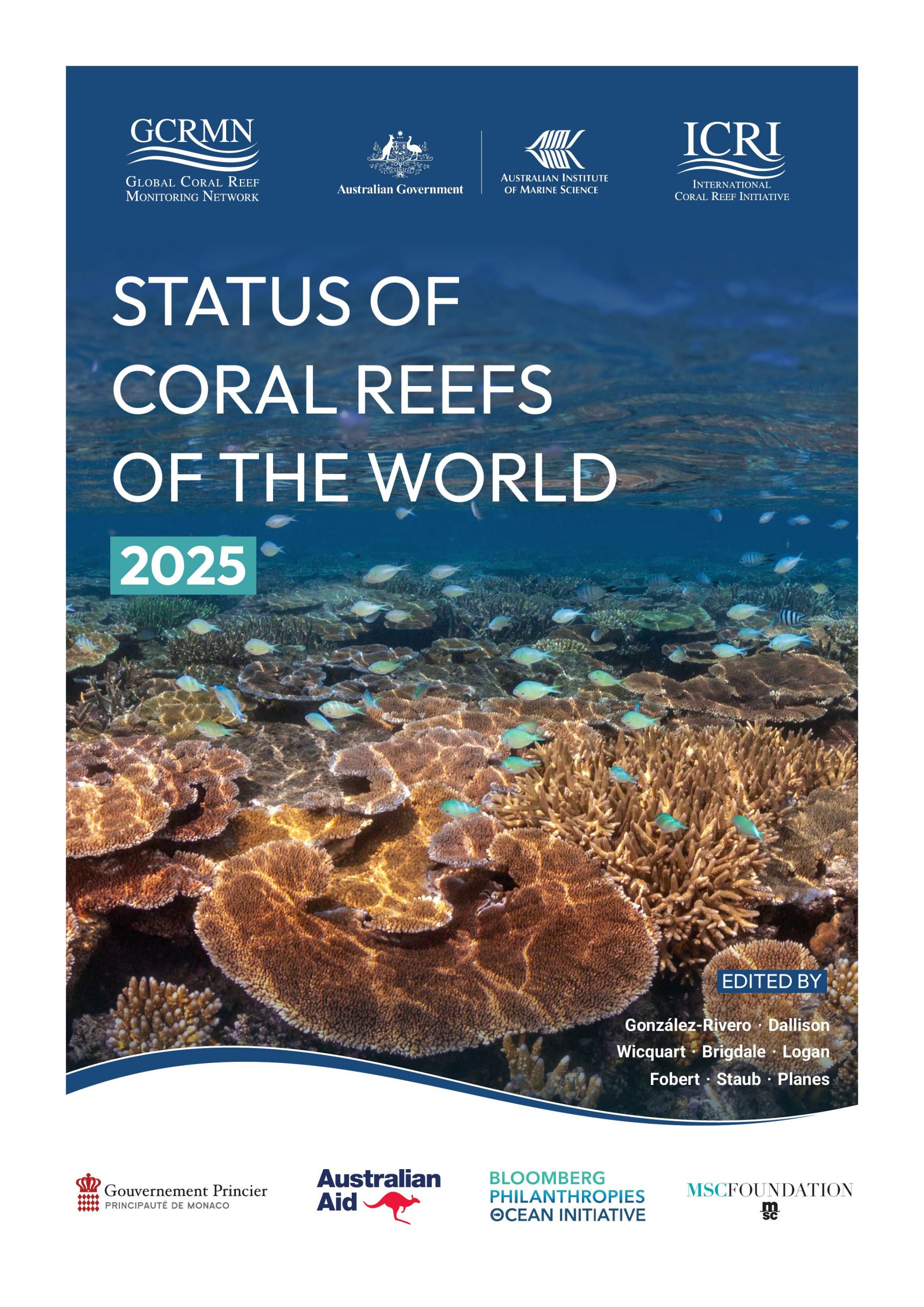
Today, the Global Coral Reef Monitoring Network (GCRMN) released Status of Coral Reefs of the World: 2025, the most comprehensive assessment to date of the status and trends of coral reefs worldwide. The report brings together an extraordinary amount of information collected over more than four decades—and the Khaled bin Sultan Living Oceans Foundation is proud to have contributed data from the Global Reef Expedition to this global effort. 

Read More
Privacy Overview

This website uses cookies so that we can provide you with the best user experience possible. Cookie information is stored in your browser and performs functions such as recognising you when you return to our website and helping our team to understand which sections of the website you find most interesting and useful.  You can view our complete Privacy Policy here.

Strictly Necessary Cookies

Most of our cookies are used to improve website security and reduce spam. These cookies should be enabled at all times. They also enable us to save your preferences for cookie settings.

3rd Party Cookies

This website uses Google Analytics to collect anonymous information such as the number of visitors to the site, and the most popular pages. Keeping this cookie enabled helps us to improve our website.