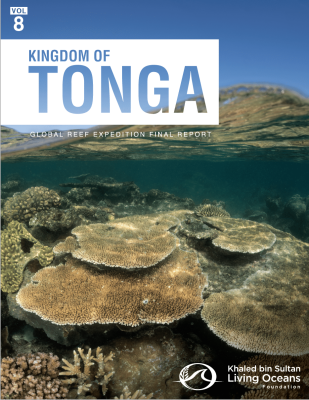
The Khaled bin Sultan Living Oceans Foundation embarked on the Global Reef Expedition—the largest coral reef survey and mapping expedition in history—to study the coral reef crisis on a global scale. As part of the 5-year expedition, an international team of scientists traveled to Tonga in 2013 to assess the health and resiliency of coral reefs in the Kingdom of Tonga. The Global Reef Expedition: Kingdom of Tonga Final Report provides a comprehensive summary of the Foundation’s research findings from the Expedition, along with recommendations for preserving Tonga’s coral reefs into the future.
This report provides scientists, managers, and stakeholders with information on the status of corals and reef fish in Tonga and helps further our understanding of the resiliency of these fragile marine ecosystems. Coral reefs face many threats, including pollution, climate change, overfishing, storm damage, and outbreaks of crown-of-thorns starfish. In order to see how these threats impacted reefs, and assess the status of Tonga’s marine resources, scientists on the expedition worked closely with local partners and government officials to study coral reefs and reef fish in three key regions of Tonga: Ha’apai, Vava’u, and Niua. During the course of the month-long research mission, they conducted nearly 500 coral and reef fish surveys and collected information to create over 2,200 km2 of high-resolution habitat and bathymetric maps of the seafloor in Tonga.
The Khaled bin Sultan Living Oceans Foundation hopes the data presented in this report will be used to protect and conserve Tonga’s coral reefs, so they can continue to be used and enjoyed by the people of Tonga for generations to come.