Abstract
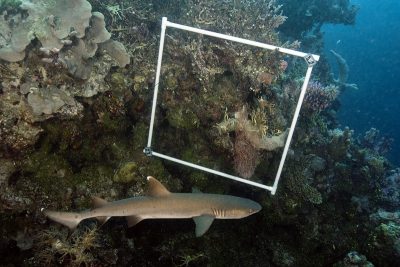
Global overfishing of higher‐level predators has caused cascading effects to lower trophic levels in many marine ecosystems. On coral reefs, which support highly diverse food‐webs, the degree to which top‐down trophic cascades can occur remains equivocal. Using extensive survey data from coral reefs across the relatively unfished northern Great Barrier Reef (nGBR), we quantified the role of reef sharks in structuring coral reef fish assemblages. Using a structural equation modelling (SEM) approach, we explored the interactions between the shark abundance and teleost mesopredator and prey functional group density and biomass, whilst explicitly accounting for the potentially confounding influence of environmental variation across sites. While a fourfold difference in reef shark density was observed across our survey sites, this had no impact on either the density or biomass of teleost mesopredators or prey, providing evidence for a lack of trophic cascading across nGBR systems. Instead, many functional groups, including sharks, responded positively to environmental drivers. We found reef sharks to be positively associated with habitat complexity. In turn, physical processes such as wave exposure and current velocity were both correlated well with multiple functional groups, reflecting how changes to energetic conditions and food availability, or modification of habitat affect fish distribution. The diversity of species within coral reef food webs and their associations with bottom‐up drivers likely buffers against trophic cascading across GBR functional guilds when reef shark assemblages are depleted, as has been demonstrated in other complex ecosystems.