eTN News
by Juergen T Steinmetz
June 9, 2024
A major milestone in its ongoing efforts to advance marine conservation and promote sustainable marine tourism in the Saudi Arabian Red Sea took place with a new partnership announced by the Saudi Red Sea Authority (SRSA)
The Saudi Red Sea Authority (SRSA) signed a memorandum of understanding (MoU) with the Khaled bin Sultan Living Oceans Foundation, to explore ways to cooperate.
What is the Saudi Red Sea Authority
The Saudi Red Sea Authority (SRSA) began its journey towards building and regulating the coastal tourism sector in 2021, with the objective of enhancing integration among relevant entities by issuing licenses and permits, formulating essential policies and strategies, assessing infrastructure requirements, preserving the marine environment, attracting investments, and fostering navigational and marine tourism activities, all of which will add value to the national economy.
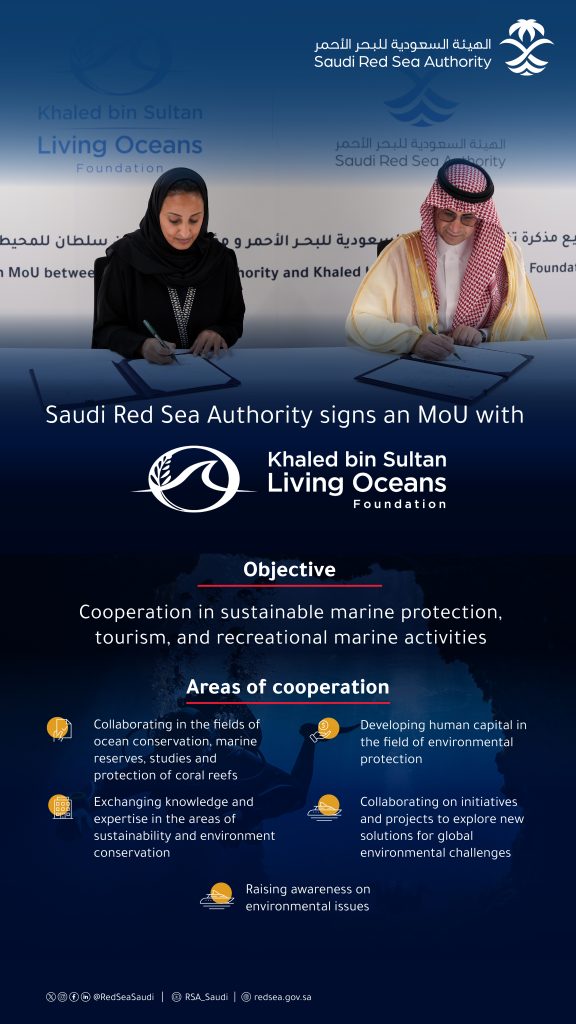
During the signing ceremony, SRSA was represented by the CEO Mr. Mohammed Al-Nasser, while Khaled bin Sultan Living Oceans Foundation was represented by their president, HRH Princess Hala bint Khaled bin Sultan Al-Saud.
The MoU is part of SRSA’s efforts to expand its strategic partnerships and falls under its mandate to establish a mechanism that ensures the protection of the marine environment while utilizing best international practices to develop navigational and marine and tourism activities.
The MoU also aims to achieve integration with relevant entities from public, private, and third-sector organizations, ultimately realizing the goals of Saudi Vision 2030 by enabling coastal tourism to become a valuable sector of the national economy.
Areas of Cooperation
- Developing Future Leaders: Providing scholarships and educational opportunities to nurture the next generation of marine scientists and conservationists.
- Exchanging Knowledge and Expertise: Sharing insights and best practices in sustainability, climate change, and environmental conservation to enhance our collective impact.
- Fostering Collaboration: Jointly organizing and hosting conferences, seminars, and workshops focused on ocean conservation, marine reserves, blue finance, and coral reef protection to foster knowledge exchange and collaboration.
- Collaborative Research Initiatives: Conducting joint research projects to address global environmental challenges and find innovative solutions for marine conservation.
- Raising Environmental Awareness: Engaging in joint outreach campaigns to raise awareness about important environmental issues and encourage positive change.
The agreement entails several areas of cooperation, including human capital development, ocean conservation, marine reserves, plastic pollution, protection of coral reefs, blue economy, knowledge sharing, research initiatives, and awareness campaigns.
Environmental Conservation
SRSA and the Khaled bin Sultan Living Oceans Foundation look forward to using their new partnership to support environmental conservation and sustainable use of the marine environment in Saudi Arabia.