 Scientists on the Global Reef Expedition surveyed and mapped New Caledonia’s most remote coral reefs—some for the first time
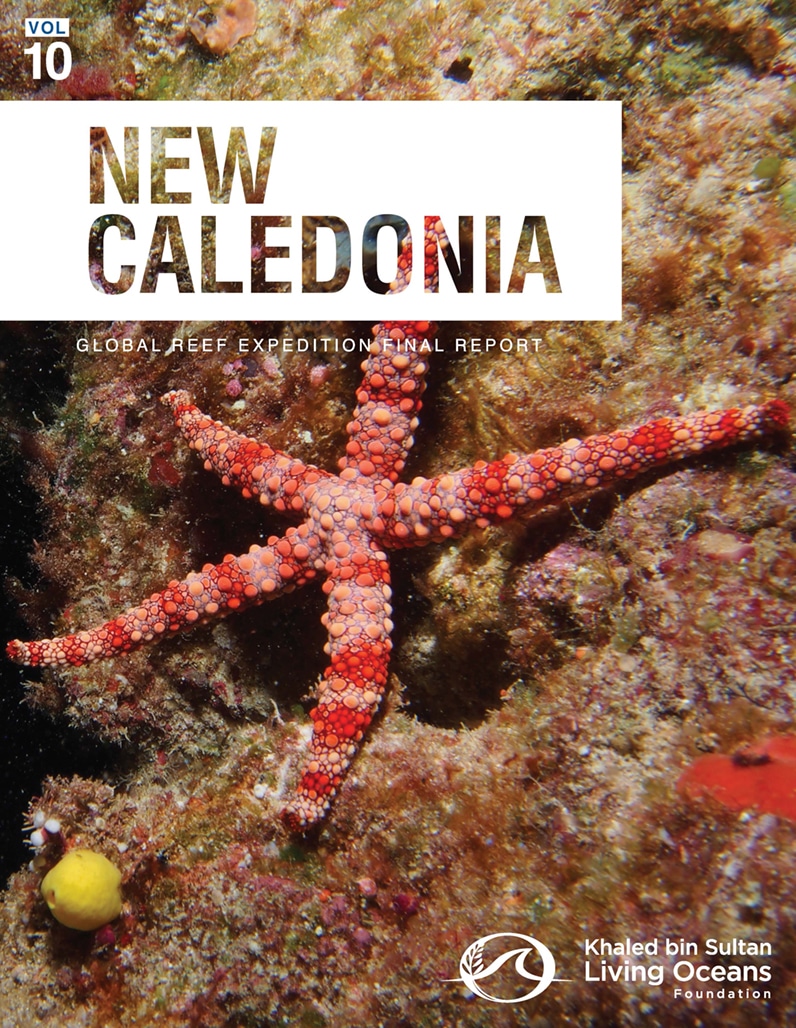
The Khaled bin Sultan Living Oceans Foundation is proud to release the Global Reef Expedition: New Caledonia Final Report. The report provides an assessment of the health and resiliency of New Caledonia’s coral reefs along with recommendations for preserving these reefs into the future.
On the Global Reef Expedition—the largest coral reef survey and mapping expedition in history—KSLOF brought together an international team of scientists, who worked closely with local partners and government officials to study remote coral reefs in New Caledonia. In 2013, they spent a month at sea, conducting over 1,000 standardized surveys of coral reefs and reef fish. They also created benthic habitat and bathymetric maps for 2,600 km2 of shallow-water marine habitats in New Caledonia.
Released today, the Global Reef Expedition: New Caledonia Final Report contains valuable information on the status of coral reefs and reef fish in the Entrecasteaux Atolls, Cook Reef, Ile des Pins, and Prony Bay. Our surveys found the reefs to be in surprisingly good shape at the time, with some of the highest coral cover we found on the entire Global Reef Expedition. Reefs far from shore, or protected in Marine Protected Areas (MPAs), were in particularly good condition, but many nearshore reefs showed signs of fishing pressure with few large and commercially valuable fish.
“The reefs of New Caledonia are simply spectacular. Incredible diversity. Remarkable morphology,” said Dr. Sam Purkis, KSLOF’s Chief Scientist as well as Professor and Chair of the Department of Marine Geosciences at the University of Miami’s Rosenstiel School of Marine and Atmospheric Science. “But in New Caledonia, as elsewhere, the reefs are gravely threatened by local impacts and climate change. The Living Oceans Foundation achieved two important objectives in the country – first, they mapped, using satellite, many of the remotest reef systems in New Caledonia for the first time. Second, the field data collected by the Foundation set a baseline condition for these reefs which can be tracked into the future to understand change.”
The foundation is grateful for the opportunity to conduct this research and hopes the data in this report will help New Caledonia with ongoing efforts to manage their MPAs, regulate nearshore fisheries, and monitor changes to the reefs over time. We are sharing this report widely with government officials, marine park managers, stakeholders, and conservation organizations in New Caledonia, and copies of the report are available to download on our website in French and English.
Global Reef Expedition: New Caledonia Final Report
The Global Reef Expedition: New Caledonia Final Report presents the Foundation’s findings from the Global Reef Expedition mission to New Caledonia. It includes our assessment of the status of New Caledonia’s coral reefs, along with recommendations that can help preserve the reefs into the future.
Global Reef Expedition Final Report: New Caledonia