Winners of the 2022 Science Without Borders® Challenge
The 2022 Science Without Borders® Challenge marked the tenth year of this international student art competition, inspiring young artists to learn about the ocean through creative expression. The theme, “Ridge to Reef,” encouraged students to explore the interconnectedness of land and sea, highlighting how actions taken throughout entire watersheds can influence the health of marine ecosystems, particularly coral reefs.
This competition introduced students around the world to the plight of coral reefs and encouraged them to learn more about what can be done locally to save this critical marine ecosystem. With over 500 entries from nearly 50 countries, the competition showcased the diverse perspectives and artistic talents of students from around the world. Their artwork vividly illustrated how protecting forests, reducing pollution, and managing land use can have profound effects on coral reefs far downstream. From reforestation efforts to sustainable agricultural practices, these young artists captured the essence of ridge-to-reef conservation and its critical role in safeguarding marine biodiversity.
The winning entries stood out not only for their aesthetic appeal but also for their compelling narratives about the symbiotic relationship between terrestrial and marine environments. Each piece serves as a testament to the power of art in raising awareness and inspiring action, reminding us that protecting coral reefs begins long before the water reaches the shore. We are proud to present the 2022 Challenge winners, whose art advocates for a holistic approach to conservation that bridges the gap from ridge to reef.
Winners & Finalists Ages 11-14:
First Place (11-14): "Coral Reef in the Bosom of their Mother" by Hyobin Pyo, Age 12, New Jersey, United States of America
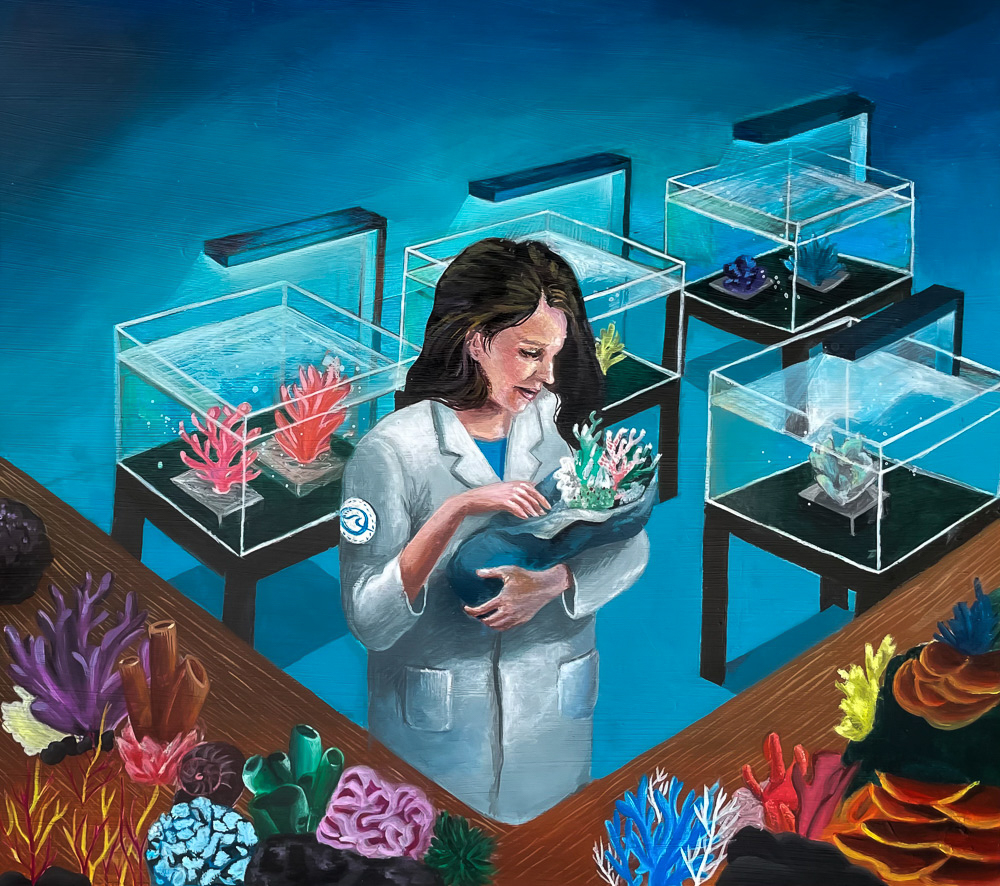
ARTIST'S STATEMENT: Coral reefs provide a home for diverse creatures in the ocean. However, because of pollution and climate change caused by humans, coral reefs are disappearing rapidly.Many creatures are losing their habitats and hiding places from their predators. Scientists are researching and studying how to breed corals in laboratories to find the right environment for them to flourish. In the painting, a scientist is portrayed as a mother nurturing a baby. She has her child (baby corals) in her arm and is gingerly touching the coral with the hope of giving it a better future. Baby corals, in water tanks, are under lights in a protected environment. The table in front of the mother has corals that were successfully bred and are ready to restore the natural habitat for many creatures in need. We need to work together to save the ocean’s treasure, as it can save us all in return.
Winners & Finalists Ages 15-19:
"Cutting Our Coral Reefs Free" by Karis Choe, Age 16, California, United States of America
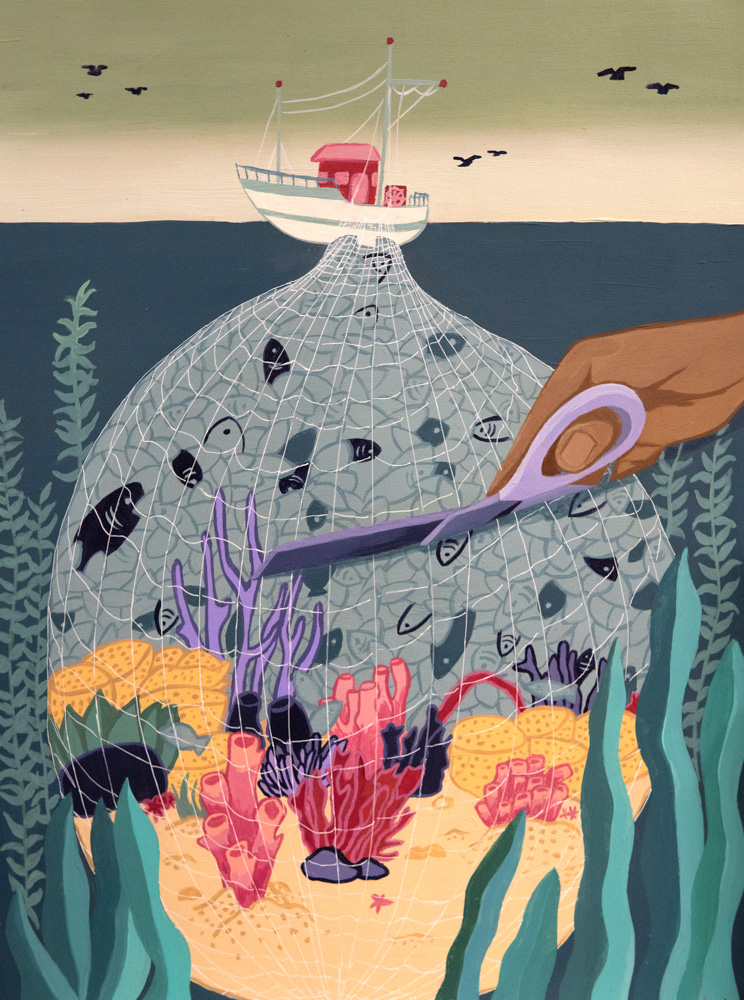
ARTIST’S STATEMENT: Overfishing, affecting over fifty-five percent of the world's coral reefs, allows for the overgrowth of algae. With the depletion of fish, algae growth can't be regulated, killing coral reefs by suffocating and shading them from sunlight. Supplying half of Earth's oxygen, the preservation of coral reefs is extremely important for humanity as a whole. The net holds a surplus of fish as well as a coral reef to represent how overfishing not only impacts fish populations, but also coral reefs. In the fishing industry, the consequences of overfishing are often overlooked due to food supply demands. This is represented by the stark size difference between the boat and net. A hand cuts through the net to free the fish and coral. Representing humanity, the hand highlights the necessity of people to come together to advocate for fishing regulation reform, so that we can ultimately "cut" overfishing out of the picture.