Focus for today:
Marine Pollution.
Target key stage:
Key Stage 4: National Science Curriculum, Dual Award, Sc2, 5b; the impact of humans on the environment depends on social and economic factors, including population size, industrial processes and levels of consumption and waste / Sc2, 5c; the importance of sustainable development.
Key information:
Saudi Arabia has by far the longest coastline of any country on the Red Sea (about 1,500 km) and this coastline is studded with coral reefs. Prior to 1970, there was little human impact on these reefs but in recent years, commercial and industrial development, fuelled by the oil industry, have led to differing scales of marine pollution.
Oil tankers, cargo and passenger ships and fishing boats ply their trade across the surface of this great waterway. In addition, the Red Sea is a vital commodity for local people, for example, the city of Jeddah in Saudi Arabia is totally dependent on it for household and industrial supplies and there are huge desalination plants that supply both drinking water and non-potable domestic water. Seawater is also used by oil refineries and cement works situated on the coast. With such shipping and coastal development, the risk of marine pollution is always high, especially from oil spillage. A Royal Decree forbids the discharge of any pollutant substance, including oil, within 100 miles of the Saudi Arabian coastline.
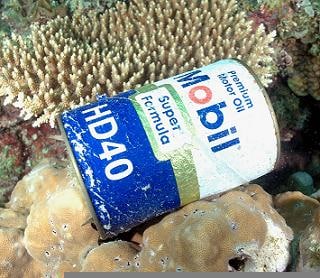
Reef Litter
Marine pollution can be thought of in terms of scale – large-scale such as oil slicks or small-scale such as litter on beaches. All pollution has a severe impact on the marine environment.
Large-scale marine pollution impacts such as oil spills are often accidental and clean up operations are costly and time-consuming. Consequently, the impacts on the marine environment are very severe. Reefs and seabirds are smothered in oil and quickly suffocate. Sewage outfalls introduce high levels of nutrients into the ecosystem, leading to algal blooms and eutrophication. Sedimentation on the reef may be induced through coastal development. Sediment smothers the corals and can devastate entire reef systems. Dredging of the sea-bed to construct deep-water channels into ports also induces sedimentation.
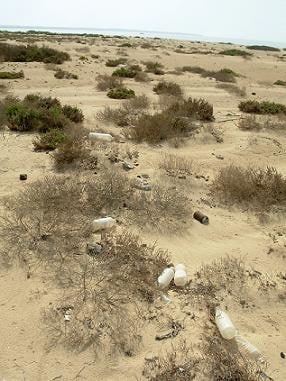
Masad Island – plastic litter
Small-scale marine pollution can be observed as litter washed up on beaches – probably something you will have observed somewhere in the world. The sea acts as a huge transport system and non-biodegradable materials are carried as flotsam and jetsam around the world on the path of ocean currents. Not only does litter look unsightly, many marine animals and seabirds eat this material and die. For example, turtles often eat plastic bags floating near the surface, mistaking them for jellyfish.
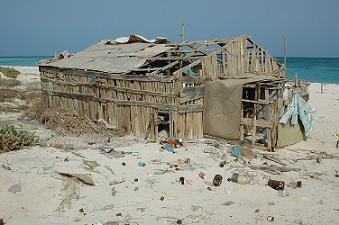
Littter left by fishermen
Although marine pollution is a global problem, everyone can do something to help. By tackling this problem on a small scale, you too can help to clean up the marine environment.
Question for students/food for thought:
How do you think we can help combat the problem of marine pollution? – think of both large scale practises that governments could undertake and also small-scale activities that individual people could do to help.
What measures could be taken to minimise the impacts of coastal development? Can you think of any areas where coastal development has taken place successfully in harmony with the surrounding natural environment?
Additional information:
The scientists have been delighted to see very little rubbish on the reefs and beaches of the Farasan islands. Although litter may be washed ashore from elsewhere, the small human population (approximately 20,000) in the Farasan Islands and the fact that only a few of the islands are inhabited is helping these islands stay clean.
However, development of the Farasan Islands may occur in the future and necessary precautions much be taken to minimise future impacts on the marine ecosystem. Unfortunately, today, some members of the science team observed litter strewn around a fisherman dwelling on one of the smaller islands. This litter had not been washed ashore, but had been dumped when the fishermen left the island.
Also, Abdullah Alsuhaibany arrived onboard Golden Shadow today. Abdullah works for Persga and, over the past few days, has been working on Farasan Kabir delivering an educational programme to local schools. Abdullah is a bird specialist and will be conducting sea-bird surveys during the remainder of the expedition.
And finally – last night it rained! During dinner Annelise suggested she had seen rain, but some of her fellow science team quickly dismissed this as madness (suggesting instead it was the crew washing down the decks) – however, later last night a crew member on-watch also made the same observation. Phil and Bernhard, maybe you owe Annelise an apology?!