Focus for today:
Breeding Gulls in the Farasan Islands.
Target key stage:
Key Stage 4: National Science Curriculum, Dual Award, Sc2, 5a: the distribution and relative abundance of organisms in habitats can be explained using ideas of interdependence, adaptation, competition and predation.
Key information:
There are about 45 species of Gulls (Laridae) in the world. Of these, only two species (Sooty Gull, Larus hemptichii and White-eyed Gull, Larus leucophthalmus) breed in Farasan Islands; both are endemic, i.e. they only exist in these islands!
Breeding Gulls in the Farasan Islands
Sooty Gull, Larus hemptichii.
This species is widely distributed and the most common gull in the Red Sea Islands and coasts. It has a distinctive brown and white plumage. Sooty gulls are common scavengers on beaches, around fisherman and ships, in harbours and on rubbish-tips, but it will also catch fish from the sea surface whilst in flight and even when swimming. It nests on islands from June to September, in a bare scrape, occasionally decorated with dry seaweeds and broken shells. Sooty Gulls have been recorded nesting on several of the northeast Farasan islands, and they have been observed to nest in industrial ports.
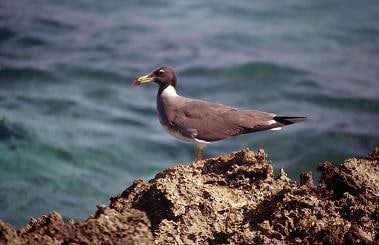
Sooty gull
White-eyed Gull, Larus leucophthalmus.
This gull species can be identified from the Sooty gull by its black head and upper breast, dark back and dark grey wings. The brown eyes are surrounded by a red ring, and they have a white crescent both above and beneath them. The bill is slender, red, and droops slightly to the black tip. The legs are bright yellow.
The white-eyed gull is classified as Near Threatened (NT) on the IUCN Red List 2004 and is listed on Appendices I and II of the Convention on Migratory Species (CMS or Bonn Convention). This species forms loose colonies of between six and several hundred pairs, but usually around 25 pairs. They nest on bare rock and sand, lining a shallow scrape with seaweed and debris. Details of incubation and fledging periods have not yet been recorded.
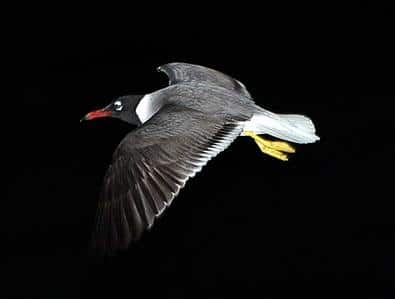
White eye gull
The white-eyed gull consumes mainly fish, but will also take crabs, molluscs and worms and even some fruits. It plunge-dives at the water surface, far out to sea, and may also scavenge in harbours. It has been known to gather into foraging flocks of hundreds of individuals. This species is thought to be threatened by collection of eggs and chicks, as well as disturbance. The tourism industry has decreased the area available to breeding gulls and has resulted in lower reproductive success. Oil spills and exploration for oil sources also threaten this species.
Question for students/food for thought:
Can you list any threatened species in your local area? Why might they be threatened, and what implications might these same threats have for other species?
Additional information:
The Farasan Islands are also home to many other bird species. One such bird is the very beautiful Tropic Bird.
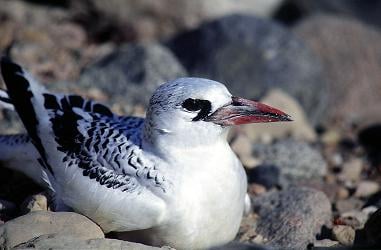
Many peoples favourite – the Tropic bird
Today the science team are preparing to depart the Golden Shadow. Although the team does not leave until the early hous of Thursday morning, there is much pre-departure work to be done – equipment has to be cleaned and boxed ready to be shipped home, data have to backed-up, and plans have to be made regarding reporting on the work completed. Once the expedition is over, the real work actually starts: all the data that have been collected now have to be processed, interpreted and published!
A scientists work is never complete…..