Focus for today:
Dugong
Target key stage:
Key Stage 4: National Science Curriculum, Dual Award, Sc2, 5a: the distribution and relative abundance of organisms in habitats can be explained using ideas of interdependence, adaptation, competition and predation.
Key information:
Today the mammals/turtles team visited Khor Maadi. Dugong (Dugong dugong) have been recorded in this Khor (translatted to ‘bay’ in English), in1994 and 2005 by NCWCD. Dugongs, or sea cows as they are sometimes called, are marine mammals which can grow to about three meters in length and weigh as much as 400 kilograms. They can live for about 70 years. The name sea cow refers to the fact that they graze on the seagrasses, which form meadows in sheltered coastal waters.
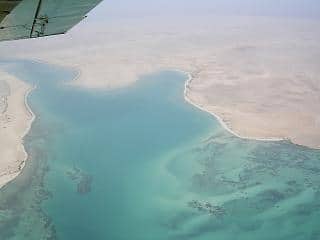
Aerial view of Khor Maadi
Dugongs are the only true marine herbivorous mammals and thought to be related to elephants. The Red Sea is the Western extremity of the range of this tropical Indo-Pacific species. These animals have poor eyesight, but acute hearing. They find and grasp seagrass with the aid of coarse, sensitive bristles, which cover the upper lip of their large and fleshy snout. Small tusks can be seen in adult males and some old females. During the mating season, male dugongs use their tusks to fight each other. Reproduction rate is slow and on average a single calf is produced after about 12 months. The calf stays with the mother for about a year, and calves are spaced about two years apart.
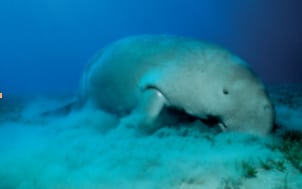
Dugong
Seagrass habitats critical for Dugong feeding are rare in the Red Sea (in which coral reefs dominate), and it is therefore critical for their survival to protect habitats such as those found in the Farasan Islands. Whilst on site, the team studied the seagrasses in the area to identify the density and species abundance of this crucial Dugong habitat; seagrasses are the primary habitat of the Dugong. Three species were observed, Haladale uninervis, Halophila ovalis and Thalassia hempricchii.
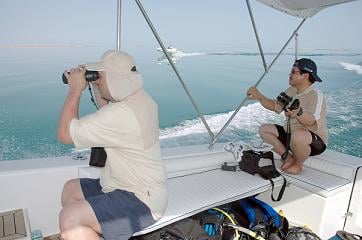
The team also saw 39 common dolphins, in five schools. Hump-backed dolphins were also observed, as were two green turtles and a number of hawksbill turtles. Although the team did not see any Dugong, their highlight was the sighting of numerous mantas rays in the NW Farasan Islands.
Question for students/food for thought:
Why do you think it is important to secure the sustainable management of the habitat to which Dugong are associated? Why do you think Dugong populations are depleting the World over?
Additional information:
Another good day on the Golden Shadow! Today we had a visit from the Golden Eye seaplane; the film crew boarded the Golden Eye and flew to Jizan, in readiness for another days filming. They have been fortunate to secure the support of the Saudi Arabian authrorities, who have offered them the use of a helicopter to take aerial footage of the Golden Shadow. Although we have the us eof the Golden Eye seaplane, better footage can be gathered from the helicopter due to its slow operating speed.
We are planning another busy day tomorrow. We will be deploying some of the ground-truthing targets as descibed in the methodolgies section of this website.