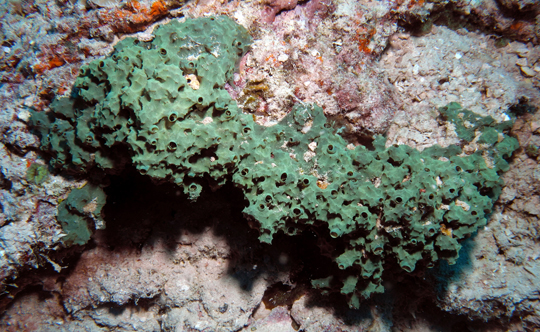
One of our local partners, Dr. Sylvain Petek, from the Institute for Research and Development (IRD) in Tahiti studies sponges. He is looking at the taxonomy of sponges throughout French Polynesia and chemical compounds found within these animals. On every dive, he carefully searches the reef for sponges, starting at 30 m and working up to the shallows. Each time he finds a different species, he collects a sample. Back on the Golden Shadow, these are either preserved in ethanol and later identified to species or frozen until the chemical compounds can be extracted. These chemical compounds, referred to as secondary metabolites, are not involved in primary metabolic pathways in the sponge. Instead, they provide the reef sponges with chemical defenses against predators, competitors and pathogens. In many locations, bioprospecting scientists collect reef sponges in search of unique chemical compounds that may help treat human diseases, such as anti-cancer compounds, or to produce azidothymidine (AZT), which is used to fight the AIDS virus.
Sylvain’s research has more of an ecological angle. Knowledge of the ecological role of these compounds may provide key information on the future of coral reef sponges. One forecast is that sponges will gain greater dominance on the reefs in the face of ocean acidification, partly because of their superior competitive ability, and more importantly, they do not have a calcified skeleton, like that found in reef building corals. Ocean acidification may lead to the dissolution of coral’s calcium carbonate skeleton, which would prevent a coral’s ability to grow or maintain its structure.
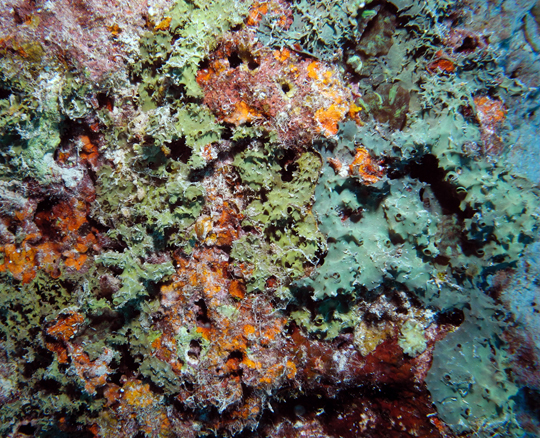
One of Sylvain’s key findings is that the concentration and type of chemical compounds found within each species of sponge varies depending on the location. He identified about 30 species of reef sponges in the five atolls we have examined thus far on this research mission. Two of these sponges are thought to be new to science. Sylvain found the highest number of different species of sponges on the fore reef, and far fewer in the lagoon, with most occurring from 20-30 m depth. The highest diversity of sponges overall was identified on a fore reef off Huahine. Interestingly, to date, only four of the 30 species of reef sponges are found throughout the four archipelagos (Society Islands, Tuamotu, Gambier and Marquesas); the rest are unique to the Society Islands.
Sylvain is taking his reef sponge collection back to the lab for identification and to extract and identify the chemical compounds. The results of these surveys will be compared to similar surveys carried out in Society Islands in 2010.
(Photos by: Dr. Andy Bruckner)
To follow along and see more photos, please visit us on Facebook! You can also follow the expedition on our Global Reef Expedition page, where there is more information about our research and team members.