Expedition Log: Maldives – Day 4
Whenever crown of thorns starfish (COTS) are reported, we never know if they will still be in the same location or how much they have moved. In part, this depends on how quickly a response is initiated, and more importantly how many starfish are present in an outbreak and how extensive their food supply is. It is typically easier to control an outbreak if the starfish are removed very soon after the first siting, as they tend to invade an area in a large swarm, and over time will disperse throughout the reef expanding into all depths and into multiple habitats – basically wherever there is food.
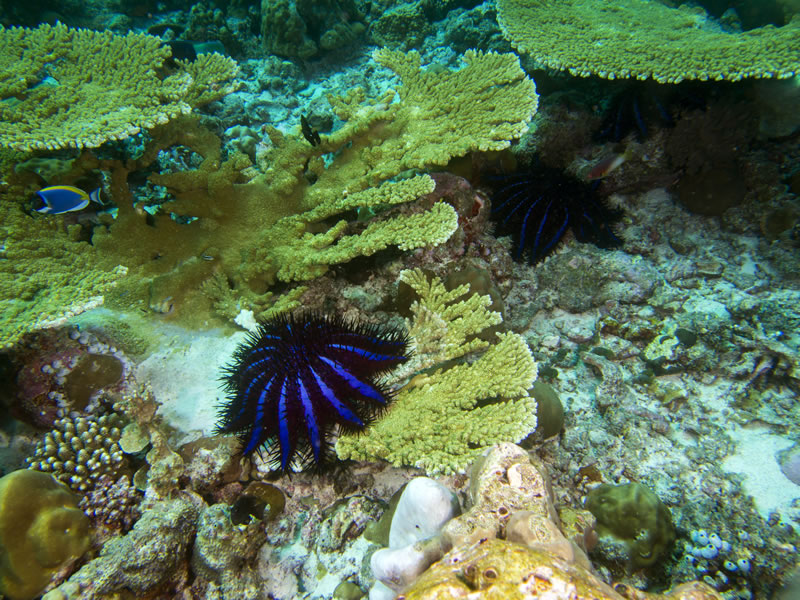
COTS on table acroporids.
In Gili Lankanfushi, COTS were first observed on the house reef, a linear reef system on the leeward side of the island that faces towards the lagoon. The highest densities were seen near a mooring (possibly because this is the site most frequently dived), and they were absent from other frequented dive sites. They also occurred to the north of the mooring, with very few seen to the south.
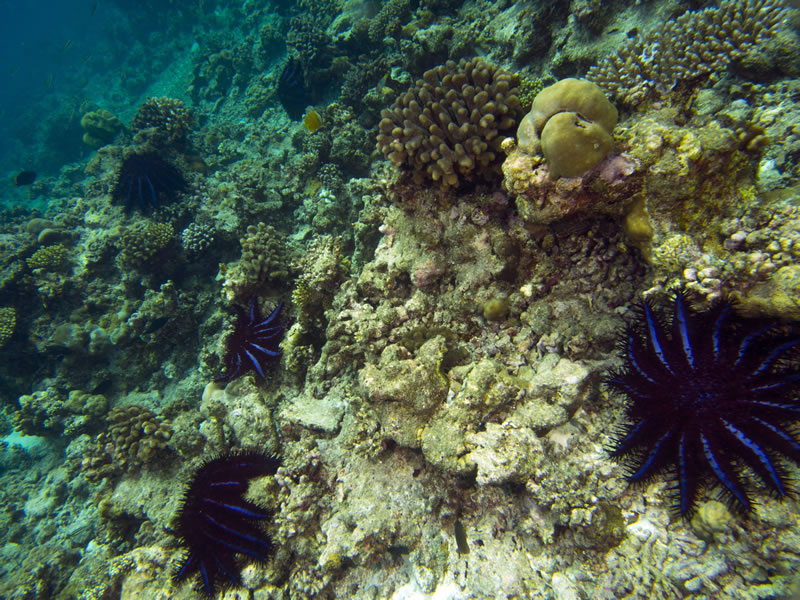
COTS along the reef slope.
For our first dive, we started at the mooring and swam along the reef slope. Our surveys were concentrated from 2-15 m depth because there was little coral found both shallower and deeper. The team swam in a row, each buddy team separated by about 5 m to ensure that we covered the entire reef system.
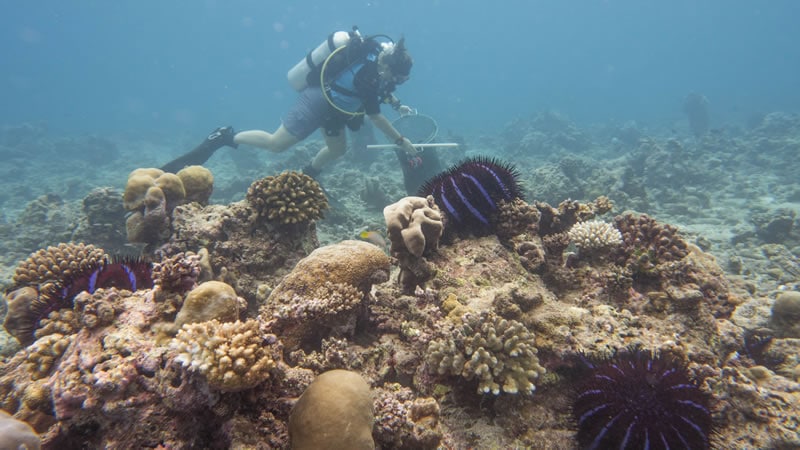
KSLOF SCAR team scouts for COTS.
We started removing COTS immediately. Starfish were concentrated in the reef crest and on the shallow slope, but densities were fairly low. It was rare to see more than one or two COTS near or on an individual coral head and they were usually 5-10 m apart. After several more dives, we had collected COTS along much of the reef. Since the last time Marine Biologist Deb Burn had visited this reef, their population had expanded over a km further south. We also collected COTS to the north, in front of the neighboring island of Himmafushi.
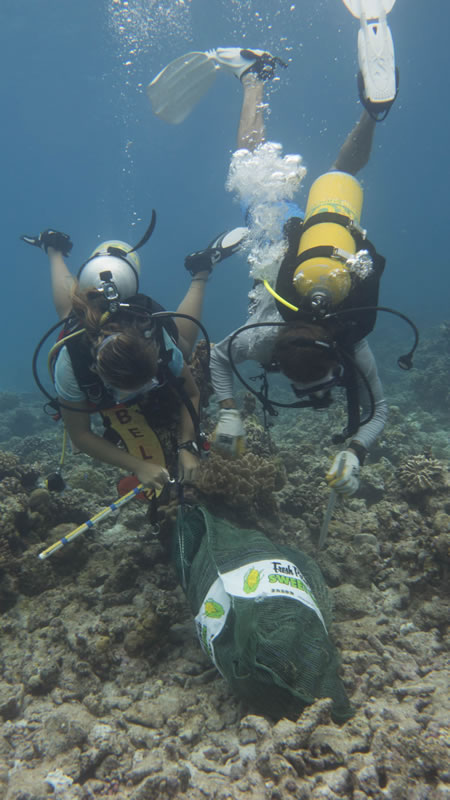
SCAR team removing COTS.
By looking at the patterns of mortality to corals and the condition of the coral skeleton we can estimate when they were eaten. COTS found south of the mooring had only recently invaded that section of reef, as the corals they had eaten still had stark white skeletons. Moving to the north, the reef was a mix of live corals (mostly non-preferred massive corals), partially dead and completely dead corals (mostly branching species, especially Acropora, as well as plating corals). Some of these had been recently eaten (stark white skeletons), while others were eaten weeks to months earlier, as evidenced by the growth of filamentous algae on the skeletons.
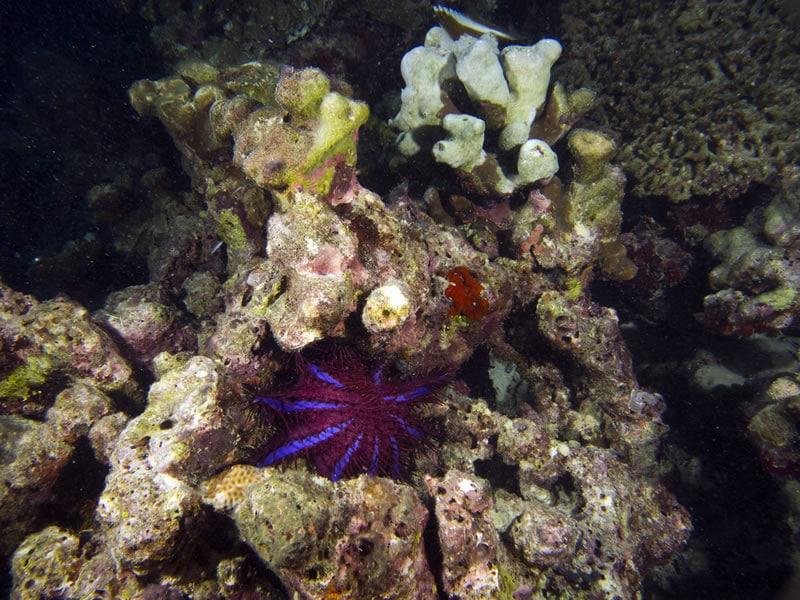
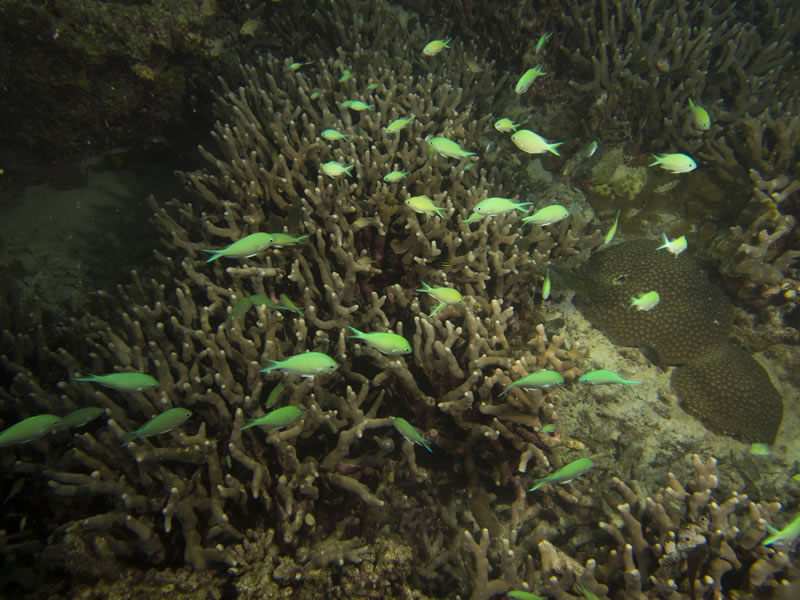
After eating all the branching corals, the remaining COTS eat massive species (left). / Porites cylindrica is never eaten (right).
The numbers of old dead corals that had been consumed by COTS (corals covered in turf algae) increased as we reached the neighboring island. There were also many fewer remaining live colonies of branching and plating corals and we began to see COTS lesions on massive corals such as Porites and Pavona clavus.
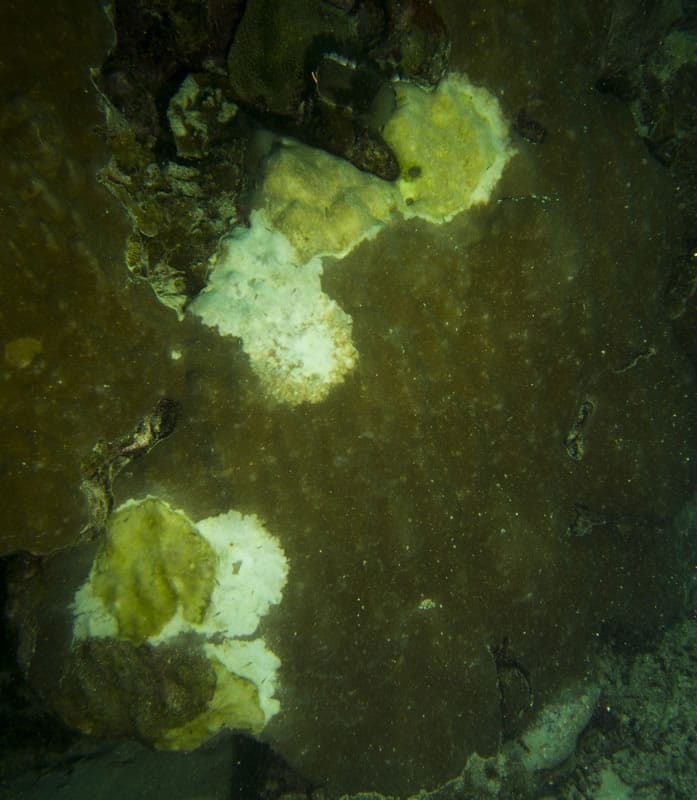
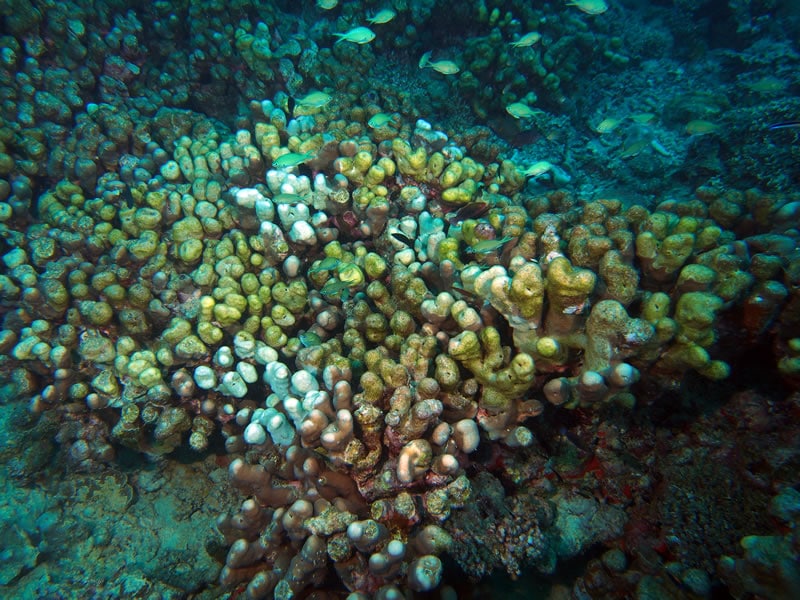
Rarely eaten Porites with recent and week old lesions near channel (left) / Pavona clavus COTS damage (right).
Continuing to the north, we identified the epicenter of the outbreak. COTS were concentrated among the stands of branching and table acroporids in shallow (2-8 m depth) water and among staghorn coral, various plating corals and massive corals slightly deeper with COTS found throughout the reef system. COTS occurred at densities of 2-5 per square meter with some aggregates containing 10-15 starfish.
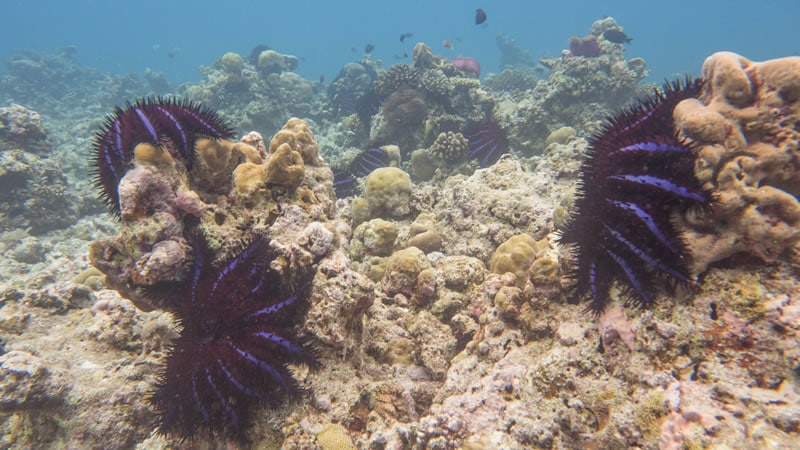
Numerous COTS found along Gili’s reefs.
After removing every COTS we found within this patch of reef, we did additional exploratory dives to the north and west, and examined a neighboring reef across a channel to the north. There were no COTS seen, and no evidence of past mortality. In four days, we collected 974 COTS from a single reef system. We believe we were able to remove the majority of the outbreak, preventing the loss of additional coral from this reef. The two resort marine biologists will dive this reef system again once we leave to remove any last remaining COTS.
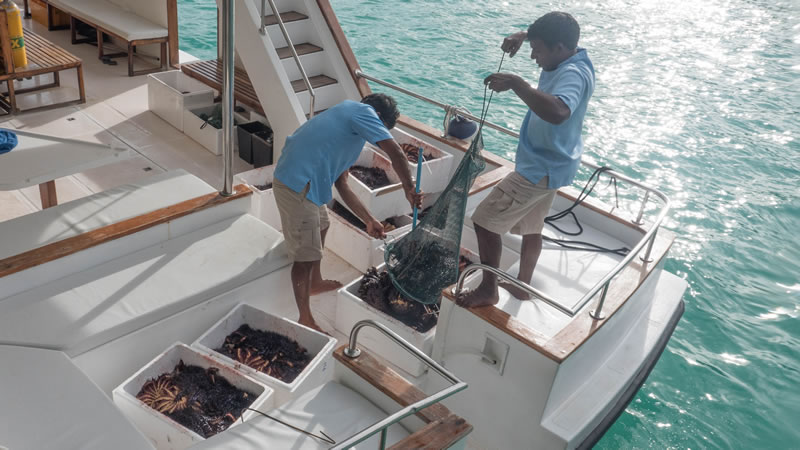
Science divers organize their COTS catch for later counting and cataloging.
Photos: 1,2,5,6,7,8 Andrew Bruckner, 3,4,9,10 Stefan Andrews