Today is our last day diving and providing education near Malakobi Island. The wind has picked up; however, the sun is still out. Today the education team traveled to Kia to provide their education program. Families in Kia started seaweed farming about one year ago. They were kind enough to show us one of their farms.
In part one of this blog, you learned about the uses of carrageenan and how the Solomon Islands has created a sustainable seaweed farming practice. In this blog, you will learn about the process of farming seaweed.
In the Solomon Islands, they grow seaweed, Kappaphycus alvarezii, which is often referred to as Kappa. It can also be referred to by its trade name, Eucheuma cottonii, or just Cottonii.
Seaweed farms are run by families. All members of a family are responsible for participating in farming seaweed. The Ministry of Fisheries and Natural Resources Department of Agriculture will provide seed stock to initiate a farm. Once provided with the seed stock, families select a site and create test plots. Ideally, they will plant the seedlings in water where there is a good current and high salinity.
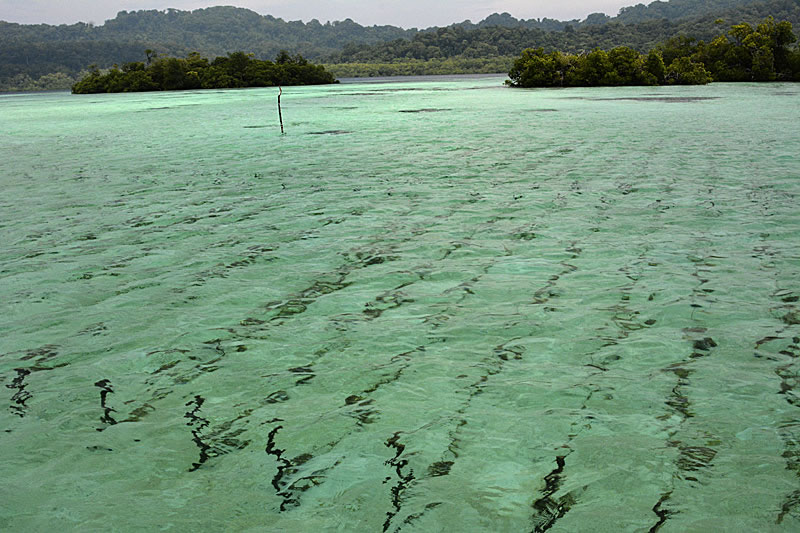
Above water view of seaweed plot marked by stakes.
There are a couple of different farming methods used. The most common is called the off-bottom method. This method of farming takes place in shallow sandy areas. Posts are placed in the sand opposite one another. Then rope is tied from post to post. The seedlings are then tied onto the rope.
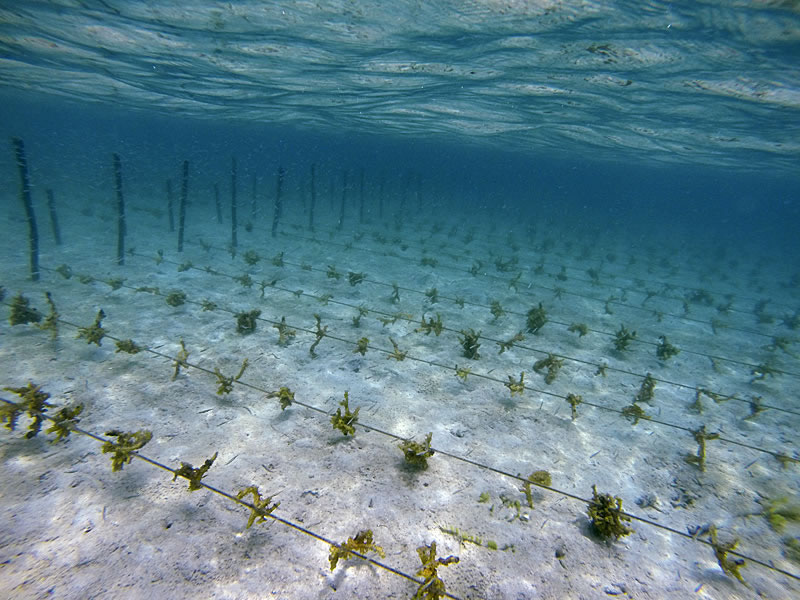
Off-bottom method of seaweed farming.
Once successful results are obtained using the test plot, then farmers can plot additional ones. It is suggested that it takes 6 weeks for the seaweed to reach an optimal size. These plots are harvested on a rotation schedule so that each week they yield a product. For example, during the first week one plot will be planted. Then the following week a second plot will be planted and so on.
Once the optimal size is reached, the seaweed is harvested. The seaweed is placed on raised drying tables. The drying tables are covered with raised plastic to prevent rain and condensation from rewetting the seaweed. Once the seaweed is dried, it is weighed, and placed into sacks that are ready to sell. The seaweed is sold to local agents and then exported to Southeast Asia.
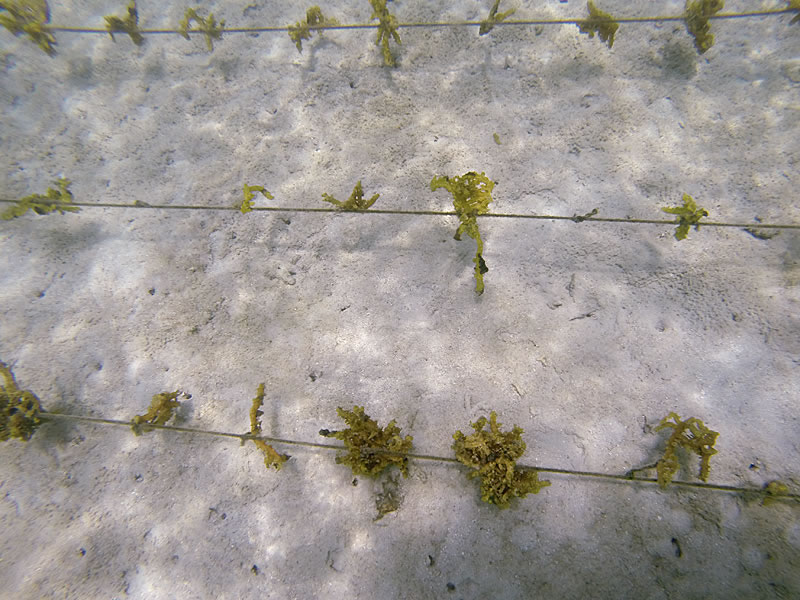
Seaweed attached to rope.
In some communities, such as Wagina, the majority of families are seaweed farming. In 2005, it was reported that 40 of the 58 households were farming seaweed for their main source of income. Seaweed farming has replaced unsustainable fisheries and meets the financial needs and livelihoods of communities in the Solomon’s. These jobs provide sustainable long-term job opportunities for families, especially in rural coastal communities.
Photos: Amy Heemsoth, 1-3