During a dive on an inshore reef I saw my first cuttlefish, a pharaoh cuttlefish (Sepia pharaonis). A cephalopod related to the squid and octopus, this animal has eight tentacles and two arms located in pouches beneath its eyes. It was swimming slowly down the reef slope, backwards.
These animals are found in the Indo-Pacific Ocean from the Red Sea to Japan and Australia. While they are less common in the northern part of the Red Sea, as you move south you can see them in great numbers, but today I saw only one.
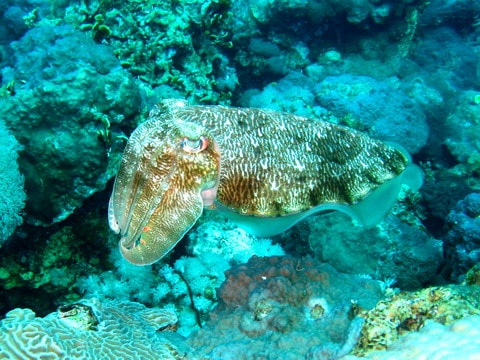
Pharoah’s cuttlefish: Sepia pharoanis
These animals use jet propulsion to swim, which is powered by water ejected from its mantle cavity through a small internal funnel. While I needed to put a bit of air in my BC to avoid sinking to the depths too fast, the cuttlefish can regulate its buoyancy by altering the amount of fluid and gas in its shell chamber. It also uses its fins for stabilization, which slowly undulated, allowing precise more precise steering and propulsion.
Swimming much more slowly than squid, it let me approach quite quickly, changing color as I approached. Rapid color changes are often used by this animal for camouflage as well as fear, anger or sexual arousal.
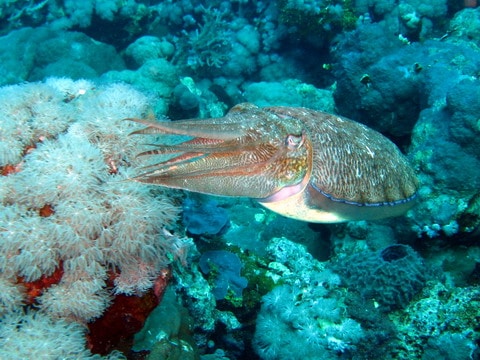
A cuttlefish swimming down the reef slope.
The cuttlefish uses its eight tentacles, with suction cups on the inner surfaces, to capture prey and its two arms to hold the prey while it consumes the food through its parrotlike beak, using its radula to rasp or tear.
It seemed to be keenly interested in me and was unwary. Cuttlefish have eyes that are binocular and provide excellent sight.
The pharaoh cuttlefish eats fish, shrimp or crabs smaller than itself. Unlike octopuses, it doesn’t like to eat shelled mollusks, but they are known to be cannablistic if they can’t find any other food. They don’t live very long – males may survive up to about 220 days, while a female will mate when she is 110 days old, becoming lethargic and rapidly deteriorating after spawning.
While these animals are not yet threatened, they are used by man. Cuttlefish ink is composed of melanin and has been used as the artist’s pigment called sepia. Their shells may be used as a calcium supplement, or ground into a powder for polishing silver and cleaning teeth.
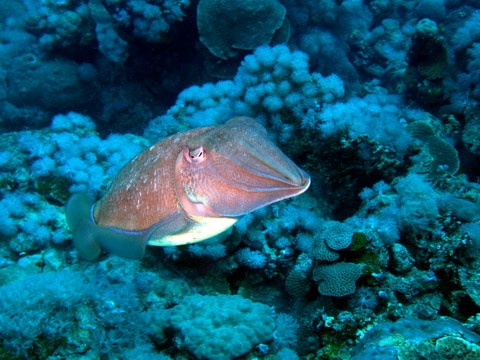
The graceful cuttlefish
There is a second species of cuttlefish found in the Red Sea as well as a few species of Octopus. With any luck, I may see these before the end of our Expedition.