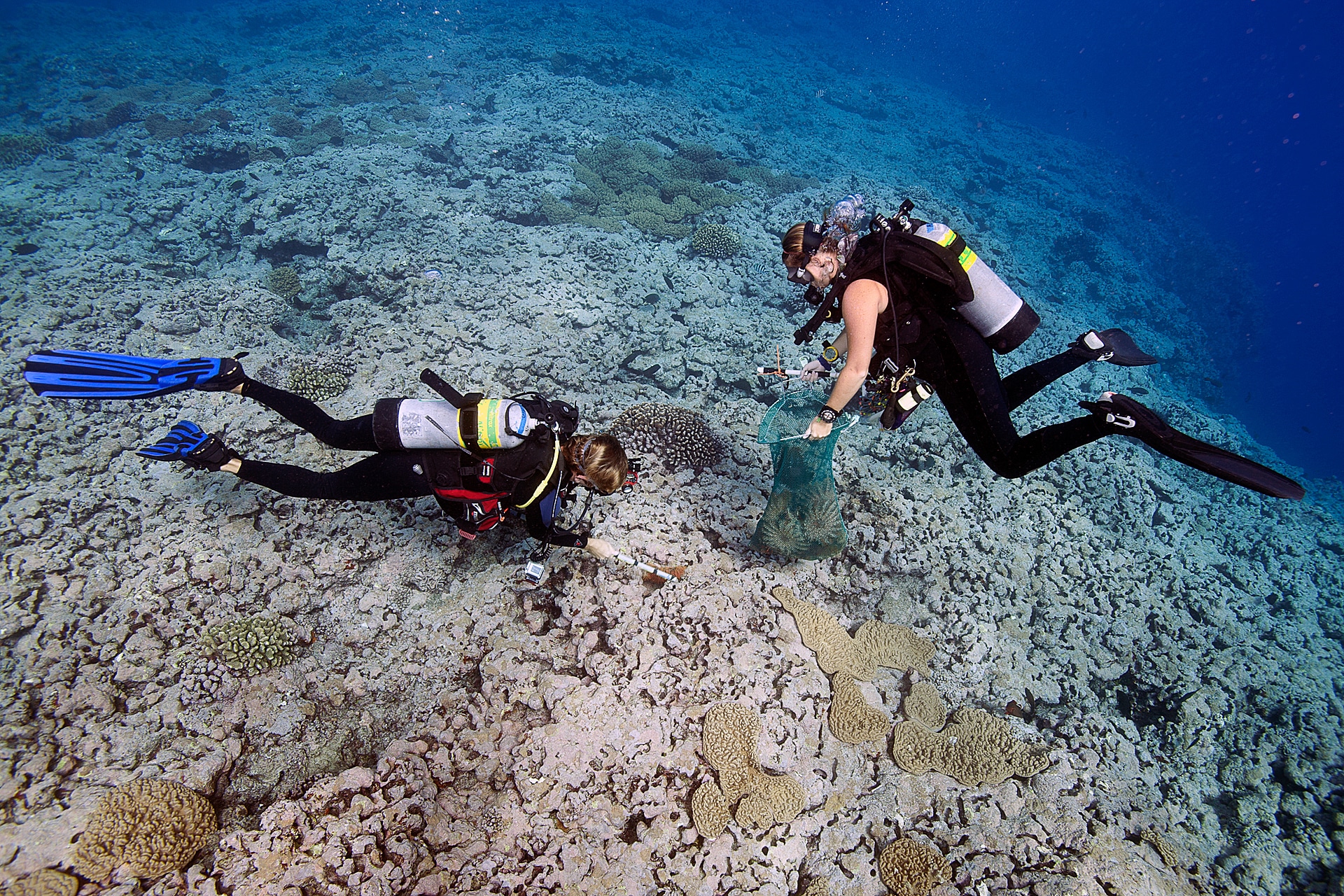
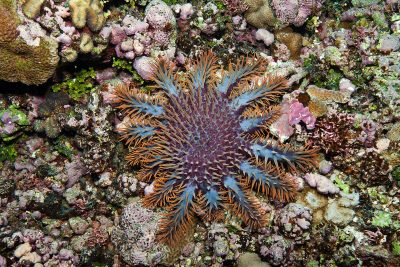
While conducting coral reef surveys in the Cook Islands, scientists were shocked to see the ongoing devastating effects of a Crown-of-Thorns-Starfish (COTS) outbreak. On the reefs surrounding the island of Aitutaki, over 80 percent of the live coral community was decimated by these corallivores. But what exactly are COTS?
Crown-of-thorns starfish (COTS) are naturally occurring organisms on the reefs of the Indo-Pacific Ocean that primarily eat coral. Finding a few COTS living on a coral reef is a normal and healthy part of the coral reef ecosystem. However, at times their population can drastically exceed normal levels and a COTS outbreak can occur. COTS outbreaks can cause extremely rapid destruction of coral reef ecosystems in a matter of months. In recent years, COTS outbreaks have increased in scale and frequency, causing marine resource managers and scientists to take action. We saw outbreak numbers in the Cook Islands, specifically on the reefs surrounding Aitutaki. Our science team decided to take the initiative and physically removed COTS from the reefs to better study their size class structure and record the number of starfish. But this was no small task.
There are several techniques that can be used to remove COTS from a coral reef. The best and most successful method is to remove the starfish from the water to be destroyed. Experienced divers can use a wooden stick, PVC pipe, metal spear, boat hook or some other easily manipulated rod to remove the starfish from the reef. COTS can hide in small holes or crevices and use their tubefeet to suction onto the reef. This can make collecting COTS challenging, that is why using a rod or stick to pry the starfish off the reef is the best tool. The collected starfish were placed in large bags and brought to the boat. The sharp poisonous spines of the starfish can penetrate the bag and are very painful if stung, so extreme caution was used by the scientists to try to avoid any spine pricks.
Once the starfish were removed from the water, scientists measured each starfish and logged those metrics into the database for further analysis. On the Global Reef Expedition in 2013, a total of 530 starfish were collected from 10 locations in Aitutaki. These animals were 9-38 cm in length, with an average of 26.8 cm. After the measurements were collected, the starfish were placed in a large container filled with freshwater and submerged for at least 48 hours.
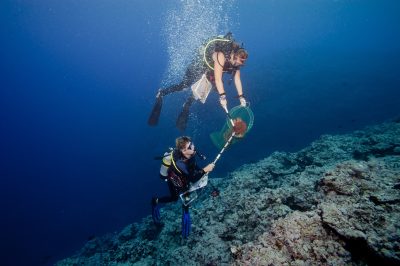
After witnessing such a devastating outbreak of COTS on Aitutaki, we kept in close contact with government officials in the Cook Islands including the Aitutaki Council and Mayor, concerned dive operators, hotel owners, and other local stakeholders. In July 2015, we were asked to return to Aitutaki to assess the newest wave COTS outbreak. On that two-week mission, we saw that the COTS population had exploded once again and that the starfish had begun to start feeding on patch reefs in the lagoon, which had not occurred at the time of 2013 GRE mission. We surveyed 53 new dive and snorkel sites around Aitutaki, removing another 276 starfish from the reef.
The big question though is can reefs recover from several extensive COTS outbreaks? The answer, of course, is rather complicated and dependent on several environmental factors. With successful coral recruitment and COTS management, it is possible for reefs to rebound, but with the ever-changing impacts of climate change on coral reefs, the outcome is difficult to predict.
[embedyt] https://www.youtube.com/watch?v=-ardrFZuFkU[/embedyt]
Learn more
 For more detailed information on our work on coral reefs in the Cook Islands, read our latest publication, the Global Reef Expedition: Cook Islands Final Report.