Students Explore the Hidden World of Microscopic Marine Life Through Art
The Khaled bin Sultan Living Oceans Foundation is proud to announce the winners of the 2026 Science Without Borders® Challenge, an international student art contest that promotes ocean science and conservation. This year’s theme, Microscopic Marine Life, challenged students to explore the hidden world of ocean microorganisms and illustrate how these tiny organisms sustain marine ecosystems—and life on Earth itself.
Open to primary and secondary school students ages 11–19, the competition received nearly 900 submissions from 65 countries around the world. Through painting, drawing, and mixed media, students transformed invisible ocean life into vivid visual stories, highlighting the critical role microscopic marine organisms play in producing oxygen, supporting marine food webs, recycling nutrients, and regulating Earth’s climate.
The winning entries reveal a remarkable blend of artistic talent and scientific understanding. From phytoplankton drifting beneath sunlit waves to microscopic organisms fueling deep-sea ecosystems around hydrothermal vents, students explored the extraordinary impact of life too small to see with the naked eye. Artwork in the competition was judged in two categories based on age. The winning entries in each age group are not only beautiful pieces of artwork, but they also encourage viewers to take a closer look and appreciate marine organisms that are invisible to the naked eye.
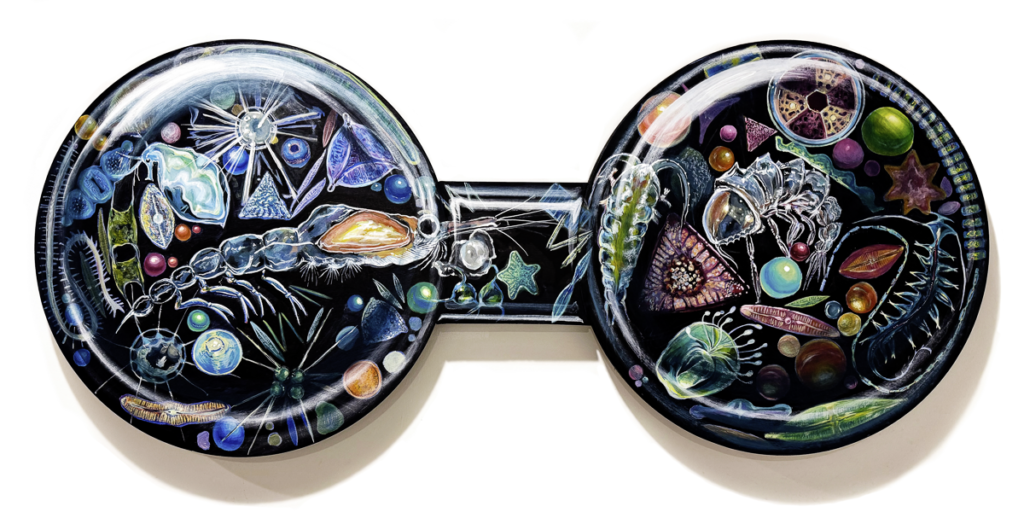
In the 15–19 age group, the first-place winner of the 2026 Science Without Borders® Challenge is Sophia (Jiye) Lee, a 17-year-old student at Bergen County Academies in Hackensack, New Jersey, for her striking mixed-media piece, Ocean’s Hidden Jewel Box. Inspired by the structure of an oxygen molecule, Sophia created her artwork on a custom-shaped wooden canvas that transforms microscopic marine organisms into glowing jewel-like forms, emphasizing their beauty and importance in sustaining life on Earth. Although invisible to the naked eye, microscopic marine organisms such as plankton produce more than half of the oxygen we breathe, making them essential to life on our planet.
“When people see my work, I hope they recognize that significance is not defined by scale. I want them to feel a sense of awe for the unseen and to realize that impact can extend beyond just the source,” said Sophia. “Just as my piece breaks traditional borders of a canvas, the contribution of these organisms breaks the borders of the ocean to sustain every breath we take, no matter where we are.”
Second place in the 15–19 category was awarded to Qing Yang Cheng, age 17, from Canada, for The Deep Microcosm of Life, a detailed portrayal of hydrothermal vent archaea and the deep-sea ecosystems they support through chemosynthesis. Third place went to Hyang Yu Lee, age 17, from the Republic of Korea, for Sea Manual, an innovative piece that presents how marine bacteria support decomposition and nutrient cycling in the style of an IKEA instructional manual.
In the 11–14 age group, the first-place winner of the 2026 Science Without Borders® Challenge is The Giant and the Invisible: A Story of Ocean Recycling by Olivia Shin. Created in charcoal on a piece of recycled cardboard, the artwork depicts the decomposition of a blue whale carcass by microscopic marine organisms, highlighting their role in recycling nutrients and sustaining deep-sea ecosystems for decades after a whale fall reaches the ocean floor. Olivia, a 14-year-old student from Calgary in Canada, used both her materials and composition to reinforce the interconnected systems that support life in the deep sea.
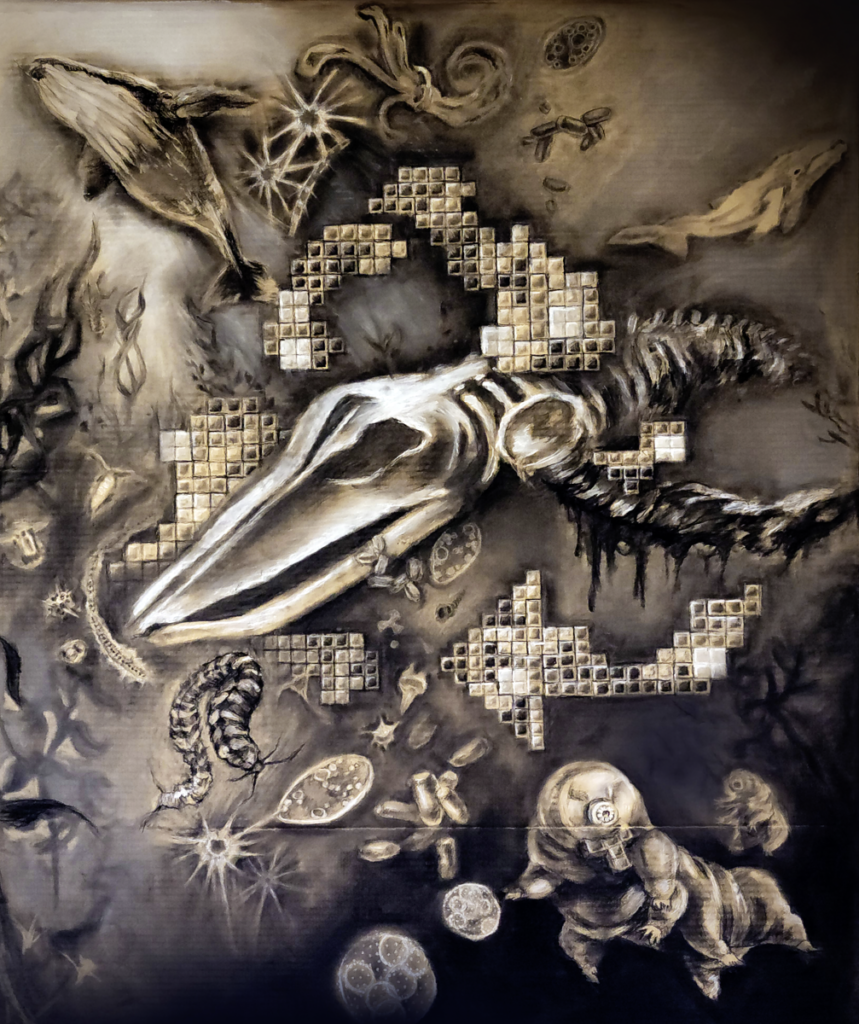
“I was inspired by how bacteria clump together and work with microorganisms, which to me resembled the game of Tetris,” said Olivia. “I hope that my artwork can encourage others’ thoughts and interest in marine life.”
At only 11 years old, Jieming Zhang from China took home second place in the younger age group for his piece, The Touch of Life, for their vibrant illustration of the role symbiotic microalgae play in providing energy and supporting the health of their coral hosts. Third place was awarded to Eason Liang, age 14, from Irvine, California, for The Invisible Engine of the Ocean, which reimagines microscopic marine life as the machinery powering Earth’s natural systems as they regulate climate, sustain food webs, and maintain balance in the ocean.
Each winner will receive a scholarship of up to $500 from the Khaled bin Sultan Living Oceans Foundation to celebrate their achievements and help them pursue their interests in art and ocean conservation.
Now in its 14th year, the Science Without Borders® Challenge continues to engage students around the world in important ocean science and conservation topics through art. The Khaled bin Sultan Living Oceans Foundation created the competition to educate students about the need to protect our oceans and inspire the next generation of ocean advocates.
“This year’s theme challenged students to explore a world that is rarely seen but absolutely essential to life on Earth,” said Amy Heemsoth, Chief Operating Officer and Director of Education at the Khaled bin Sultan Living Oceans Foundation. “Through their artwork, these students transformed complex scientific ideas into powerful visual stories, helping others better understand the critical role microscopic marine life plays in sustaining our oceans and our planet.”
The Khaled bin Sultan Living Oceans Foundation extends its heartfelt congratulations to all the winners and participants of the 2026 Science Without Borders® Challenge and thanks them for using their creativity and passion to raise awareness and inspire positive change for our oceans.
For more information about the Science Without Borders® Challenge and the Khaled bin Sultan Living Oceans Foundation, please visit www.LOF.org/SWBChallenge.
Winners of the 2026 Science Without Borders® Challenge
SECOND PLACE (15-19): "The Deep Microcosm of Life" by Qing Yang Cheng, Age 17, Canada
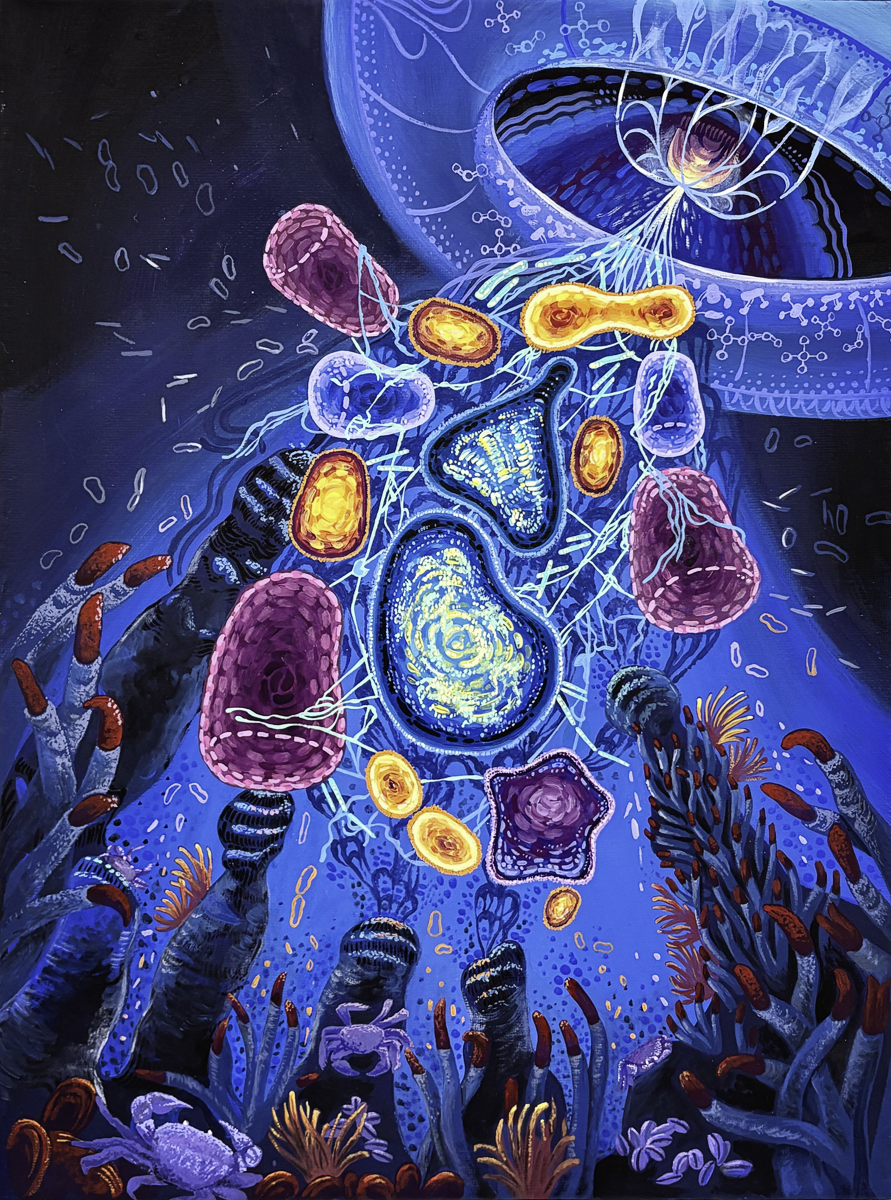
ARTIST’S STATEMENT: Beneath the dark, remote world of hydrothermal vents, microscopic archaea power entire ecosystems. A cross-section of the “Pyrolobus fumarii” reveals its generative inner workings that use chemosynthesis to transform vent chemicals into food, forming the foundation of deep-sea food webs. The crucial role hydrothermal vent archaea play as primary producers is reinforced by the cluster of microbes magnified to radiate light, representing the brilliance of the life that sustains the surrounding deep-sea marine community. “Methanopyrus kandleri” interlace into lines that converge in the center of a cyclical shape that symbolizes the global cycles of carbon and methane these archaea contribute to. The use of pointillism and visual contrast between luminous microbes and encircling darkness mirror the dichotomy between the minuscule scale of microbes and the immense vitality they support. It evokes a sense of awe at how tiny life underpins hydrothermal vent ecosystems and the planet’s key geochemical cycles.