The Science Without Borders® Challenge continues to inspire young artists around the world to explore ocean issues through art. This year’s first-place winner in the 15–19 age group, Sophia (Jiye) Lee, brought the 2026 theme, Microscopic Marine Life, to life in a really unique way with her piece, “Ocean’s Hidden Jewel Box.” From the moment I saw her artwork, I could tell how much thought and intention went into both the science and the message behind it.
Sophia’s piece transforms microscopic marine organisms into glowing, jewel-like forms, highlighting both their beauty and their importance. Painted in acrylic on a custom-built wooden panel shaped like an oxygen molecule, her work pushes beyond a traditional canvas to show how these tiny organisms play a huge role in producing oxygen and supporting life on Earth.
Her Fine Arts Teacher at Bergen County Academies, Ms. Natalia Mak, shared that she saw Sophia grow in so many ways throughout the Challenge. She described her as “increasingly self-motivated and resourceful,” especially when it came to researching complex ideas and refining her work. She also noted that Sophia’s openness to feedback and willingness to improve really helped elevate the final piece.
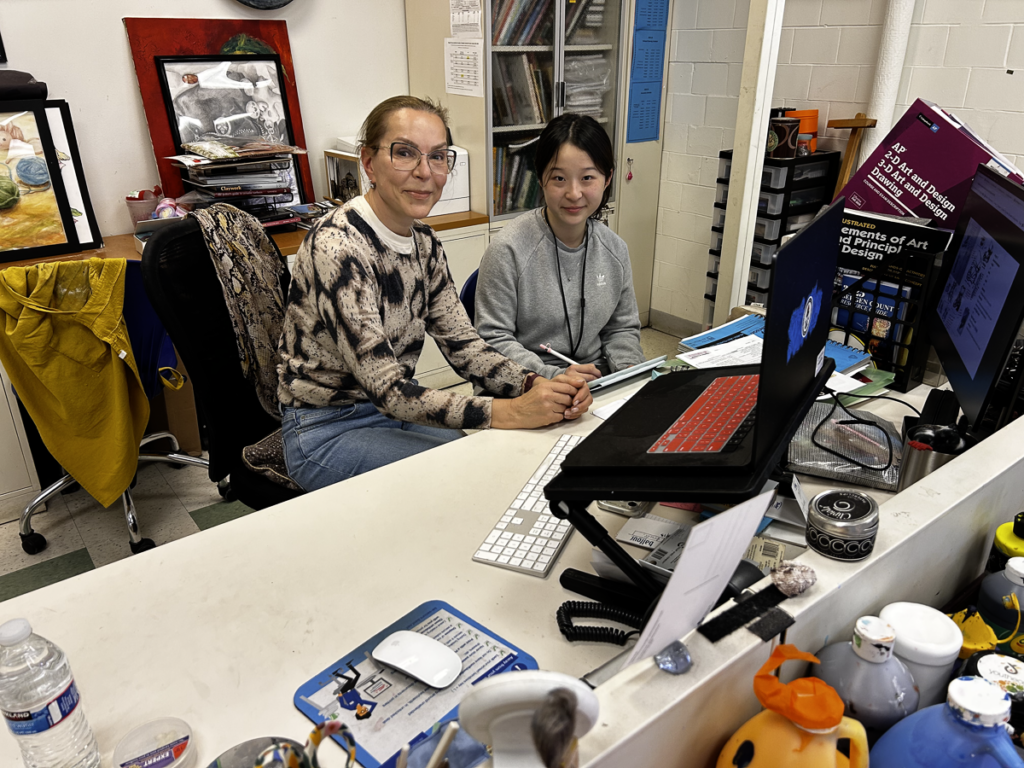
It’s easy to see why this artwork stood out. As Ms. Mak put it, it reflects “technical skill, artistic approach, new fresh format, and deep thinking.”
Read on to hear from Sophia about her inspiration, what she learned, and why microscopic marine life matters more than we might think.
Q: Congratulations on winning the Science Without Borders Challenge! What does winning this contest mean to you?
A: To me, this win is an incredible validation of my creative process, and it’s an honor to be recognized at an international level. This win reminds me that the issues facing our oceans are universal, and participating in this competition allowed me to feel connected to a larger community of young activists and artists who are all working toward a similar goal: advocating for a healthier planet. Moreover, it was extremely rewarding to translate a somewhat challenging story visually and see that effort resonate with others.
Q: Tell me about your artwork. What does it mean to you?
A: To me, this artwork was a convergence of my academic, personal, and artistic interests. Every choice I made, from researching to arranging my canvas a certain way to using the “gemstone” metaphor to depict marine life, was considered to fulfill my goal as a student activist and artist: to shift the viewer’s perspective. By framing these seemingly invisible organisms as precious jewels at an enlarged scale, I wanted to highlight that, though they are so small as to be unseen, their impact is so great that they dictate the very shape of the canvas. This piece is a reminder that our survival doesn’t just depend on the vast, visible parts of nature, but also the delicate, microscopic systems that hold everything else together.
Q: What inspired your idea? What do you hope people think or feel when they see your work?
A: I initially got my inspiration while going through my old school assignment papers. During that time, I had been sketching ideas for depicting microscopic marine life when I came across a worksheet I had done in my chemistry class on Lewis structures. Looking at the interconnected circles and lines representing molecular bonds, I realized that a standard rectangular canvas was too restrictive for a subject that is essentially a building block of our atmosphere.
I decided to extend my message beyond the frame, making the canvas itself an active component in my work. I wanted to highlight that the vital work these organisms perform cannot be contained in a box-like structure; their influence flows throughout the entire planet. By shaping the canvas into an oxygen molecule, I wanted to physically represent the output these microscopic lives help produce.
When people see my work, I hope they recognize that significance is not defined by scale. I want them to feel a sense of awe for the unseen and to realize that impact can extend beyond just the source. Just as my piece breaks traditional borders of a canvas, the contribution of these organisms breaks the borders of the ocean to sustain every breath we take, no matter where we are.
Q: What did you learn by participating in the Science Without Borders® Challenge?
A: From participating in the Science Without Borders® Challenge, I learned not just about the ocean’s microscopic marine life and what they do, but also about myself. Reading scientific articles about plankton and diatoms felt intimidating at first, but once I started sketching and painting them, I became genuinely fascinated. The biggest surprise was realizing how beautiful these tiny creatures are. The challenge was recreating that beauty accurately while also telling a meaningful conservation story. In the end, I learned that I could turn my initial fear of complex ideas into creative fuel.
Q: Why do you think microscopic marine life is important? Has this experience changed how you see your role in protecting the ocean or the planet?
A: Microscopic organisms are important because they are the invisible engines of our planet. Organisms like plankton and diatoms produce over half of the Earth’s oxygen and form the foundation of the marine food web. Without them, larger marine life—and ultimately humans—cannot survive. Though they are small, their absence would collapse entire ecosystems.
Researching and translating what I learned into a visual art format changed how I see my role: I no longer think of ocean conservation as just protecting coral reefs, coastlines, or big animals. Now, I feel responsible for protecting and advocating for the not-so-easily seen creatures. I cannot personally see phytoplankton from the shore, but I now know that every breath I take is a result of nature’s interconnectedness. Moving forward, I want to use my art to give a voice to overlooked subjects.
Q: Is there anything else that you would like to add?
A: To start, I want to thank the organization for allowing me to have such a big platform to share my work. When I found out I won, I honestly didn’t believe it at first. After the shock wore off, I felt something deeper than excitement—I felt seen. Not just my art, but the message I had poured into every detail, from the canvas formation to the tiny white sparkles of the diatoms. Overall, it was an incredibly validating experience.
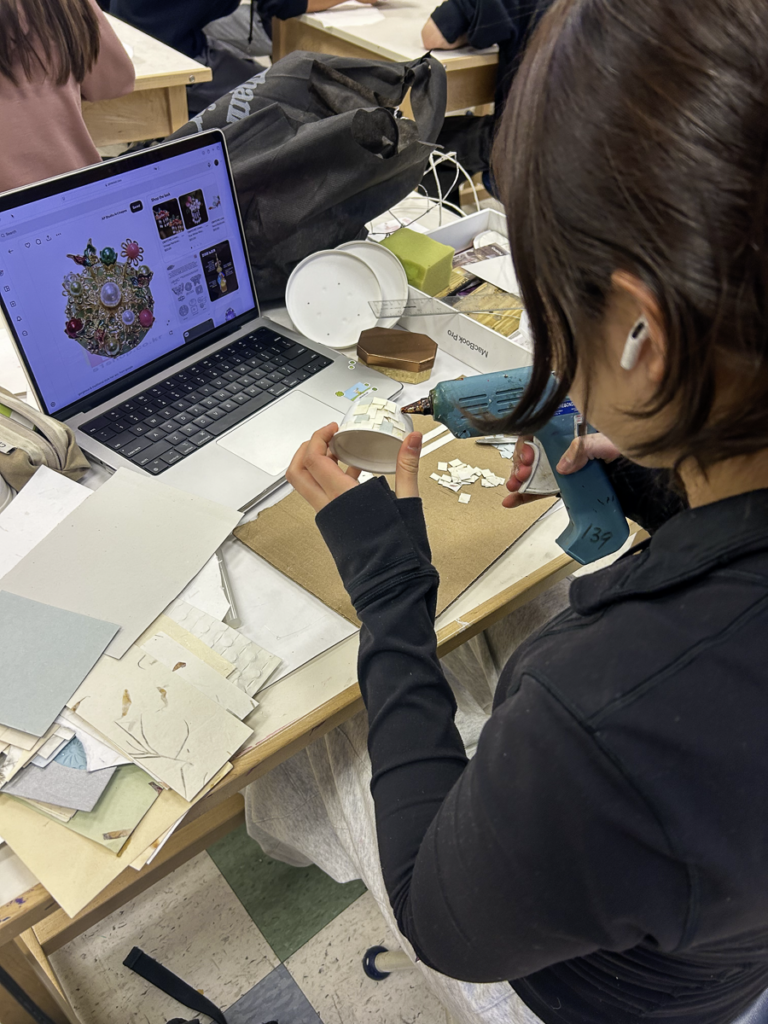
The most enjoyable part of creating this artwork was experimenting with the unconventional canvas shape. Spending time with my uncle and teacher to assemble the oxygen molecule was a frustrating, but fun process. Every moment of the creative process for this work taught me something new. One moment that stood out was when I finally placed the two circular panels together and stepped back. For the first time, I saw the tiny “jewels” glowing against the black background, and I realized they looked exactly as I had imagined. That doesn’t really happen often for me as an artist.
What I want people to know about the ocean is this: you don’t have to live near it to be connected to it. The oxygen in our lungs, the rain that falls in our area, and the temperature of the summer we share are all influenced by organisms that we often don’t and never will see. Protecting the ocean starts with respecting what lies beyond our vision.