
search-icon
Death by 1000 Cuts

Worldwide, coral reefs are declining at an alarming rate.  This is most apparent in the Caribbean, where reefs have been transformed from coral gardens – 60-70% of the bottom was carpeted in thickets of elkhorn coral and staghorn coral, mountainous boulders of star coral and foliaceous plates of lettuce coral in the 1970s- to meadows of fleshy algae, or macroalgae with less than 5% living coral cover.  There are similar examples in the Pacific.  We’ve seen the most majestic of reef environments in one location, while a reef located a few km away is devoid of coral.
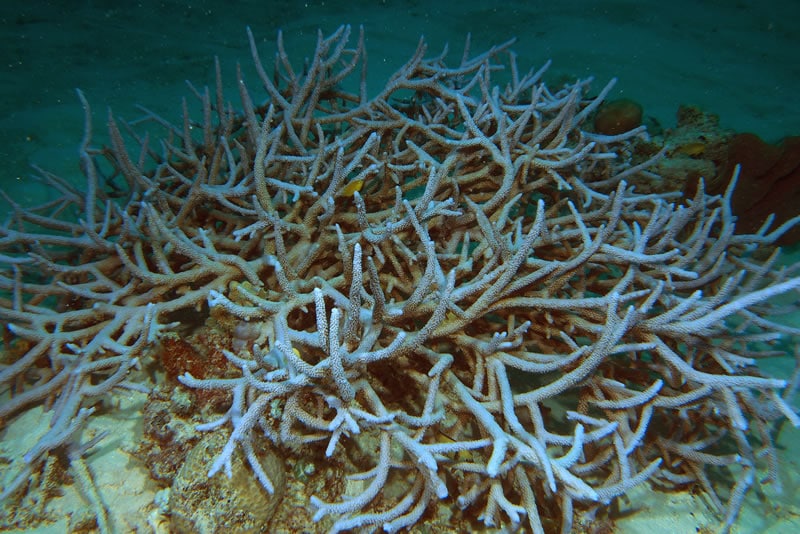
Fragile branching corals such as this Acropora (staghorn coral) tend to grow in sheltered locations.

Why is this happening?  Climate change, especially increased sea water temperatures are the most severe global cause of decline, but many other localized impacts such as overfishing, destructive fishing, sedimentation and pollution associated with land-based activities and a host of other factors are also responsible.  There are natural causes as well.  We’ve seen many areas devastated by crown of thorns sea stars.  And we’ve witnessed coral disease outbreaks.  Storms can also cause catastrophic losses of corals and destruction of the reef framework.
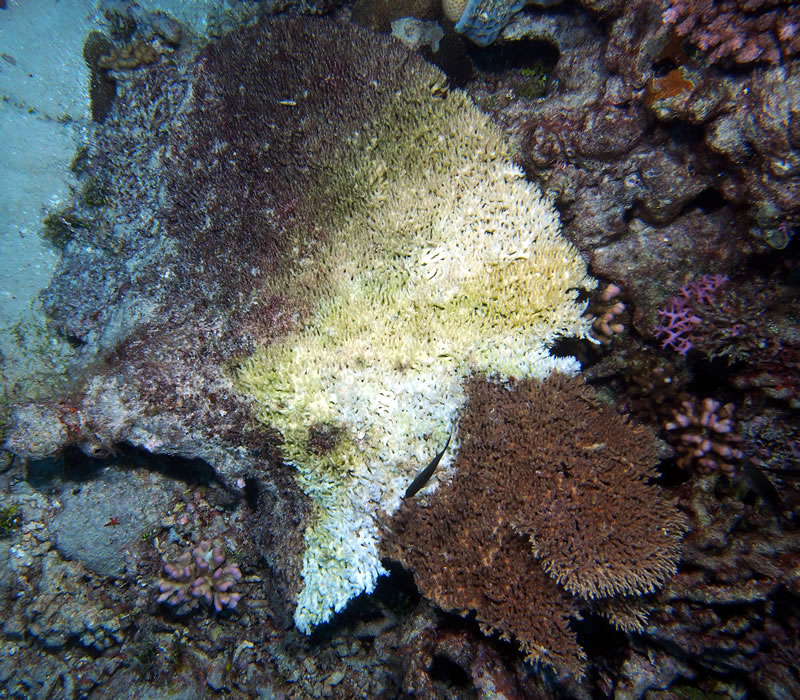
Coral fragments that are broken and toppled during storms may be abraded or buried by sediment and they are often more susceptible to coral diseases such as the table acroporids shown here.
(Click thru on image for more detail.)

Tropical Cyclone Ita Damage to the Great Barrier Reef

In April, 2014 a particularly devastating storm, Tropical Cyclone Ita, attained peak intensity as a  Category 5 cyclone as it moved away from Papua New Guinea and tracked south-southwest, making landfall near Cape Flattery, and then moving offshore past Lizard Island.
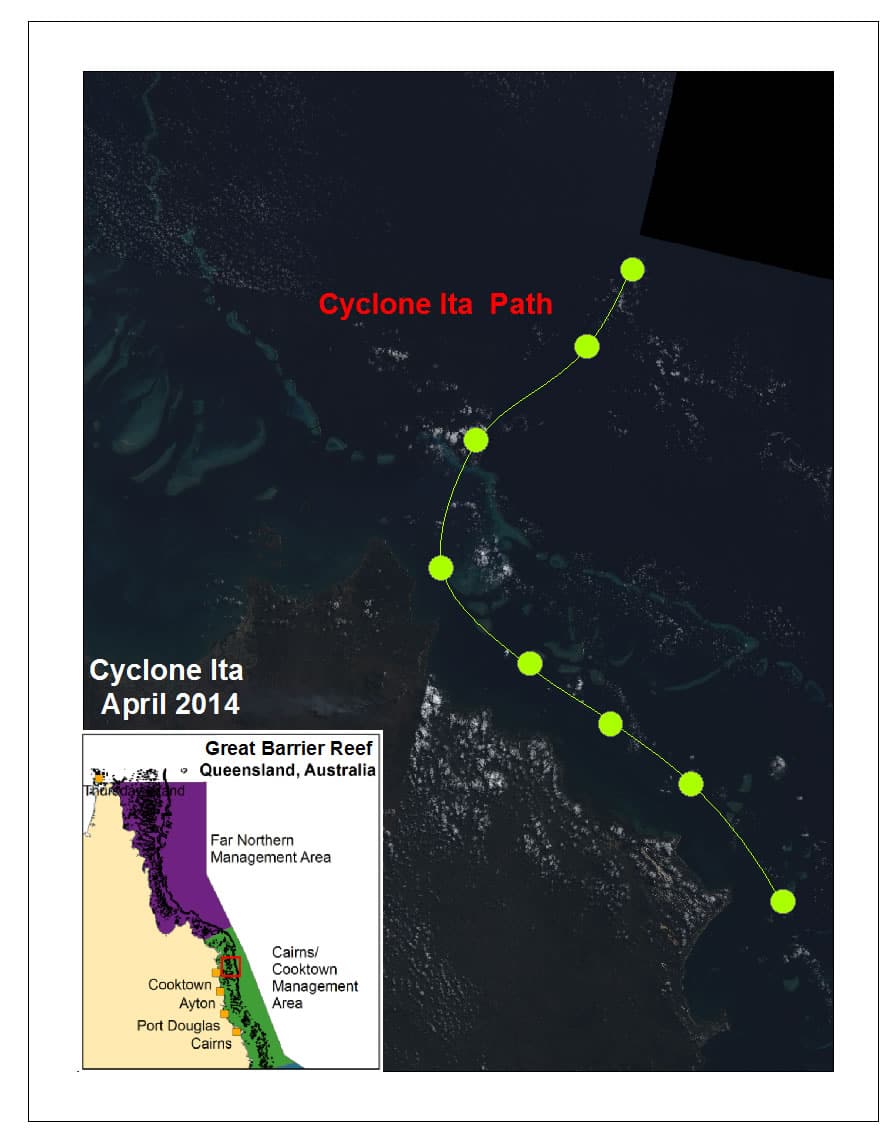
Path of Tropical Cyclone ItaPath of Tropical Cyclone Ita
(Click thru on image for more detail.)

Today’s dive, at the southwestern end of Hicks Reef, we witnessed considerable storm damage. Thickets of staghorn coral had been crushed and their skeletons littered the bottom. Large massive corals and entire chunks of reef rock had tumbled down the reef accumulating at the base of the reef slope.  We measured rubble piles that were more than 70 cm deep.
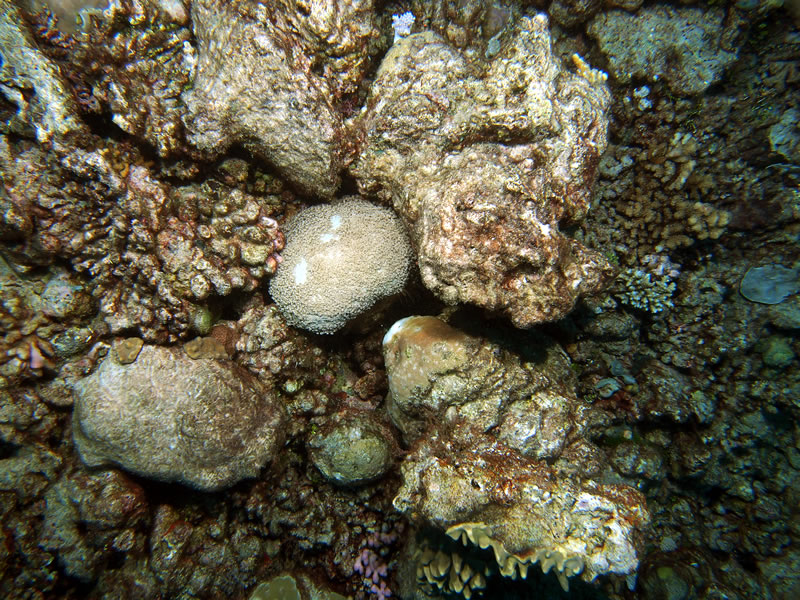
Boulder corals that were detached from the reef and accumulated at the base of the reef slope.
(Click thru on image for more detail.)

While the damage was alarming, reefs have weathered storms throughout their history and in absence of other stressors they demonstrate remarkable resilience, rebounding in a matter of years.  Given the high survival of coral fragments we observed among the rubble piles, we expect similar rates of recovery on Hicks Reef.
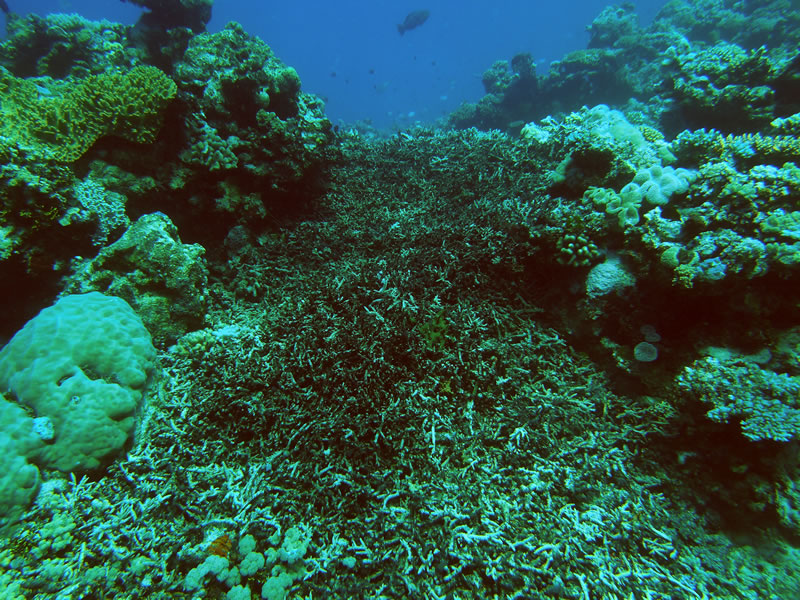
A thicket of staghorn coral that was flattened by Cyclone Ita.
(Click thru on image for more detail.)

Photos by Andrew Bruckner.
Related Posts

Introducing Our New Website: A Fresh Look for the Foundation’s Future

As we celebrate the Khaled bin Sultan Living Oceans Foundation’s 25th anniversary, we are proud to unveil our newly redesigned website—a modern home for our science, conservation work, and educational programs. This launch marks an important moment for the Foundation as we honor our long history and look toward the future of ocean conservation.

For more than two decades, the Foundation has worked tirelessly to improve the health of our living oceans. We have advanced ocean science, led one of the largest coral reef research missions in history, restored mangrove forests with local communities, created award-winning education programs, and shared the wonders of the ocean with people around the world. Our new website reflects the organization we are today—focused on conserving coral reefs, restoring mangrove forests, and improving ocean literacy—while still highlighting the legacy of work that brought us here.

The redesigned site…

Read More

Connecting People, Art, and Oceans: Championing Conservation at the 2025 IUCN Congress

The IUCN World Conservation Congress brings together thousands of leaders and decision-makers from governments, non-profit organizations, civil society, Indigenous groups, and the private sector to shape global conservation policy and action. This influential gathering serves as a platform to share knowledge, build partnerships, and advance initiatives that protect our planet’s biodiversity.

As a member of the International Union for Conservation of Nature (IUCN), the Khaled bin Sultan Living Oceans Foundation was honored to take part in the Congress, joining a global community of leaders, organizations, and changemakers committed to protecting nature and advancing sustainable futures.

Read More
Privacy Overview

This website uses cookies so that we can provide you with the best user experience possible. Cookie information is stored in your browser and performs functions such as recognising you when you return to our website and helping our team to understand which sections of the website you find most interesting and useful.  You can view our complete Privacy Policy here.

Strictly Necessary Cookies

Most of our cookies are used to improve website security and reduce spam. These cookies should be enabled at all times. They also enable us to save your preferences for cookie settings.

3rd Party Cookies

This website uses Google Analytics to collect anonymous information such as the number of visitors to the site, and the most popular pages. Keeping this cookie enabled helps us to improve our website.
