Expedition Log: BIOT – Day 17
Every marine biologist has a bucket list of creatures they want to see during their life underwater. I am no exception and during the BIOT missions I seemed to have amazing luck, with the opportunity to cross several items off my list. Dive with dolphins, see an oceanic sunfish (Mola mola) up close and personal and have some extraordinary encounters with different species of rays, to name a few. However, it was on our second-to-last day of research when I had the chance to experience one of my most incredible marine life encounters.
For our second dive of the day we jumped in to survey a fore reef at Peros Banhos. The visibility was great, the water was warm and I watched as the team slowly descended on to the reef to begin their work. I don’t know what made me look up at this point, but I did and just above me, in arms reach was a 6-7m long whale shark (Rhincodon typus).
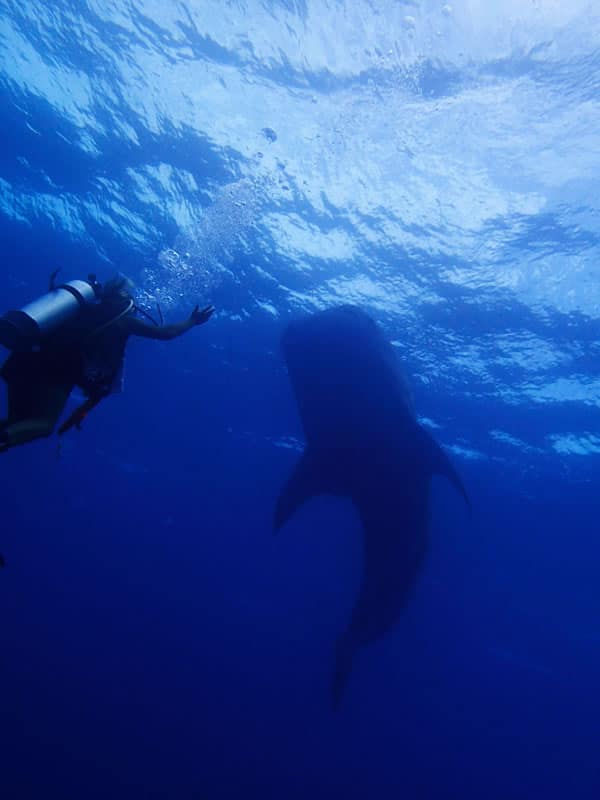
Here’s what I saw when I looked up … a 6-7m long whale shark!
This was the first time I had ever seen a whale shark, let alone be so close to one that I could have touched it. All I could do was yell in to my regulator in the hope of getting everyone’s attention, and then enjoy the moment with the world’s largest species of shark, one of the ocean’s most majestic animals and number one on my marine bucket list.
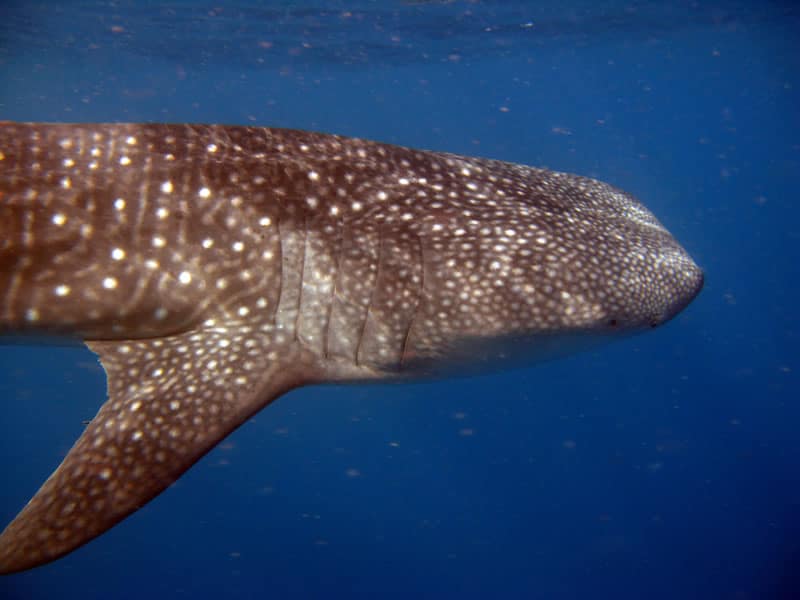
My whale shark encounter … close up.
Whale sharks are the largest non-mammalian vertebrate in the world and have been recorded up to 12.6m in length and over 21 tonnes. These sharks are filter-feeders, using their enormous mouths to filter plankton, larvae, krill and small nektonic life from tropical and warm temperate waters.
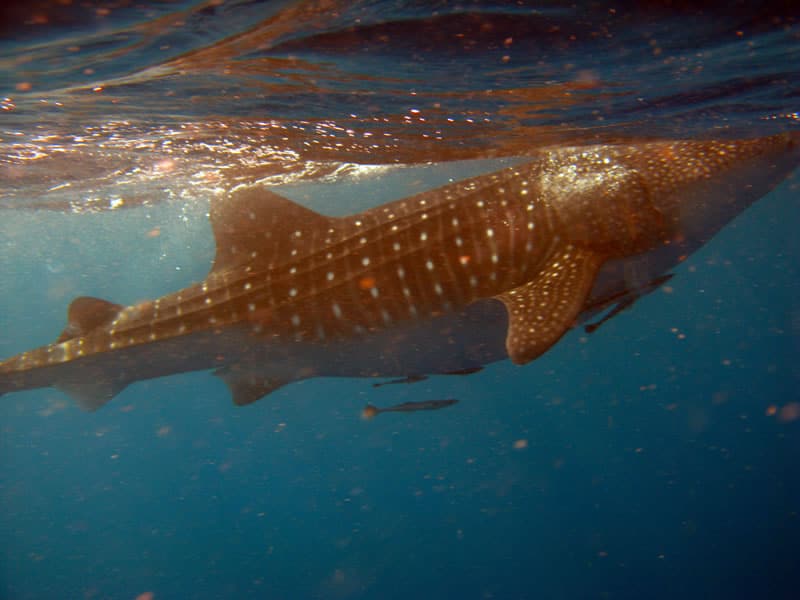
A whale shark feeding … filtering plankton, larvae, and krill.
Compared with other sharks not much is known about their life history but they reach sexual maturity around 30 years old, can live up to 70-100 years and are highly migratory. Recent satellite and tagging studies have revealed that whale sharks undertake several long-distance migrations each year, sometimes over 10,000 km per migration! Despite their high economic value in tourism these characteristics have unfortunately made them vulnerable to both direct and indirect fishing in some parts of the world. As a result, they are now listed as vulnerable on the IUCN Red List and worldwide extensive efforts are in place for their conservation.
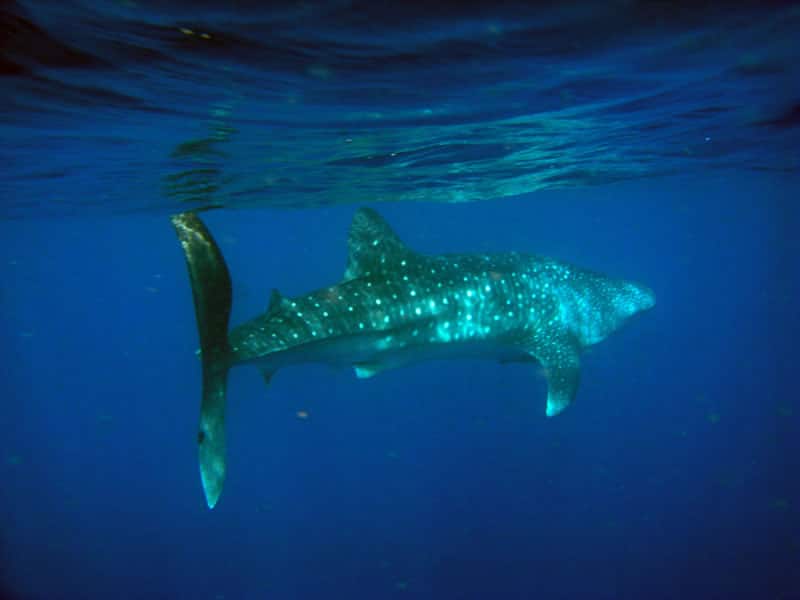
One last look as the whale shark swims away.
I feel very lucky to have experienced the outstanding and vibrant reef environment of BIOT; from the schools of thousands of brightly coloured anthias to the large rays and sharks. These research missions have shown me that you never know when there will be the opportunity to cross something off your marine bucket list. But, for me, that is part of the magic of working in the ocean.
Photos: 1 Anderson Mayfield; 2-4 Andrew Bruckner