Traveling from dive spot to dive spot in Tonga it’s not difficult to find a misty cloud of water near the surface. We have arrived during Megaptera novaeangliae, humpback whale season. Why are there humpback whales near Tonga this time of year?
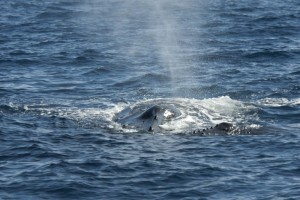
As humpback whales exhale, they can be observed at the surface of the water.
Humpback whales are found throughout all of the ocean basins. They seasonally migrate thousands of miles from high latitudes (poles) to lower latitudes in the subtropics and tropics. During the winter months, humpback whales migrate from the cold waters near the poles where they are feeding to the warm waters of the subtropics and tropics. They return again to these higher latitudes during the summer months when it’s warmer. Since seasons are opposite across in the northern and southern hemispheres, these two populations of whales are not thought to interbreed.
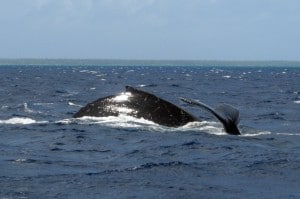
Two humpback whales diving.
Northern hemisphere humpbacks are typically present in the lower latitudes from late November to May. In the southern hemisphere, humpbacks are present in lower latitudes from about mid-July to mid-October.
Why make this immense journey? One of the reasons that these whales are traveling so far away is to go to their calving and breeding grounds. Pregnant females give birth to their calves in warmer waters because they would not survive the harsh winter months of the poles. Initially when calves are born, they do not have an insulating blubber layer making them vulnerable to colder temperatures.
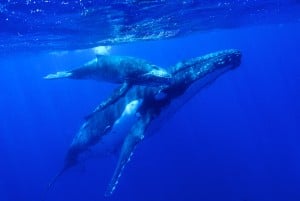
Mother and baby humpback whale photographed in Vava’u.
Also in their wintering grounds, humpback whales mate. Males display courtship rituals to attract females or to establish dominance over other males. Pregnant females have a gestation period around 11.5 months. Continuing the migration cycle, females will return to their breeding grounds almost one year later to give birth to their calves.
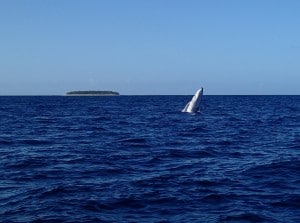
Baby humpback whale breaching.
Keep following our blogs to learn more about humpback whales.
Photos: 1,3 Karen Stone; 2 Ken Marks; 4 Rob Gardiner