
search-icon
2023 Science Without Borders® Challenge: Introducing the 15-19 Year-Old Finalists

The response to our Science Without Borders® Challenge has been overwhelming! We’ve been blown away by the sheer number of submissions that we received from aspiring young scientists and artists all over the world. Last week, we proudly unveiled the finalists in the 11-14 age group, and now, we’re ecstatic to announce the finalists in the 15-19 year-old category.

These young artists hail from all corners of the globe, including China, Indonesia, Korea, the Philippines, Poland, Singapore, Spain, the United Kingdom, and the United States. You will be amazed at their incredible artwork and how well they captured the essence of the theme, “The Sixth Extinction.” Students depicted a diverse range of endangered marine animals in their artwork including whales, fish, polar bears, sharks, sea otters, horseshoe crabs, seals, and crocodiles. We were amazed by these students’ boundless creativity, execution of the theme, and artistic abilities.

Without further ado, please meet our talented 15-19 year old finalists! These exceptional artists have not only showcased their incredible talents but also their unwavering passion for marine conservation.

First Place (15-19): "We Are Next" by Boram Shim, Age 16, United States of America
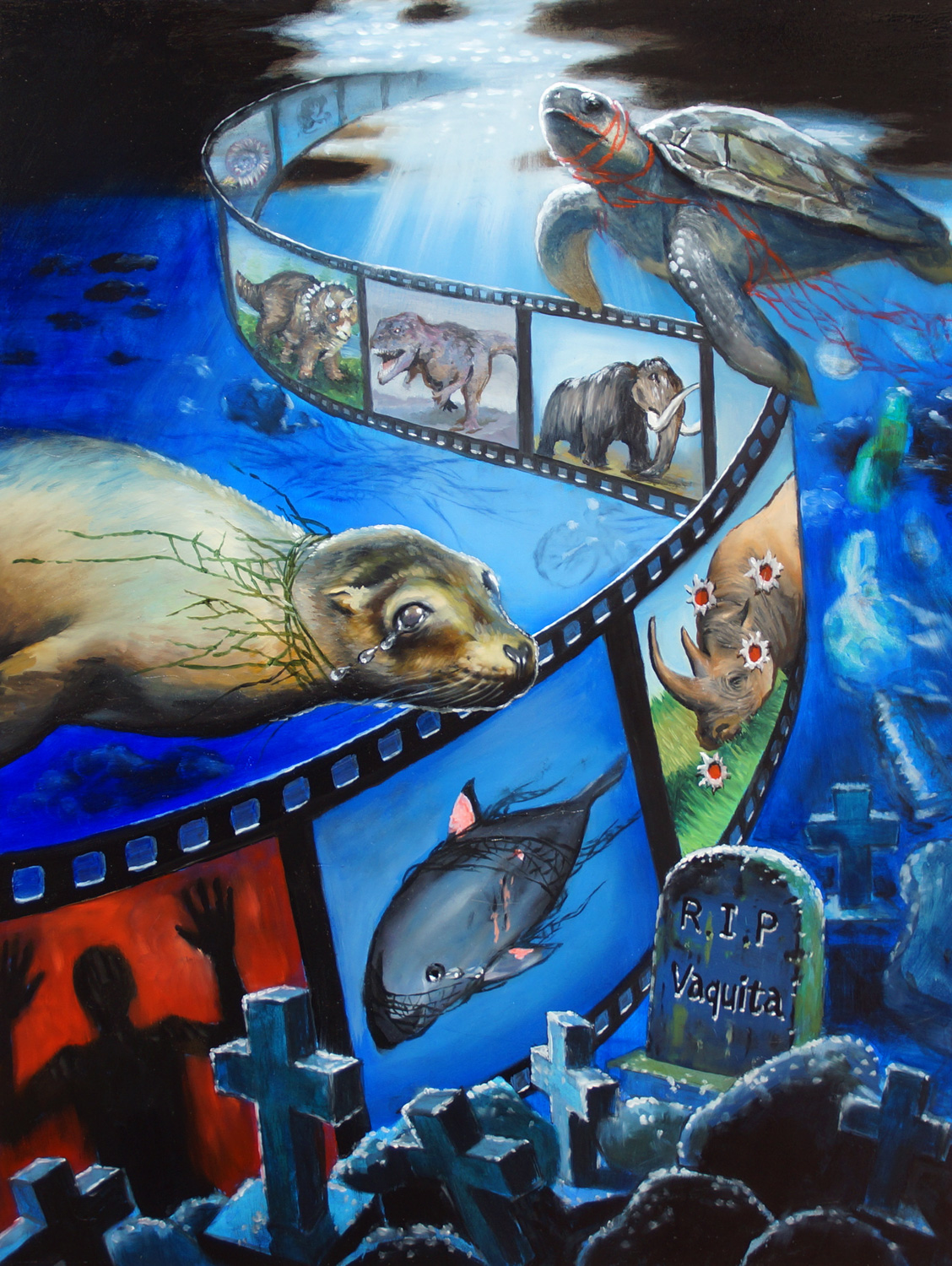
Image 1 of 16

ARTIST’S STATEMENT: Humans would be the ones getting extinct at the end of the sixth extinction. I portrayed the extinct animals, an endangered dolphin, and a person lining up in a film tape as a warning that it will eventually be our turn to be extinct, like a scene in a filmstrip that would inevitably be played in chronological order. Unlike the five previous mass extinctions that occurred due to environmental pressures, “the sixth extinction” is driven by human activities like oil spills, ocean trash, and net entanglements. Vaquita is on the verge of extinction—only ten left—due to illegal fishing and entanglement in gillnets. Moreover, less than 10,000 Kemp’s Ridley Turtles are left due to pollution, overfishing, and humans’ use of artificial light. Furthermore, only 1570 Hawaiian Monk Seals are left due to net entanglements. Finally, tombstones symbolize the deaths of humans following the destruction of marine ecosystems.
Stay tuned! We will announce the winners in the next couple of weeks.

Related Posts

Everything You Need to Know About the 2027 Science Without Borders® Challenge

Are you ready to combine your creativity with ocean science?

The 15th Annual Science Without Borders® Challenge is now open! Whether you’re participating for the first time or returning for another year, this guide will help you get started.

This year’s theme, Navigate With Care, invites students to explore how responsible navigation helps protect both people and life in the ocean. Through your artwork, you can compete for scholarships and international recognition while inspiring others to protect both people and life in the ocean.

Read More

Global Reef Expedition Data Contributes to Landmark Report on the World’s Coral Reefs

More than a decade after scientists aboard the Global Reef Expedition surveyed coral reefs across the Pacific, the data they collected continues to contribute to our understanding of the world’s coral reefs.

Today, the Global Coral Reef Monitoring Network (GCRMN) released Status of Coral Reefs of the World: 2025, the most comprehensive assessment to date of the status and trends of coral reefs worldwide. The report brings together an extraordinary amount of information collected over more than four decades—and the Khaled bin Sultan Living Oceans Foundation is proud to have contributed data from the Global Reef Expedition to this global effort. 

Read More
Privacy Overview

This website uses cookies so that we can provide you with the best user experience possible. Cookie information is stored in your browser and performs functions such as recognising you when you return to our website and helping our team to understand which sections of the website you find most interesting and useful.  You can view our complete Privacy Policy here.

Strictly Necessary Cookies

Most of our cookies are used to improve website security and reduce spam. These cookies should be enabled at all times. They also enable us to save your preferences for cookie settings.

3rd Party Cookies

This website uses Google Analytics to collect anonymous information such as the number of visitors to the site, and the most popular pages. Keeping this cookie enabled helps us to improve our website.